


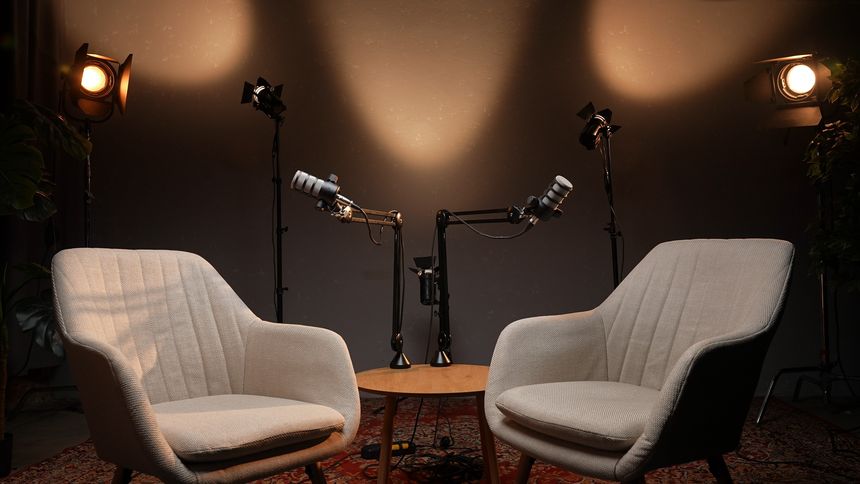

Very shortly, the CMO Series Podcast, which launched in 2019, will celebrate it's 200th episode, gathering more than 1,000,000 total listens.
Most podcasts have a consistent post, but when we designed that podcast, we knew that our host would be a distributed job. Our client facing people in sales and client success would need to be the hosts. We wanted to build their networks, establish their profiles as experts and lean on their relationships to make sure that we kept a regular flow of episodes.
It's been a hugely successful deciscion, but has meant that our production needs to be good at training people to conduct good interviews. In this post, we investigate one of the most difficult yet important skills to develop and how we think about “keeping the conversation flowing” as an interviewer.
Keeping it conversational
The most difficult habit most new interviewers need to break is filling the space after a candidate's answer with something like "amazing" or "interesting" or "brilliant." It feels warm and encouraging. It does an important job of closing out that particular answer. It also has big downsides.
It tells the candidate their answer has been judged, it interrupts any follow up, and if you do it after every answer it becomes meaningless noise, or starts to sound disingenuous.
In audio-only interviews this is especially important because you can't reply on physical prompts, like a nod, lean forward, or writing something down. Everything has to be verbal.
The problem is hard. You need something that does three jobs at once: closes out the previous answer, earns the right to move on, and doesn't make you the subject of the conversation.
The structure: echo, space, pivot
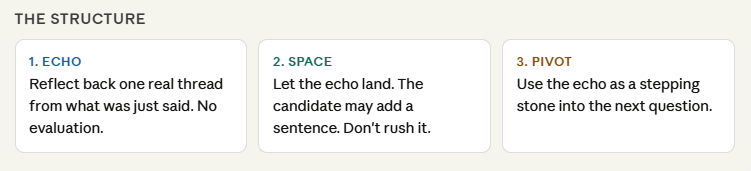
Echo. After the candidate finishes, reflect back one real thing from what they just said. Not a judgement, not a score, just a brief restatement that proves you were listening. Something like:
"So you were essentially learning the role while also having to deliver in it..."
"It sounds like the relationship with the client shifted quite a lot over that period..."
"You clearly had to make some calls there without having the full picture..."
The echo should be short, a sentence, maybe one and a half. It names what happened without evaluating it. The candidate hears that their answer registered and contributed something, which is all they need.
Space. After the echo, don't immediately pivot. Leave a beat. This is where something useful often happens: the candidate will add a final thought, correct something they said, or close out the subject themselves. Let them. That extra sentence is often the most honest thing they say. Once they've finished, or once the beat has passed and they haven't added anything, you've earned the move on to the next topic.
Pivot. Use the echo as a stepping stone into the next question. Something like:
"...that actually leads me to want to ask you about..."
"...which connects to something I want to explore with you..."
"...moving on to something a bit different..."
The pivot should feel natural, a progression of the conversation. Sometimes the need to prepare questions can lead to a bit of a robotic exchange, rather than a natural discussion. The model above is not perfect, but is a really good shortcut to build from, one that allows you to be really prepared with the content of your questions and natural in your delivery of them/
What it sounds like in practice
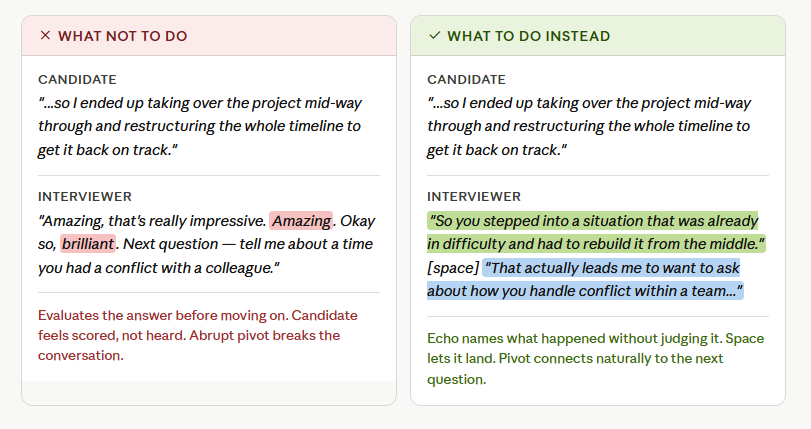
Without bridging:
Candidate: "...so I ended up taking over the project mid-way through and restructuring the whole timeline to get it back on track."
Interviewer: "Amazing, that's really impressive. Amazing. Okay brilliant. Next question, tell me about a time you had a conflict with a colleague."
The candidate has been graded and then immediately processed. The conversation feels like a form being filled in.
With bridging:
Candidate: "...so I ended up taking over the project mid-way through and restructuring the whole timeline to get it back on track."
Interviewer: "So you stepped into a situation that was already in difficulty and had to rebuild it from the middle..."
…Candidate: "Yeah, exactly, it was probably the hardest thing I've done professionally, if I'm honest."
Interviewer: "That actually leads me to want to ask you about how you handle conflict within a team..."
The candidate added something genuine in the space. The pivot felt natural.
Why interviewers default to "amazing"
It feels kind, natural. People think they're putting the candidate at ease.
The problem is that, because the candidate and the audience can't tell whether that enthusiasm is genuine. Showing you heard them without telling them how they did, is more respectful because it treats them as someone capable of handling a real conversation.
The echo is a simple technique, that doesn't take much more effort than "amazing", but is an important skill to master for those doing podcasts, interviews or live events.
/Passle/53d0c8edb00e7e0540c9b34b/MediaLibrary/Images/2026-01-12-10-16-56-904-6964ca18ab784af100f11853.jpg)
/Passle/53d0c8edb00e7e0540c9b34b/MediaLibrary/Images/2026-10-08-10-14-29-755-6ac76d050b30ba925ae8bc36.jpeg)
/Passle/53d0c8edb00e7e0540c9b34b/MediaLibrary/Images/2026-10-08-07-04-41-374-6ac740898f60cb75fde15df0.jpg)
/Passle/53d0c8edb00e7e0540c9b34b/MediaLibrary/Images/2026-10-08-07-04-41-241-6ac74089ce624e48d6cc6df6.jpg)
/Passle/53d0c8edb00e7e0540c9b34b/MediaLibrary/Images/2026-10-08-07-04-41-183-6ac74089d24614eebffa86bf.jpg)