

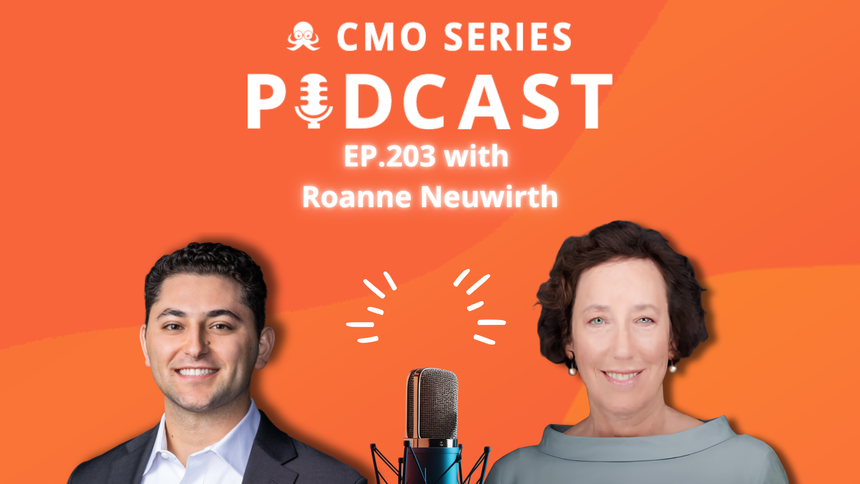



In a market where everyone has smart people, strong credentials, and now access to the same AI tools, what is the actual differentiator and how do firms truly stand out?
On today's episode of the CMO Series Podcast, Alex Haidar is joined by Roanne Neuwirth, a B2B enterprise marketing leader and advisor whose career spans over two decades across law firms, global management consultancies, and boutique professional services firms. From Hale and Dorr to Boston Consulting Group, Farland Group, and Bates Communications (acquired by BTS), Roanne has spent her career working with leadership teams to define market position, build client relationships, and drive sustainable growth.
Roanne brings her unique outside-in perspective to challenge how legal and professional services marketers think about positioning, growth, and the role of AI. She makes the case that while technology levels the expertise playing field, genuine thought leadership and client feedback programmes are more important than ever in advancing marketing into the strategic force that truly differentiates.
Roanne and Alex discuss:
- What actually separates the firms that grow from the ones that stand still
- Why marketing should be at the table driving growth, not sitting behind it
- The difference between a market position and a service list, and why so few firms get it right
- Where firms are going wrong on AI, and what they should be asking instead
- Whether the bar for building authentic client relationships has been raised
- Her number one piece of advice for the next generation of professional services CMOs
Transcription
Alex: In a market where everyone has smart people, strong credentials, and now access to the same AI tools, what is the actual differentiator? In this episode of The CMO Series Podcast, I'm delighted to be joined by Roanne Neuwirth, a marketing leader, independent advisor, and strategist with over two decades of experience in building and scaling marketing functions across law firms, global management consultancies, and boutique professional services firms.
Today, Roanne uses her unique background to offer a valuable outside-in perspective on what legal and professional services marketers are getting right and where they are falling short. She makes the case that while AI levels the expertise playing field, genuine thought leadership and client feedback programs are more important than ever in advancing into the strategic force that truly differentiates their firm.
Charlie: This episode is brought to you by CrossPitch AI, the new cross-selling tool from Passle. Cross-selling should be the easiest way for law firms to grow, but most firms struggle. Why? Lack of awareness, lack of trust, and frankly, fear of selling. The result? Missed revenue. CrossPitch.ai fixes that. It breaks down silos, helps professionals connect, and delivers timely, relevant insights to the right people inside the firm and out. There's no heavy roll-outs. Just switch it on and try it today. Head to crosspitch.ai to book your demo and make cross-selling happen. Now, back to the podcast.
Alex: Roanne, welcome to The CMO Series Podcast.
Roanne: Great to be here, Alex.
Alex: Now, Roanne, you've spent your career sitting inside some of the most growth-focused professional services firms in the world. Now, what have those vantage points taught you about what actually separates the firms that grow from the ones that stand still?
Roanne: I love this question. I think there's really, there's, I think, four things that I would say are critical to growth for professional services, and the most important one is relentless focus on the client and their challenges. You know, what is it they need to do to create value and solve their problems? And this starts with how they go to market, and then carries through to having a system of client listening, client care, and also taking action on what they're hearing and making investment in growing the relationships. And this includes things like skill building and reward systems to reinforce client-focused relationship building behaviors, and also a well-developed account management system. So, that relentless client focus is really the first and most important.
Alex: Mm-hmm.
Roanne: Secondly, and I think you touched on this a little in the introduction.Having deep credibility in the marketplace, and they've established this through a clearly articulated point of view that they've backed up by research-based, relevant, insightful thought leadership, and they've built it into an engine that connects directly with what clients care about. And this goes far beyond what I see in a lot of professional services firms, which is an ad hoc approach to writing blogs, creating podcasts. It really means investing in creating value through insight that differentiates the firm and also builds bottom-line business. So that's the second key differentiator. I think the third, and I've seen this increasingly as AI kind of creates this pool of sameness, these growth firms understand the power of focus and priority in their go-to-market.
You know, they know how to focus their story for the market in a way that plays to their strengths, but also creates clarity on who they help and how they help them. And this doesn't necessarily mean they stop offering a wide range of services or that they, you know, take on work for a valued client that isn't part of their core offering, but it really means that these firms are confident to hone their market-facing value proposition to accelerate their business. And so it really means taking a stand. Finally, to double down on a point that I made earlier, growth firms take the time to train and grow their practitioners in the art of consultative selling and relationship building. You know, and what I've you know, I've seen over the years, so many professional services firms make what I feel is a really costly mistake of just promoting their client-facing experts as they gather more and more technical expertise.
And at the same time, they're expecting those experts to learn to build relationships and sell just by osmosis, just because they've been promoted. But these are skills that really take time to build, and not everyone does them equally well. And so the growth firms that, um, establish role models and they clear behaviors, and also expectations along those, the art of selling and relationship building, and then backing it up, most importantly, with training and aligned rewards, that pays huge dividends on, on the growth front because then you have the whole firm moving together to sell what is a market-differentiated offering.
Alex: So what I'm taking from those four points, basically, you know, a relentless focus on what the client actually needs and, you know, a client listening program, deep credibility in the marketplace and an engine that drives that. Having a focus and priority that plays to the strengths of the firm and not just having a focus and priority that plays to the strengths of the, of the expertise, and then also training the experts to really be consultative sellers in relationships, really building those, building those relationships. And kind of what I'm hearing from all of that is that there is blurring the lines between the services and their marketing position. Instead of stating what they do,they should be, it sounds like you're saying they should be stating and trying to put out why they think they should be the ones doing it.
Now, why do you think that's such a hard problem to solve? And what does it really look like when a firm gets it right?
Roanne: You know, it's, it really, it really is hard, and I think part of, part of why it's hard is, is sort of the very essence of being a professional services firm. So, you know, professional services, whether it's law, management, consulting, accounting, you know, their firm is based on expertise, and you can't really separate what the firm does from the people who do it. And every firm hires smart people. They have lots of expertise. They have lots of training. And at the same time, you know, experts tend to be very attached to and very enamored of their methodologies, their frameworks, their special approaches. You know, because they understand these methodologies so deeply, and they connect personally to the technical reasons why they might be different or better, it can be very challenging for the experts in these firms to really step back and flip the script to translate that into why clients should care or how the technical difference actually translates into something the client values or experiences in a way that matters.
I mean, a lot of the, sort of the, the description of services and, and methodologies, it just, it really it can even say... It can sound like gobbledygook to clients, and it certainly doesn't sound like something that sort of solves their problem. And in truth, and, and again, I think this is where marketing is so important and helpful, you know, many experts in these firms don't actually really understand what their clients do in their roles or how they're measured. You know, not a lot of, um, not all, um, professional services experts have, you know, have really been trained in business and understand their client's business. They understand their own business and their own expertise. And so making that connection through to the problem that you solve as opposed to how you solve it is very hard.
And sort of, you know, I can give you an example. I mean, I think, I mean, if you say, "We help organizations execute strategy," you've, you've probably seen that on-
Alex: Yeah ...
Roanne: Hundreds of websites. That's a service. It's not a market position. And I think developing a market position is really, it requires that firm leaders pause to ask, you know, "Of everything that we claim to do, what is it that we actually do better than anyone else, and what do our best clients come back for specifically?". And it's, it's a tough exercise, and a lot of leadership teams at professional services firms can't really agree on the answers. You know, if you think about all the different practices, all the different specialties. And that disagreement itself is a positioning problem, and it definitely muddies the waters when you get to the marketplace.
And I think what, what does work is really when a firm can identify a very specific and very defensible point of view about an industry problem. Something that clients care about and something that they, the firm, see that others don't, and it's grounded in real client experience. I mean, that's the magic, and that's why sort of the, that client focus that we talked about at the beginning of the first question is so important, is that the differentiated point of view has to be grounded in the firm's real client foc- real client experience working with this problem in the trenches with a client.
Alex: Yeah.
Roanne: And I think what, what it's not, and I think sometimes gets confused, is this is not the same thing as a tagline or a value statement. It's really a genuine intellectual position that only this firm can credibly own and that's something that, you know, CMOs can build the market presence around, um, because it's, it's really actionable. And I think this, this point really goes back to my third point in the first question around the power of focus and clarity. And so let's take,another common before version, and, you know, all right, we partner with organizations navigating complex transitions to develop tailored strategies that align leadership, culture, and operations for sustainable long-term success.
First of all, you're out of breath just reading it. And then l- let's say, I mean, let's take this as an alternative. So we work with companies in the first 18 months after a major transition, new CEO, merger, market disruption. That's the window where everything is in play, and the decisions made will define the next decade. After that window closes, we're not the right firm. Now, it's the same idea in terms of helping organizations navigate complex transitions, but the second one gets really tight around where the client problem that that firm has particularly differentiated expertise in.
Alex: That's, yeah, I mean, I love how you kind of reworded those, I guess, those statements that you definitely you find on any professional services website, and I love how you kind of, how you change that into something tangible, not very pie in the sky, but something that shows your market exactly why they should be the ones, going to you for this very specific piece of work. And also, like you said before, you know, actually understanding what is bringing your clients back to that firm. And so now I know you had a brief stint at a law firm but, you know, marketing and law firms can often be positioned as just a support for the, you know, the fee earners, the billers. You know, they're, they're doing rebrands, they're in charge of the website, content, and events.
So kind of putting all this together with what you just said, coming from a mainly consulting background where the CMOs really have that position, what do you see differently about how marketing can drive growth and, in your opinion, what would it take for a legal marketing leader to play that kind of role?
Roanne: Well, you know, interestingly, I'm, you know, giving this question a bit of thought. I, I actually have to say that I don't really see too much difference in how larger cons- at least larger consulting firms position marketing. I think for most professional services firms, especially the larger ones, it does tend to be considered support or enablement since it's not a client-facing function, right? I mean, that's sort of almost the nature. But I actually think that this doesn't mean that marketing is not driving growth. And, and I think my view, and certainly what I've seen and experienced. You know, in professional services, actually all of those marketing activities, the brand, website, content, events, all of that, they actually play the core fundamental role of establishing and reinforcing the firm's credibility that we talked about earlier, and that's how the firm's able to align what they do to the business problems and challenges that their clients face.
And if you consider the fact that, like, we're in an era where 70 or more percent of a B2B buyer's journey happens before they even talk to someone at the firm-
Alex: Right
Roanne: You know, this, and, and that jou- that journey's increasingly fueled by AI search, which goes out to find expertise. You know, it's actually not fluff. It's really, it's, in fact, how sales happen. My, the CEO that I worked with before my last company and where we sort of built the brand and then sold that consulting firm, you know, her view is sort of marketing is what makes people wanna talk to you, and sales is having the conversations.
Alex: Right.
Roanne: And so, you know, I think- The other point though around, kind of this world of AI search is that it really ups the ante for marketing to come in and extract and amplify what's different and unique about how a service can solve these problems, right? Because, like, you know, as we talked about earlier, the experts are sometimes too deep in that. And I think in... If you think about, you know, firms full of, of experts who they're all deeply enmeshed in their practices, and there's no way for them to have that outside market facing perspective. And so that's where marketing comes in, and I think that's, to me, that is directly linked to growth because that's how the only way that the market is gonna find you and think you're different.
And, and I think maybe, you know, and again, going back, linking back to my first, very first point around sort of relentless client focus, I think the biggest growth lever to really remember when you're talking about, whether you're talking about a law firm or any other professional services firm, is the client relationship.I mean, as you know, in professional services firms, most of growth typically comes from landing and expanding, and also from embedding really deep in those existing relationships. I mean, that's, you know, it's a faster way to grow, it's a more reliable way to grow, and, and, and it helps ward off competition if you're really embedded deep.
And so I think, to me, the more marketing in professional services firms is connecting to clients directly, whether it's client events, advisory councils, co-created thought leadership, you know, running client feedback and input kinds of programs. And also, of note, as being a key member of the account planning teams, the closer it connects marketing to growth and the more, the closer the line is to how marketing supports and drives growth.
Alex: I mean, I loved how you started that, you know, talking about the, bringing up that 70% stat, about 70% of the client journey happens before they actually meet with someone. And then you also brought up the AI search, and then talking about what is really keeping those client relationships and embedding them, and some of those are, you know, thought leadership, keeping people involved in the events, and having a really close relationship with your clients.
So then I kind of wanted to tie those all together and think about, you know, we're in the AI age right now, and there's enormous pressure on firms to be showing the market that they're investing in AI. And I guess, what do you think professional services firms are getting wrong in those conversations, and what questions should they be asking instead?
Roanne: Well, you know, it's, it's really, it's already becoming painfully obvious, all over the business press, all over LinkedIn that, you know, this sort of commit, committing random acts of AI and simply counting and monitoring usage of the random AI tools is having no positive impact on the bottom line. And so I think the question to ask is, and, and I would say that a lot of leading professional firms, CMOs are doing this right now for their function, so what are our workflows? And which part of our workflows are best done by humans and which are done by AI? So the focus should be on the work, not the AI.
AI is a great tool, a very powerful tool, but if you're really digging into your workflows and stepping back to consider, how do we actually do things differently? You know, this is how we're working now, and, you know, what do we need to do differently to be more efficient? And also, I think when you really look at the kind of work you're, that humans can do versus AI, it helps you really understand how your human team members can do work differently also, and possibly organize differently. So I think the idea is around what's the work that needs to be done? And, and certainly the tools and, and it's, it's wonderful to continue to experiment. And I think a lot of, you know, CMOs, are sort of championing experimenting across their teams, which is a great thing. But I think the question needs to be at a level up from what makes sense for humans to do, what makes sense for machines to do, and what is the best way to do the work of whether it's marketing, whether it's product development, whether it's finance.
I mean, all the functions should be having those, those same conversations. And, and I think, you know, when it comes to the piece about what's best done by humans, especially in marketing, I think it's critical to go back to the lens of strategy, trust, and differentiation, right? Because if you think about how AI is really contributing to, sort of the samification, everyone sounds the same because the content is not differentiated. It's content, not thought leadership. Judgment pays an even, plays an even more important role in the world of AI and AI agents because, you know, you need the experts that have, the ability to have, have the taste and judgment to know what's insightful, what's not, what's powerful, what's not, what's differentiated, what's not, what at- what accurately reflects what our clients care about, and in a way that is insightful.
You need the human to know what's insightful. And sort of understanding the how and why of your ways of working is gonna enable much more effective use of AI, and also of the team's time.
Alex: I love how you kind of put that. Obviously thinking about what is the best value for a human to be, uh, focusing on or versus what AI should be focusing on.
Roanne: Let me share a perspective, 'cause I think it's a good warning for people to be thinking about. In the context of AI changing how work gets done and what it means for clients who are demanding more transparency, I mean, you know, I think clearly the elements that build relationships are still the same, but I see risk, and, and this is where...This actually probably goes back to the first question about what differentiates the growth companies, in that the risk comes in if you don't have the right relationship foundations to begin with, if you've never operated with transparency about how you provide value, if you've never partnered with your clients to define it together, then you're going to find yourself very quickly in tactical commodity-focused conversations.
And if your practitioners, back to the training around relationship building and consulted selling, if your practitioners don't know how to work with clients beyond just delivering projects or point solutions, you're gonna be very quickly doomed to that low provider, low-cost provider status. And so I think that the…So what AI, what the era of AI is gonna do is just ratchet it. It's going to expose professional services firms that don't have the right relationship foundations. And, and, and th- that's where the risk will be.
Alex: I like that. You sparked like another thought. What you talked about in this, you know, tactical commodity-focused conversations as in, like sitting down with your clients and saying, "Where are we giving you value?" or them asking where we're, where the firm is providing value. Could you maybe give... Do you have an example of what that would look like?
Roanne: Sure. So think about your typical client relationship, right? There's sort of, there's a lot, you know, there's some senior executives that kind of, you know, the senior partners that kind of own the relationship, and then you have, the sort of the team that's kind of doing the work. And a lot of times, and then there's some people sort of in between or that maybe they're, they're more senior than the team, they're not quite the partners. If you only ever talk to your client wherever you sit in that- Whether you're the senior partner is responsible for the relationship or for the people that are sort of delivering the work on a day-to-day basis, if the only conversations you ever are, have are around specific deliverables, specific action items, and if you never have separate conversations about just, you know, monthly check-in.
I mean, the senior partners should be having, you know, a monthly virtual or real lunch with their senior counterpart in that large client relationship. Not to ask for business, and not to talk about anything that's going on day to day, but just what's in your world. You know, how can I help you? whether it's, you know, finding some really interesting sort of piece of research online, maybe it's your own research, maybe it's someone else's, that actually will really, you know, unlock some interesting thinking on the part of the client, and sending it to them and saying, "Hey, let's have a conversation about this. Like, I just, you know, I thought this was really interesting. You know, we had been talking about challenge X and I came across this. I thought this would be really valuable when you go into that board meeting. Having this article might be really valuable for you." So it's looking, it's having conversations that help the client, that build rapport, and that sort of make sure... And also, obviously, you definitely want to be making sure that they're happy, and it sometimes can mean a lot of, you know, probing questions and, you know, more than just sort of, "Well, you know, hopefully you're happy with us. How are we doing?" But really, you know, "How, how's the work landing?
Is it you know, I know you had a goal of sort of, you know, getting funding for this sh- this initiative. Has the work we've done with you actually, is it helping?" You know, so sort of getting, getting more specific around how you're helping and how you could help, and kind of so that the clients know that you actually really care about the world they're living in.
Alex: It kind of, it goes back to, you know, I guess the very beginning when you said it's all about really understanding your clients and understanding their business, not just understanding your practice,and being able to position yourselves as not just, you know, a service provider, but a strategic advisor who, you know, is, you're working and partnering with them to help them achieve the goal. And I love that example, and you've given so many great tangible examples about how you do that in how you build that effective relationship. And you've had, I mean, you have such, there was so much there, and I just wanted to ask maybe finally if you have a number one piece of advice for the next generation of professional services CMOs looking to earn a seat at that strategic table.
Roanne: Well, it's funny 'cause I think it would be this. I mean, I think I've had this conversation with so many people on, on all of my teams. And I say this exact thing to them. The most important thing for any professional services marketer, especially those early in their career, is to learn everything you can about how the business works.
Alex: Yeah.
Roanne: What services does it offer? How do the services actually help clients? How does the business actually make money? You know, how, where, how does it come in? How does it go out? And then, and how it goes to market. You know, having really learned from the salespeople how they talk about it, hearing from leaders on how they think about growing the business, all of those aspects. The more deeply you understand the business, the more, as you summarized beautifully, the more you can be a strategic advisor. I think it's also really important to know how to read a balance sheet, and know what finance cares about. And also the other thing that I have seen to be a big difference maker, and that, and, and I think this is true for any aspiring leader, but I think it makes a big difference for marketers in particular, is not just what finance cares about, but the role and perspective of all the other functions.Because, you know-
Alex: Mm-hmm...
Roanne: You really wanna have an enterprise view, not just what does marketing care about and what are, what do we need to do, but, you know, what's on everybody else's agenda? What do they, what do they... what is IT, responsible for? How do they work? How does finance work? How does, you know, how does project delivery work? How does HR work? Because that enables you to partner more effectively, and ultimately as you know, become, you know, as you become a CMO, you're gonna be a peer around the table, and the more you understand all of them, the more effective and respected peer you'll be when you get there.
Alex: I mean, I think you put that really eloquently. And, I mean, Roanne, it's been such a pleasure talking to you and hearing all of your stories, and I was wondering maybe you could stick on, stick around for a few quick-fire questions just to kinda get to know you personally.
Roanne: Sure. Happy too.
Alex: All right. Now, I would love to hear if you're, what you currently are listening to. Now, it could be music, podcasts, audiobooks, anything.
Roanne: Well, one of my favorite podcasts is How I Built This by Guy Raz.
Alex: Mm-hmm.
Roanne: And it's so... it's my favorite because there're so many fascinating stories about entrepreneurs of all types, every different kind of business you could imagine, and so many interesting trials and tribulations and the path to building a successful business. And I always learn something new, and I always get inspired to try something different even if it's hard, because after hearing those stories you can't help but think, "Well, of course I can do this. If they can do that, I can do this."
Alex: I love that. Staying creative. Now, what is the best piece of advice you've ever received?
Roanne: Well, let's see. I've got two. I've got one in life and one in work.
Alex: Yeah, that's perfect.
Roanne: So in life, when I got married, my boss at the time told me his single piece of he sat down at the reception and said, "My single piece of advice to you is separate checkbooks." And it's so interesting because it stuck with me for many years, and he was right, literally, but it's also been sort of an important metaphor for many aspects of marriage and life. And, and then in work, someone early on said to me, "You know, you're the only one who's in control of your career, and you're the only one who will ever care about it." So own it and make the choices you need to make along the way. No company will do that for you, and they'll be making their choices too.
And so you can't feel guilty or beholden about the path you need to take. And that's something that I think... And I've turned around and told people even on my team that, that, you know, it's you, you're in charge of it, and you need to own it, and you need to do what's right for you. And I think that's, it's a game-changing perspective that both should enable and embolden but, uh, and also free people for doing the things that they need to do to have the career that's right for them.
Alex: Awesome. Both are very empowering. Now, Roanne, what is a book or resource you'd recommend to anyone in your field?
Roanne: So, um, you know, I think, I'm, there's so many books, but one I'm reading right now, and I think this one will be kind of near and dear to your heart, it's The ROI of Thought Leadership by Cindy Anderson and Anthony Marshall. They lead IBM's Institute for Business Value, and it's so compelling. They've managed to sort of- Look at the business value of thought leadership and actually calculate the ROI for the very first time, and they've actually proven an extremely significant ROI in investing in true thought leadership. And so I think it's a super important read for any marketing leaders in any professional, professional services role because thought leadership, you know, being a brand differentiator, it's both eye-opening and it creates a path to make the story and case internally about why it's important.
Alex: Wow. Yeah, I definitely need to add that to my Goodreads. I haven't heard about that, but I'd love to see, you know, how they put it into numbers and calculate that value. Now Ruann, what is your favorite way to unwind after a busy day?
Roanne: So I know a lot of people think this is crazy, but I actually love being in the kitchen.
I love cooking. I love making a super delicious but also super healthy meal and enjoying it with my husband. And if I have time to take a walk outside before dinner, all the better.
Alex: Yeah, I love that. I mean, I love eating good food, so in order to love- ... if you wanna eat good food, you gotta cook good food, so- I'm definitely on board with that. And lastly, what is your favorite place to visit and why?
Roanne: So it's hands down Scotland. It's just an amazing mix of mystical beauty, unparalleled beauty, together with warm and welcoming and just funny, funny people. The history is fascinating, and the food and drink is great, and it's just, it fills up my soul every time I go there.
Alex: Amazing. Well, listen, again, Roanne, it's been an absolute pleasure talking with you. Um, I think this is gonna be a really important episode for all marketing leaders to listen to, and you've got some really great examples and feedback. So again, thank you so much for joining The CMO Series Podcast.
Roanne: Thanks so much, Alex. Delighted you invited me, and then hopefully what I've shared is helpful to others.
Charlie: You can follow The Passle CMO Series Podcast on your preferred podcast platform. Thanks for listening, and we'll see you next time
/Passle/53d0c8edb00e7e0540c9b34b/MediaLibrary/Images/2026-01-12-10-16-56-904-6964ca18ab784af100f11853.jpg)
/Passle/53d0c8edb00e7e0540c9b34b/MediaLibrary/Images/2026-10-08-10-14-29-755-6ac76d050b30ba925ae8bc36.jpeg)
/Passle/53d0c8edb00e7e0540c9b34b/MediaLibrary/Images/2026-10-08-07-04-41-374-6ac740898f60cb75fde15df0.jpg)
/Passle/53d0c8edb00e7e0540c9b34b/MediaLibrary/Images/2026-10-08-07-04-41-241-6ac74089ce624e48d6cc6df6.jpg)
/Passle/53d0c8edb00e7e0540c9b34b/MediaLibrary/Images/2026-10-08-07-04-41-183-6ac74089d24614eebffa86bf.jpg)