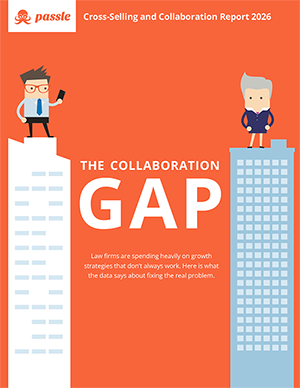




Here at Passle, we speak to professional service firms on a daily basis and it seems that every managing partner of every professional services firm wants their people to do more cross-selling. Few professional advisers, however, want to follow in the footsteps of bank managers who were once seen as trusted advisers but are now regarded by many as peddlers of financial products (The PACE Partnership).
As The PACE Partnership explores, making cross-selling work in practice means tackling two deep-rooted internal barriers: trust between colleagues and awareness of the firm’s broader capabilities. Many partners hesitate to introduce another lawyer to “their client” for fear that a difference in tone, quality, or style could harm a hard-won relationship. Trust, in this sense, isn’t automatic; instead, it must be earned internally before it can be extended to clients.
Even when trust exists, awareness can be lacking. Lawyers often work in narrow silos, with a deep focus on their own area of practice but little visibility of what colleagues elsewhere in the firm can offer. That lack of internal knowledge means potential opportunities are either missed altogether or pursued without the credibility and context needed to succeed.
The article also highlights a third challenge: a limited understanding of the client’s business as a whole. Professionals are often project or transaction-oriented, engaging only with the part of the client’s organisation that relates directly to their work. This creates hesitancy, where lawyers avoid conversations that take them beyond their comfort zone, fearing “dumb questions” or irrelevant suggestions. Without a richer, strategic understanding of the client’s needs, any cross-selling attempt risks falling flat.
Overcoming these barriers requires deliberate, long-term actions. Structured client review meetings, attendance at client industry events, and even investing non-chargeable time in relationship-building all help deepen client understanding. At the same time, firms should find creative ways to raise internal awareness - sharing case studies, client-relevant insights, and updates on new capabilities so that every lawyer can confidently connect a client to the right person in the firm.
Finally, there’s the “pigeonholing” problem: clients often categorise a firm based on the specific expertise they’ve used, making it hard to be seen as anything else. Changing that perception doesn’t mean pushing irrelevant messages, it means targeted communications that expand the client’s understanding of what you can do, framed in terms of their needs.
When trust between colleagues is strong, lawyers know the breadth of their firm’s capabilities, and when they truly understand their clients’ worlds, cross-selling stops being a holy grail and becomes the natural by-product of excellent client service.
/Passle/53d0c8edb00e7e0540c9b34b/MediaLibrary/Images/2026-10-14-09-22-13-024-6acf49c5944aac193a981bb9.jpg)
/Passle/53d0c8edb00e7e0540c9b34b/MediaLibrary/Images/2026-10-13-16-00-13-704-6ace558d477453bcaa2eba35.jpg)
/Passle/53d0c8edb00e7e0540c9b34b/MediaLibrary/Images/2026-09-28-10-59-02-989-6aba4876c6484376446500cc.png)
/Passle/53d0c8edb00e7e0540c9b34b/MediaLibrary/Images/2026-10-08-10-14-29-755-6ac76d050b30ba925ae8bc36.jpeg)
/Passle/53d0c8edb00e7e0540c9b34b/MediaLibrary/Images/2026-10-08-07-04-41-374-6ac740898f60cb75fde15df0.jpg)