


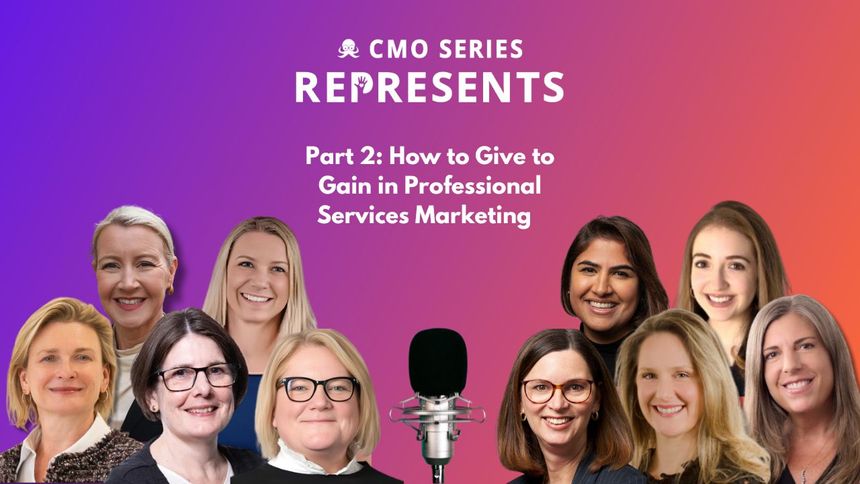


To mark International Women’s Day 2026, Part two of our special episode of CMO Series REPRESENTS brings together senior leaders from across the legal sector to explore one thing. How firms turn intent into action for women in professional services.
The conversation focuses on advocacy and access, who is in the room when decisions are made, who gets named in the room when they are not there, and who is given real exposure to clients, leadership and opportunity.
Our guests discuss how progress doesn’t happen by chance. Firms must create structured pathways to influence, move beyond informal networks and back women with visible sponsorship. Flexibility and parental support also need to be real, not theoretical, if firms want talent to thrive.
The episode offers practical advice on building open, transparent cultures where equity is embedded into how firms operate.
We’re so grateful to all of our guests for joining this special episode:
- Raj Aujla, Director of Communications and Corporate Affairs, Charles Russell Speechlys
- Aubrey Bishai, Chief Innovation Officer, Vinson and Elkins
- Sarah-Jane Howitt, Business Development & Marketing Director and Partner, Weightmans LLP
- Susan Kurz, Chief Marketing and Client Development Officer, Calfee, Halter and Griswold LLP
- Laura Louw, Director of Business Development, Norton Rose Fulbright
- Laura Ottley, Chief Marketing Officer, Addleshaw Goddard
- Susanne Pugsley, Director of Business Development and Marketing, Carpmaels and Ransford
- Clare Quinn-Waters, Chief Growth Officer, Edwin Coe
- Anna Steinberg, Chief Marketing Officer, Tressler LLP
- Kerri Vermeylen, Chief Marketing Officer, Sidley Austin LLP
Catch Part 1 of this special episode, here.
Transcription:
Charlie: Welcome to the special episode of CMO Series REPRESENTS, where we are celebrating International Women's Day 2026 by highlighting the leaders and firms shaping a stronger, more equitable future for legal marketing. In part two, we dive into the role of advocacy in advancing women in law firms and how access to influence can change the game for women in professional services.
This episode is brought to you by CrossPitch AI, the new cross-selling tool from Passle. Cross-selling should be the easiest way for law firms to grow, but most firms struggle. Why? Lack of awareness, lack of trust, and frankly, fear of selling. The result? Missed revenue. CrossPitch AI fixes that. It breaks down silos, helps professionals connect, and delivers timely, relevant insights to the right people inside the firm and out. There's no heavy rollouts, just switch it on and try it today. Head to crosspitch.ai to book your demo and make cross-selling happen. Now, back to the podcast.
Charlie: Our first group of guests explore the importance of representation where key decisions are made and the impact of speaking women's names in rooms they're not in.
Aubrey: Hi, I'm Aubrey Bishai, and I am the Chief Innovation Officer at Vinson and Elkins. Law firms and leaders can advance and empower women by saying their names in rooms that they aren't in. I think when leaders assign credit to something that women have been working on, are spearheading, are taking insightful part in, and talking about that when they aren't present to others is a really empowering approach.
Susan: My name is Susan Kurz and I serve as the Chief Marketing and Client Development Officer at Calfee, Halter and Griswold, in Ohio. I believe that firms help all attorneys and staff and women, in particular, when there's representation in meaningful leadership roles. Women in leadership positions who truly care about advancing other women are well positioned to successfully advocate for, promote and support them in numerous ways, such as through fair compensation, opportunities for promotion, and meaningful client engagement to name a few. Importantly, I think women need to be at the decision-making table when compensation is discussed and decided. Having female partners access and analyze financial data and individual performance results and being part of compensation decisions is critical to ensuring accountability and fair representation across the board. In my experience, while the Mansfield Rule Certification process in and of itself doesn't require specific representation, it does guide member firms to actively consider all qualified attorneys at different levels of experience for different roles. This process leads to positive behavioral changes when law firms are encouraged to be more thoughtful and intentional about staffing matters, promotions, and leadership opportunities. A vital aspect of preparing women for leadership roles is sponsoring an impactful mentoring and coaching program for women and by women. Experienced and invested female mentors are invaluable in helping their mentees learn to successfully navigate the firm, improve their legal and client development skills, grow their networks, and ultimately build their client portfolios. Effective coaching and mentoring rely on mutual understanding, shared experiences, and the ability to be honest and transparent, all of which require as a starting point, reciprocal commitment, respect, and trust. Those trusted relationships can develop organically or through a structured program such as affinity or business resource groups, in which female attorneys and staff meet regularly to build a community based on those shared experiences and collective support. I've been working in law firm marketing and client development for nearly 20 years, and firms don't seem to struggle as much these days to hire qualified women, but many still struggle to retain highly valued and qualified women. And we know that successful women often report that a primary reason they leave firms is due to a lack of support. I think firms that are intentional in supporting female lawyers and staff, and helping them advance, are firms actively focused on some of these ideas previously mentioned. Those successful firms are also focused on other critical programs and benefits, such as paid parental and family care leave, flexible work schedules, part-time options, and alternative or parallel career tracks. In my experience, the most successful firms are also actively engaging in open conversations, both in group settings and one-on-one discussions, to identify an individual's unique work needs and personal boundaries at different stages of their career, and then ensuring that those needs are met and their boundaries are upheld and respected. Once these practices are widely adopted and institutionalized within a firm, I believe they become part of a firm's culture and serve as differentiators in attracting, retaining, and supporting the success of all attorneys and staff, including women.
Susie: Susie Pugsley. I am currently the Marketing and Business Development Director at Carpmaels and Ransford, European IP firm. I'm also a consultant in business development and marketing for many law firms over the last 22 years. One of the things that law firm leaders and law firms in general can do to strengthen women in the workplace is really to celebrate all the women in the workplace and not just the senior leadership. When I was working at a firm a few years ago, we launched a program called ‘Women Who Inspire’, and we purposefully focused on women in every level in the business, and choosing somebody within the firm who inspired them by their attitude, by their delivery, by their, you know, ethics and that they felt were inspirational to work alongside, work above, work below. So, it's not just an upward-looking piece or an aspirational piece. The aspiration being more about how you can inspire at any level in your career and how that actually helps you advance and firms to bolster and support that by shining a light on what those women bring to the business in those different roles, as opposed to just focusing on the leadership roles. Anyone who is a woman in the workplace, who has a family, or if you're of a certain age like myself, where you have elderly parents, as well as young children, there is that caregiving aspect to your life which can impact on your career and firms that lean into supporting these women in these situations are extremely positive places to be. But they also have to accept there may be an impact on the people that don't have those constraints in their lives, who may not be caregiving, and they also need to be considered and celebrated for the areas of their life where they need support. So, it's bringing that balance between ensuring the workplace is inclusive enough to support women who have outside constraints, but also not lean too heavily, therefore, on the women that don't.
Clare: I am Clare Quinn-Waters, and I am Chief Growth Officer at Edwin Coe. My advice would be to let power follow impact. There's a lot more to law firms than just lawyers. You've got marketing BD functions, HR, finance, knowledge functions, and a lot of those departments are led by women, and a lot of those departments are making a really positive impact. These are real value creation engines for any law firm. So, where women are making positive impact, give them power.
Raj: Hi, I'm Raj Aujla, and I'm from Charles Russell Speechlys and I'm Director of Comms and Corporate Affairs. So, the one thing I think law firms or leaders can deliberately give to advance women and strengthen the firm as a whole. I mean as a PR and comms person, I think it boils down to visibility. Not just being part of a panel or being in the room, it's more about active sponsorship, particularly from the senior leadership team, in terms of making sure that they are invited to the right meetings or being mentioned in a deal, particularly for big panel wins or big pitches. Advocating for women in rooms when they're not in there, and that includes when it comes to promotion discussions, lateral hires or client intros, and ensuring that they're seen by clients, partners, the wider market and not just supported behind the scenes. I think that is hugely key, particularly when it comes to winning mandates. From my experience, the doers tend to be, a lot of the women in the background, they never really wanna take the credit for it, when actually they really should be. So, having that extra visibility, sponsorship with visibility, I think would make a huge amount of difference.
Charlie: Our next group of guests join us to examine the importance of deliberate structured access to influence. They discuss why opportunity cannot be left to chance, and why they must actively create pathways that give women direct exposure to decision makers, clients, and leadership.
Laura: My name's Laura Ottley, I am the Chief Marketing Officer for Addleshaw Goddard, and I sit on the executive here and also on the board. I think that the one thing that leaders can do to advance women is for leaders to make themselves more accessible to women on a more daily basis, rather than always through the kind of structured DNI initiatives and all the great programs that most law firms now offer women. I think it's so much more than that. It has to be regular. I think leaders need to be easily accessible so they're not just giving the occasional bit of advice, but they're actually giving it daily. And I think that comes through sponsorship, it comes through presence and making sure that they are spending more time with the women in their business in a more proactive fashion, rather than just in a set piece fashion, so it becomes more part of our day-to-day and our norm.
Sarah-Jane: Hi, I am Sarah-Jane Howitt, I'm the BD and Marketing Director at national law firm, Weightmans. I think the one thing that law firms can give is deliberate structured access to influence. And I, kind of, say that because influence for me is what unlocks opportunity and visibility and ultimately delivers a more equitable environment. And I think that in law firms, careers are often shaped by things like, who will trust you with a client relationship, who puts your name forward, and who will bring you into the room. And I think sometimes women can miss out on those, kind of, informal but critical power, sort of, drivers. So in practice, giving access to influence would address some of those things. So, for example, intentionally giving women client access at, you know, pitches and giving them board level relationships and strategic, having strategic client conversations would really help. And then if senior people would sponsor, rather than mentor women, so using their standing to promote the ability of women, rather than just giving women some advice about things. And ensuring that kind of those high-value, career-enhancing work opportunities are fairly distributed so that women have a bit of a leadership platform and can get involved with firm-wide things and that sort of stuff. So, I think when women gain access to influence, the firm then can gain in so many ways, which enhances its business and its operations. So, if you think about things like improved client relationships, we all know now that clients increasingly expect diverse teams. The firm, I think, gets better retention because when women can see an upwards path, they're less likely to leave and that also in turn creates a deeper kind of future talent pool because the junior women see senior women succeeding, and that's really positive. And I think probably, finally, it creates a stronger decision-making, sort of, structure and process for the firm because we think everybody accepts now that more diverse leadership produces better decision-making and maybe more resilient strategies. So, I think that's it for me. That structured access to influence can deliver all of those things, both for women and for the firm.
Laura: Hi there. My name's Laura Louw, I'm the Director of Business Development for EMEA at Norton Rose Fulbright. So, I think the one thing that leaders and law firms can do to advance women is to give them the opportunity directly and actively. So, not just support women when they ask for things or put themselves forward, but find ways actively to support women and give them the opportunity to demonstrate their skills.
Charlie: Flexibility and meaningful support for parents are essential if firms want to create environments where both men and women thrive. Our next guest shares how her own experience reflects her firm's genuine commitment to advancing women, and offers practical insight into how others can follow suit and lead by example.
Anna: My name is Anna Steinberg, I am Chief Marketing Officer at Tressler, a national firm with 10 offices throughout the U.S. I love this topic because there are so many things law firms and leaders can do to support women. I'm gonna speak specifically to the importance of supporting parents, so both men and women, as a leading driver of law firm success. So, the Bureau of Labor Statistics reported that nearly half a million women left the workforce between January and August of last year. The majority citing caregiving responsibilities as the key driver for this alarming exodus. So, I know many people have heard about that, but I have my own interesting take on that, I had my first child over the summer. I almost became part of the statistic due to my own health complications while caring for a newborn. However, because my firm offered me flexibility, constant support, I was able to really take the time I needed and return when I was fully back on my feet. So, parental support really needs to take place both before, during, and after maternity or paternity leave. I think a point that's often missed is that folks left covering for coworkers on leave really need to be properly supported and recognized for their increased workload, you know, we're not just talking about the parents who aren't there, we're talking too about the people who are left, making sure that the law firm continues to be successful during those breaks. So, they can't be expected to work an extra job just because a teammate is deciding to have a baby, but what we can do is really work as managers and leaders in law firms to prepare, so that everyone feels supported during that time. So, all parents on leave also need to be encouraged to take the time they need to return at 100%. And that's not supportive for a law firm if you have parents rolling back in before they're ready to be there, and it's not great for clients either. So, giving resources like my other colleagues on this podcast have spoken about, like mentorship, flexibility when reintegrating to the workforce. We all know stress is a huge challenge for anyone working in the field of law, and when you have a kid, you unlock a whole new level of stress. So finally, opening and supporting dialogue between management and teams about work-life balance really is essential. So, at Tressler, we have a women's group. We have an associate liaison committee to facilitate these conversations. Our firm is also majority women, so many people reach out to each other who've gone through this life change, and it's all about supporting each other. So, you know, just in sum, a law firm thrives when its people are happy. Whether that be with children or without, ensuring that people can really achieve their dreams without giving up their careers is the true measure of success.
Charlie: Our final guest today says her advice to firms looking to build an open and transparent culture where equity thrives.
Kerri: I'm Kerri Vermeylen, Chief Marketing Officer at Sidley Austin. So, I think what firms and leaders can give people to really advance them, and this applies to both women and men, is clarity. Clear expectations, transparent criteria for advancement and direct feedback. I was really fortunate to work for strong leaders early in my career who gave me challenging work and were generous and frankly, very candid with their feedback. One of them used to say feedback is a gift. I didn't always love hearing it in the moment, but the combination of getting opportunities to stretch myself and honest input really made an enormous difference and accelerated my growth. So, I think where firms can be deliberate about that is in making that clarity systematic, rather than situational. When expectations around performance, accountability, and career development are explicit, and when feedback is direct and actionable, advancement becomes less dependent on informal networks or assumptions. So, that's something leaders can deliberately give, clarity. Not one-off conversations, but as an intentional discipline. And when advancement is grounded in transparent standards and consistent feedback, firms really unlock the full potential of their talent, and that strengthens performance across the board.
Charlie: That's all for the Special International Women's Day episode of CMO Series REPRESENTS. A huge thanks to all of our amazing guests for sharing their words of wisdom. You can follow the Passle CMO Series wherever you get your podcasts. Thanks for listening and we'll see you next time.
/Passle/53d0c8edb00e7e0540c9b34b/MediaLibrary/Images/2026-01-12-10-16-56-904-6964ca18ab784af100f11853.jpg)
/Passle/53d0c8edb00e7e0540c9b34b/MediaLibrary/Images/2026-10-08-10-14-29-755-6ac76d050b30ba925ae8bc36.jpeg)
/Passle/53d0c8edb00e7e0540c9b34b/MediaLibrary/Images/2026-10-08-07-04-41-374-6ac740898f60cb75fde15df0.jpg)
/Passle/53d0c8edb00e7e0540c9b34b/MediaLibrary/Images/2026-10-08-07-04-41-241-6ac74089ce624e48d6cc6df6.jpg)
/Passle/53d0c8edb00e7e0540c9b34b/MediaLibrary/Images/2026-10-08-07-04-41-183-6ac74089d24614eebffa86bf.jpg)