

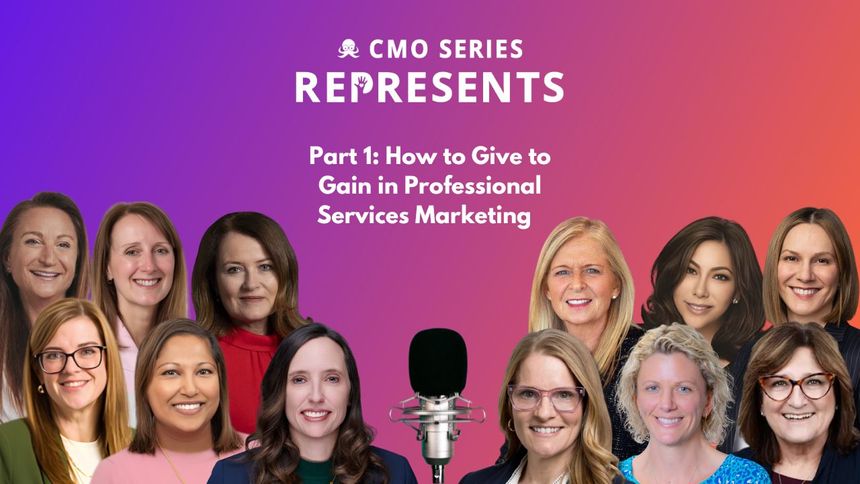


To mark International Women’s Day 2026, CMO Series REPRESENTS returns with a powerful conversation on leadership, equity and action in legal marketing.
In part one of this special edition, we bring together senior marketing and business development leaders from across the profession to explore how firms can build a true culture of giving to gain, where collaboration, sponsorship and shared success aren’t slogans, but strategic choices.
From approaching equality as a business issue, to active sponsorship of professional women in the workplace. Our guests share their candid insights and lived experiences of what’s working in professional services and where firms have the opportunity to drive meaningful change.
A big thanks to all of our guests for joining the conversation:
- Azeema Batchelor, Chief Marketing & Business Development Officer, Dinsmore & Shohl LLP
- JeanMarie Campbell, Chief Marketing & Business Development Officer, Jenner & Block
- Charlotte Eberlein, Head of Marketing & Business Development, Thomson Snell & Passmore
- Deborah Farone, Marketing & Business Development Strategist & Founder, Farone Advisors
- Tina Gandesha, Director of Business Development, Marketing & Communications, Baker McKenzie
- Helen Griffiths, Head of Business Development, Fladgate
- Rachel Hussey, Clients & Markets Partner, Arthur Cox LLP
- Susanne Mandel, Chief Marketing & Business Development Officer, Lowndes
- Molly Nunes, Director of Communications, Marketing & Client Engagement, WilmerHale
- Kimberly Rennick, Chief Business Development & Marketing Officer, Thompson Coburn LLP
- Amanda Schneider, Chief Marketing & Business Development Officer, Ballard Spahr LLP
- Tricia Weener, Global Chief Marketing & Business Development Officer, Linklaters
Hear from more inspiring leaders in Part 2, here.
Transcription:
Charlie: Welcome to the Special International Women's Day 2026 edition of CMO Series REPRESENTS, where we spotlight the leaders and firms shaping a stronger, more equitable future for legal marketing. In part one of this episode, we explore what it really means to build a culture of giving to gain where collaboration, sponsorship, and shared success aren't just values on a wall, but active choices that create opportunity and real impact across firms.
This episode is brought to you by CrossPitch AI, the new cross-selling tool from Passle. Cross-selling should be the easiest way for law firms to grow, but most firms struggle. Why? Lack of awareness, lack of trust, and frankly, fear of selling. The result? Missed revenue. CrossPitch AI fixes that. It breaks down silos, helps professionals connect, and delivers timely, relevant insights to the right people inside the firm and out. There's no heavy rollouts, just switch it on and try it today. Head to crosspitch.ai to book your demo and make cross-selling happen. Now, back to the podcast.
Charlie: First up, we hear from leaders who share their candid insights on why creating equitable environments isn't just a DEI initiative, it's a business imperative.
Azeema: Hi, I'm Azeema Batchelor, Chief Marketing and Business Development Officer at Dinsmore and Shohl, based in Washington DC. I think one of the main things that firms can do is create an environment that fosters empathy, connection, and flexibility. And I'm going to say something that might be slightly controversial for a women's day podcast, but I actually think these things need to be embedded in firm culture in a way that's gender neutral, because I truly believe this is one of those situations where a rising tide will lift all boats. Over the past decade or so, I've hit that point in my own life where I have been juggling responsibilities as a working parent, and so I have been coaching a lot of partners that are in the same stage of their lives, and it can be quite difficult. And I don't think that that is specifically relegated to one gender. So, something that I think has been, sort of, a personal mantra of mine is figuring out how you can do your own type of business development that feels authentic and true to who you are. And so that may mean connecting with clients, you know, in your school's WhatsApp chat about the silent auction at the PTO, and that might be a personal example right there. I also think that having policies in a firm that are gender-neutral, for example, parental leave or flexible work arrangements, things where we see everybody partaking, it doesn't frame certain things anymore as women's issues, and it really will help. I think, you know, we all know that statistics will show that, you know, in a dual income family, very frequently you have women who take a minute to put a pause on their career because, you know, childcare is too expensive or things like that. So again, this is very much related to this stage in my life, but it's also reflected in a lot of the conversations I've had with partners as I'm trying to do some business development coaching. There's a feeling that what worked for partners 20, 30 years ago isn't gonna cut it today and people aren't willing to make trade-offs with their families. So, finding a way to foster empathy, connection, and flexibility within a firm. Empathy, meaning everyone should understand that people may have commitments and a life outside of work, connection so that we can draw people within the firm together to make them better able to form teams, to serve clients, whatever their specialty may be, and flexibility because as one thing, you know, that we've all learned post pandemic is that work can frequently happen anywhere and at any time. So, you may have someone who comes into the office at seven and leaves at three and maybe only does that twice a month, but they make sure that those hours count. So, my personal opinion is really that what will help women is ultimately what will help everyone. And I really hope that more firms take this view so that they can recognize that things have changed, and, you know, I think we do see a lot of firms that are seeing tremendous growth taking that approach that they want their people to have that full life. And I know especially with a lot of firms, there is a strong feeling that we need to have roots in our community and so fostering those connections is a great way to do that.
Susanne: I'm Susanne Mandel, Chief Business Development and Marketing Officer at Lowndes. We are now a 100 attorney firm, headquartered in Orlando, Florida. Honestly, I don't think there's one thing, just like I don't think that there is one definition of success. I think career success is defined differently by every individual and firms that assume there is only one path to success or only one thing that would advance women, I think they risk retaining talent. There are several key strategies. A robust mentorship sponsorship program that would connect younger women with experienced mentors for skill development and career navigation. Ensuring not just equal pay, but also equitable work assignments and opportunities to meet and work directly with clients. And actively promoting women into leadership and client-facing roles, even if it's citizenship type roles within the firm. And one more critical element, I think, is flexibility in work models offering only a one-size single fits all schedule. I think that will cause an employer to eliminate a large percentage of the pool of, not just talented women, I think it will drive away many younger men as well. Family-friendly policies that provide comprehensive parental leave, emergency childcare resources, support for on and off ramping to retain parents who might leave the workplace for a while. I think all of those measures, not only support women, but improve the environment for everyone, which leads to higher retention rates and a stronger, more diverse firm.
Kimberly: Hi, my name is Kim Rennick, I'm the Chief Business Development and Marketing Officer for Thompson Coburn. I think that law firms could take a continued serious look at remote work and allow for flexibility, and I think that, not just women benefit from that, but everyone benefits from it. I do fully understand and appreciate the need to culture build inside the walls of firms and the need to have our younger generations mentored. I just hearkened back to my time as a Sales Rep for Thomson Reuters, where I felt that we had an incredibly good culture and everyone was fully remote and highly productive, we were well-trained. And how that came about was bringing together cohorts of people, in this instance, maybe it was the entire group of Sales Reps or Account Executives for off-sites or for purposeful, intentional get-togethers that included not just content consumption and learning, but also just time together. But otherwise, we were treated as adults and trusted that we would get our work done because it was obvious if the work wasn't getting done, if we weren't meeting our numbers. And I felt like that was doing pretty well before COVID and certainly during COVID, we all know we had to pivot and live in a very weird environment. But post-COVID, there's been a real push to make people get back to a very rigid approach to the office, and I just don't think that it has the fully intended consequence of bringing people together. I think it is kind of divisive.
Deborah: Hello, this is Deborah Farone of Farone Advisors in New York City. I'm the author of two books, including one that recently came out, which is ‘Breaking Ground: How Successful Women Lawyers Build Thriving Practices’, and I'm also the former Chief Marketing Officer of Cravath and Debevoise. Law firms have a great opportunity if they would just give lawyers, particularly partners, a business development budget with the understanding that each person is going to market differently and they need to be authentic in how they market. So, by giving them a budget and also giving them the training to show them the variety of different things they can do to develop business, firms will be five steps ahead.
Charlie: Our next group of guests challenge firms to rethink sponsorship entirely, not as a DEI program, but as a commercial strategy. They highlight the importance of senior partners using their influence to actively support the lawyers and business professionals they work with every day.
Amanda: I'm Amanda Schneider, Chief Marketing and Business Development Officer at Ballard Spahr. If I had to name one thing, it would be true sponsorship. Most senior leaders are mentoring people every day, and mentorship is advice and encouragement. It's telling someone to call you if they need anything, but sponsorship is a firm commitment to the success of another person. It's a senior leader saying, I'm actively going to provide you with opportunities to advance. It's putting women forward for high profile assignments, client relationship development, advocating for origination credit, and providing women with leadership roles. When women are genuinely sponsored, everything shifts. They're visible in the rooms where decisions are made, they're part of the conversations that actually shape the firm and their confidence grows, not because someone told them they belong, but because the firm is showing them they belong. I also think the firm wins in this too because you get the broader perspectives and leaders who don't all come from the same background. It's not just the right thing to do, but it's a smarter way to build a business. Sponsorship sends a very clear cultural message that developing talent isn't optional, that advocacy is part of being a leader, and inclusion isn't something we support in theory. It's something we actively create. I would say if a law firm wants to move the needle, I would challenge every senior leader with one question: who are you personally sponsoring, and what are you doing this year to create real opportunities for them?
JeanMarie: I'm JeanMarie Campbell, and I'm the Chief Marketing and Business Development Officer at Jenner and Block, based in New York. I would say identifying women for real leadership roles. That would be my number one. And when I say real leadership roles, I mean office managing partners, head of practices, roles that have a P and L, and a real revenue impact. To me, that's a really important part of being a leader at a law firm.
Charlotte: Hello, my name is Charlotte Eberlein, I am head of Marketing and Business Development at Thomson Snell and Passmore. If there's one thing law firms and leaders can deliberately give to advance women and strengthen the firm as a whole, it's visible sponsorship, not just mentoring, but sponsorship. I say that from personal experience. I've been very lucky in my career to work for people who didn't just advise me, they actively sponsored me by speaking about me in meetings I wasn't in, they trusted me with stretch opportunities and backed me publicly. That has changed the trajectory of my career. Because in law firms, progression isn't just about capability, unfortunately. It's about access, access to clients, access to strategic conversations, and access to influence. Mentors help you navigate the system, sponsors help you rise within it. And what I'm proud of in my own firm is that we have a good number of female equity partners as well as our current Senior Partner. That doesn't happen by accident. It happens when leadership is intentional about sharing credit and making sure talented women are visible at the highest levels. But this isn't just a diversity conversation, it's a commercial one. Clients are increasingly expecting diverse leadership. Firms that retain and elevate senior women protect their investment and build stronger, more sustainable businesses. So, if leaders want to give one thing that truly makes a difference, it's this, their influence, used deliberately to open doors. That's powerful for individuals, but also could be transformational for firms.
Tina: I'm Tina Gandesha, Director of BDMC at Baker McKenzie in the London office. The one thing that I think law firm leaders can do to advance women and strengthen the firm overall is sponsorship of female business, professional talent by senior or influential partners within the firm. The reason I think this is really important is that in most law firms, business professionals are the connective tissue of the firm. They link everything and everyone together, and they really keep the firm running. They drive the client experience, and they typically lead on transformation projects, and yet they often operate in a, kind of, professional shadow. So, when you layer on top of that gender, women in business professional roles can find themselves doubly invisible, not because they lack talent or ambition, but because the system wasn't really designed with them in mind. So, mentorship I think, is common in many firms, so it's not unusual for someone to buy you a coffee, give you advice, tell you what you should be working on, but sponsorship is a bit different. It's when those individuals go out of their way and they use some of their own capital to open doors for you. And so in law firms, that capital largely sits with senior lawyers, managing partners, those that are in influential roles, those that stand out, those that are rainmakers etc. So, the question really is how often are those individuals spending some of that capital on the business professionals that work with them day in, day out? And the honest answer is, in some firms, not all, but in some, it's not often enough. In those firms where it isn't happening as much as we would like it to be, it would be incredibly impactful for a senior or influential partner to advocate for the inclusion of their talented business professional teams. So, it's when a senior partner says things like, Claire should be leading this firm-wide initiative, or I want our COO Priya to be involved in that client conversation, that things really change and they change visibly. That one act shifts visibility, builds experience and signals to the whole firm what leadership can look like. So, the ask for firms here is simple, but deliberate. Senior lawyers should be able to name the business professional women that they actively want to sponsor and do it. And just to be clear, this isn't just about fairness. For me, it makes commercial sense too. The legal market is changing very fast, and the firms that are winning right now are the ones with operational excellence, strong client relationships, and the ability to innovate. All of that is delivered largely by talented business professionals. If a firm is losing talented business professional women through frustration, you know, slow progression, lack of visibility, or simply feeling like they'll never have a genuine seat at the table, they're losing the people who play significant roles in the firm's success. And let's face it, when that happens, replacing them is expensive, disruptive, and increasingly difficult in the competitive talent market that we now find ourselves in. Conversely, the firms that get this right send a powerful signal. They attract stronger business professional talent, and they retain it, and they build leadership teams and are more diverse in background and in their thinking, which ultimately makes better decisions. This business case isn't a footnote, it's the point. And the firms that look back proudly in five, 10 years' time won't be the ones that made more women partners, they'll be the ones that looked at all their people, saw who was being overlooked and they did something deliberate about it.
Rachel: Hi, my name is Rachel Hussey, I'm the Clients and Markets Partner at Arthur Cox. I also have a role on the 30% Club steering committee in Ireland, and I am the 30% club's representative on the government review group called ‘Balance for Better Business’, which is about making sure we get more women in senior leadership positions in business. The one thing I think that leaders can do in law firms to empower women and to strengthen the firm as a whole, is to treat the whole issue of gender diversity as a business issue. I mean, that's the reality is we have lots of data to show that diverse teams make better decisions, and that it's in everybody's interest to have diversity of thought around the leadership table. I think in law in particular, the business case is even stronger because such a high percentage of graduates from universities are women. So, I think treat it as a business issue and if it was a business issue, what you'd be doing is measuring data and measuring progress. So, measuring the data around the composition of various groups in the firm at all different levels and making sure the relevant percentages are stacking up and that there's a reason why they're not if they're not, and look into that. And I also think another element is to make people accountable to deliver on any targets that the firm might set for itself in this regard.
Charlie: This group of leaders explores the impact of active mentorship and advocacy in shaping more inclusive firms. They highlight the importance of championing talented individuals and the value of visible senior role models who invest time, share their experiences, and support women across the firm.
Molly: My name is Molly Nunes, I oversee the marketing department at the law firm, WilmerHale, as Director of Communications, Marketing and Client Engagement. Law firms have put a lot of time and energy into classes and talks and things like that, and all those things are really important. They help to inform us, and they help to educate people, and they create awareness, and they bring teams together. But, if I had to choose just one thing that leaders can deliberately give that makes a real difference, I would actually say it's mentorship and advocacy. It doesn't cost anything. It doesn't require a huge time commitment. It starts with being willing to listen and really listen to our colleagues, let them talk through things, ask questions, and think critically along with them. Being a mentor doesn't mean it's helping someone get to the next promotion necessarily. Sometimes it's just brainstorming through a project, helping them navigate a difficult work dynamic, or just letting them know that their frustrations, their worries and experiences are entirely normal and it's not the end of the world. It's a period of time. It's a moment of time, and it's not forever. To do that, those of us in leadership roles who have been in the trenches and often are still in the trenches, we're just in different phases in our careers. They have to be present, selfless, we have to be open-minded and mentally available for those moments, and it's really important that we are intentional when thinking about opportunities for others and when we see them, we should speak up on behalf of those individuals. Don't just sit back on our heels and let it happen, but really advocate for the team members that we think are strong and the team members that we think have something to give, whether it be a project or it be a promotion. And when we do that, the impact will go far beyond any initiative.
Helen: Hi, I'm Helen Griffiths, I am the Head of Business Development at Fladgate. So, in terms of one thing that law firms or leaders can deliberately give to advanced women, I think there's a lot of larger, really helpful initiatives that law firms either already do or know they should do at the very least. Things like mentoring, striving for diversity in terms of leadership roles. For me, I think there are more personal day-to-day things that would also be really valuable, particularly around women who tend to hold back a bit. So, throughout my career in various different roles, I've worked with some really fantastic and inspirational women who, kind of, quietly deliver. They're great to work with, the clients love them, they inspire other people within the team. But for some reason, they don't actively seek and sometimes sort of hold back from being involved in some of the bigger things, whether that's positions of leadership, or even speaking on panels, or taking the lead on client pitching, sometimes even offering a view in a larger meeting environment. And I mean, there are obviously men like that as well, I think that's important to say, but in my experience it's probably disproportionately women who fit into that category. For me, I think it's helpful for firms to seek out those individuals, those high-performing women who, kind of, hold themselves back a little bit and try and encourage them to take the spotlight a bit more, or at least understand, I guess, what's holding them back and how the firm can support them. You know, is it a confidence thing? Is it not wanting to step on the toes of other people? Is it capacity resourcing so that, you know, do they just not have the time? And I think there's a number of people within the business that probably have a responsibility to have those discussions and to ask those questions, whether it's the managing partners, senior partners, heads of departments, senior business services professionals, men and women. But I think to try and help those individuals overcome those challenges and take on those additional roles, but crucially, I think without needing them to change who they are. Some of the reasons that they don't naturally put their hand up might actually reflect some really positive attributes that should be celebrated and encouraged. Without wanting to, kind of, bang the drum of the firm that I'm at, that is something that I've really noticed at Fladgate, is this celebration of kindness and humanity in terms of culture, but that isn't true everywhere across the sector. And for me, I think you can have both things. You can have women at the top, and fortunately we do at Fladgate, who are really good at what they do, but they're also kind and emotionally intelligent, and if we can find some way of bringing those people to the top, it's great for their career, it's inspirational for other people to see. It's good for the firm's performance, and ultimately it's really great for the sector as a whole.
Tricia: Hi, I am Tricia Weener, I am Chief Marketing and Business Development Officer at Linklaters. I think the one thing that law firms or leaders can deliberately give to advance women is to have sufficient role models in senior positions who actively give their time in support of women across the organization, to help them navigate and create opportunities for progression within the firm. And I think within that, it's making sure that you are sharing your stories of success, but also those moments where you've had to be at your most resilient and others have been there to support you.
Charlie: Well, that's the wrap on the Special International Women's Day episode of CMO Series REPRESENTS. Thank you to our outstanding guests for their insights and candour. Join us for Part Two, where we explore why advocacy is a business issue, and how deliberate access to influence can reshape opportunities for women across professional services.
You can follow the Passle CMO Series wherever you get your podcasts. Thanks for listening, and we’ll see you next time.
/Passle/53d0c8edb00e7e0540c9b34b/MediaLibrary/Images/2026-10-14-09-22-13-024-6acf49c5944aac193a981bb9.jpg)
/Passle/53d0c8edb00e7e0540c9b34b/MediaLibrary/Images/2026-09-28-10-59-02-989-6aba4876c6484376446500cc.png)
/Passle/53d0c8edb00e7e0540c9b34b/MediaLibrary/Images/2026-10-08-10-14-29-755-6ac76d050b30ba925ae8bc36.jpeg)
/Passle/53d0c8edb00e7e0540c9b34b/MediaLibrary/Images/2026-10-08-07-04-41-374-6ac740898f60cb75fde15df0.jpg)
/Passle/53d0c8edb00e7e0540c9b34b/MediaLibrary/Images/2026-10-08-07-04-41-241-6ac74089ce624e48d6cc6df6.jpg)