


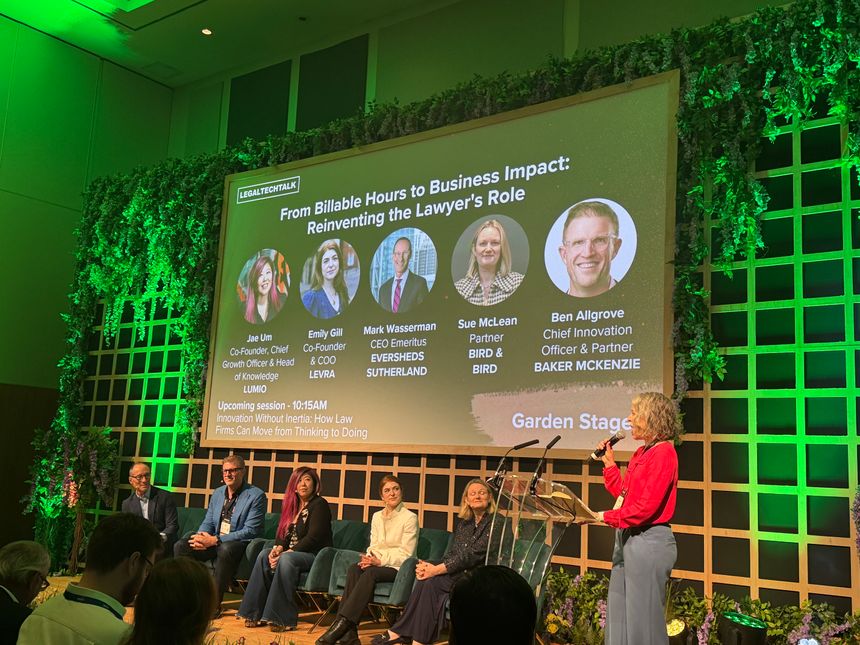

I was excited to attend my first Legal Tech Talk event or LTT as all of the seasoned attendees call it. There were so many good sessions and speakers that it was hard to choose a stage, theme and topic but i went for a hard hitting choice to start the event.
The panel consisted of Mark Wasserman (CEO Emeritus Eversheds Sutherland) as the moderator and making up the panel, Emily Gill (Co-Founder, Levra), Sue McLean (Partner, Bird & Bird), Jae Um (Co- Founder, Lumino Works) and Ben Allgrove (Chief Innovation Officer & Partner, Baker McKenzie).
Question 1: Why hasn't the billable hour died?
Ben Allgrove- it is a simple metric that hasnt changed over time. The buying patterns of clients haven't changed that much over time.
Jae Um- The actual job of the billable hour is that it creates a record and an audit trail. It has become a claring mechanism for simple transactions. There are alternatives but clients have to buy differently and the pace of learning drives the pace of change.
Sue McClean- The billable hour should be seen as an option and is often chosen because work can be unpredictable. I try not to give advice on billable hours and look at fixed fee.
Emily Gill- Lawyers arent good at selling themselves and their services. Brains and capabilities should be first.
Question 2: How do you price something that now takes 20 minutes but it used to take 4 hours?
Sue McClean- It is difficult in the modern day to now now price using the same model.
Jae Um- Clients should pay more for high stakes situations and the advice given. We need to reset the trust deficit between the client and lawyers. It shouldn't just be about the skill but it should also be based on the relationship and the speed and quality of insight.
Ben Allgrove- We didn't used to charge for the consulting part before the deal was even made. We don't set the market price and we cant optimise for efficiency now. It should be said that in house teams do need the law firm ecosystem to survive. Clients expect perfection when it never has been.
Jae Um- It matters what the market standard should be. Some work should be done in house and clients should look at this as an opportunity to save money.
Question 3: What is the value of lawyers and business impact?
Emily Gill- The value is the experience and nuances of the lawyer and with an even higher bar.
Sue McClean- What are you missing out on if you don't use a human? Independence and broader judgement is so important.
Ben Allgrove- Many firms have structured and positioned themselves as ‘all you can eat buffets’ but the fact is that some work is just not efficient and shouldn't be done.
Jae Um- The market has fragmented and lawyers have to think in a more creative and holistic way.
Question 4: What are the other alternative models to the billable hour?
Ben Allgrove- In some markets the billable hour is only 40-50% of revenue and so we have seen a change but you end up in a more complex pricing system where value based, fixed or subscription based pricing can all be chosen.
Emily Gill- There should be more collaboration to remove individual and industry billing.
Jae Um- There are so many alternative law firm models now including the barrel, the diamond, and the hour glass. The traditional lockstep model at associate level is coming under real pressure.
Mark Wasserman finished a very interesting session suggesting that there will be a complete reshuffle of the decks with the top 20 law firms all changing along with the existing structure of firms.
/Passle/53d0c8edb00e7e0540c9b34b/MediaLibrary/Images/2026-10-14-09-22-13-024-6acf49c5944aac193a981bb9.jpg)
/Passle/53d0c8edb00e7e0540c9b34b/MediaLibrary/Images/2026-10-22-11-14-29-774-6ad9f015ed262a90b1bf36f6.jpg)
/Passle/53d0c8edb00e7e0540c9b34b/MediaLibrary/Images/2026-10-19-13-24-47-415-6ad61a1fdc6374f637024697.jpg)
/Passle/53d0c8edb00e7e0540c9b34b/MediaLibrary/Images/2026-10-13-16-00-13-704-6ace558d477453bcaa2eba35.jpg)
/Passle/53d0c8edb00e7e0540c9b34b/MediaLibrary/Images/2026-09-28-10-59-02-989-6aba4876c6484376446500cc.png)