




For twenty years, finding a lawyer online meant typing a query and scanning a list of links in a search engine. AI is changing that.
Users are now increasingly asking questions to an AI directly without ever touching a search engine.
Traditional search is changing too, companies like Google and Bing are also incorporating AI in their search engine. Asking for "the top employment lawyers in London" and you get a shortlist of people and firms, with a short explanation of why each was chosen.
Here at Passle, we attempted a simple experiment to explore what gets picked up by GenerateiveAI, and allows you to be surfaced in front of potential clients.
A sample of 1000 lawyers recommended by AI
We wanted to see what the lawyers who appear in these AI-generated answers have in common. To do that we ran 100 queries through Google's AI Mode, each asking for the top 10 lawyers in a given practice area and location.
The queries covered 30 practice areas across 12 cities in the UK and US, we looked across industries, across legal specialism and across cities.
For each query, we recorded every lawyer the AI named, 842 in total. We then checked whether each one had published thought leadership: articles, insights, legal updates or commentary on their firm's site or on Lexology, Mondaq, JDSupra, National Law Review, Muck Rack, and general open web search.
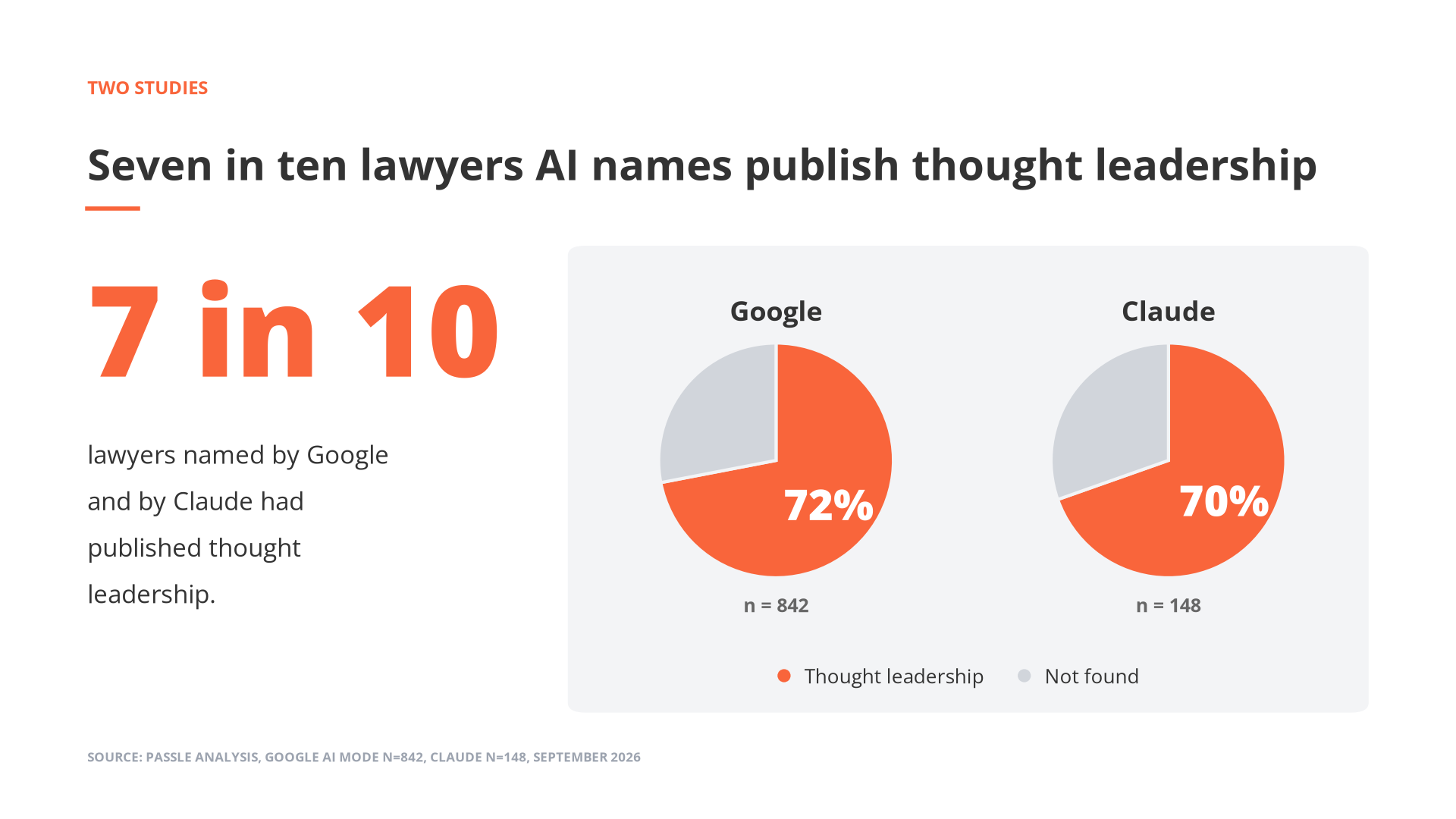
Around 72% of the lawyers Google's AI recommended had published thought leadership.
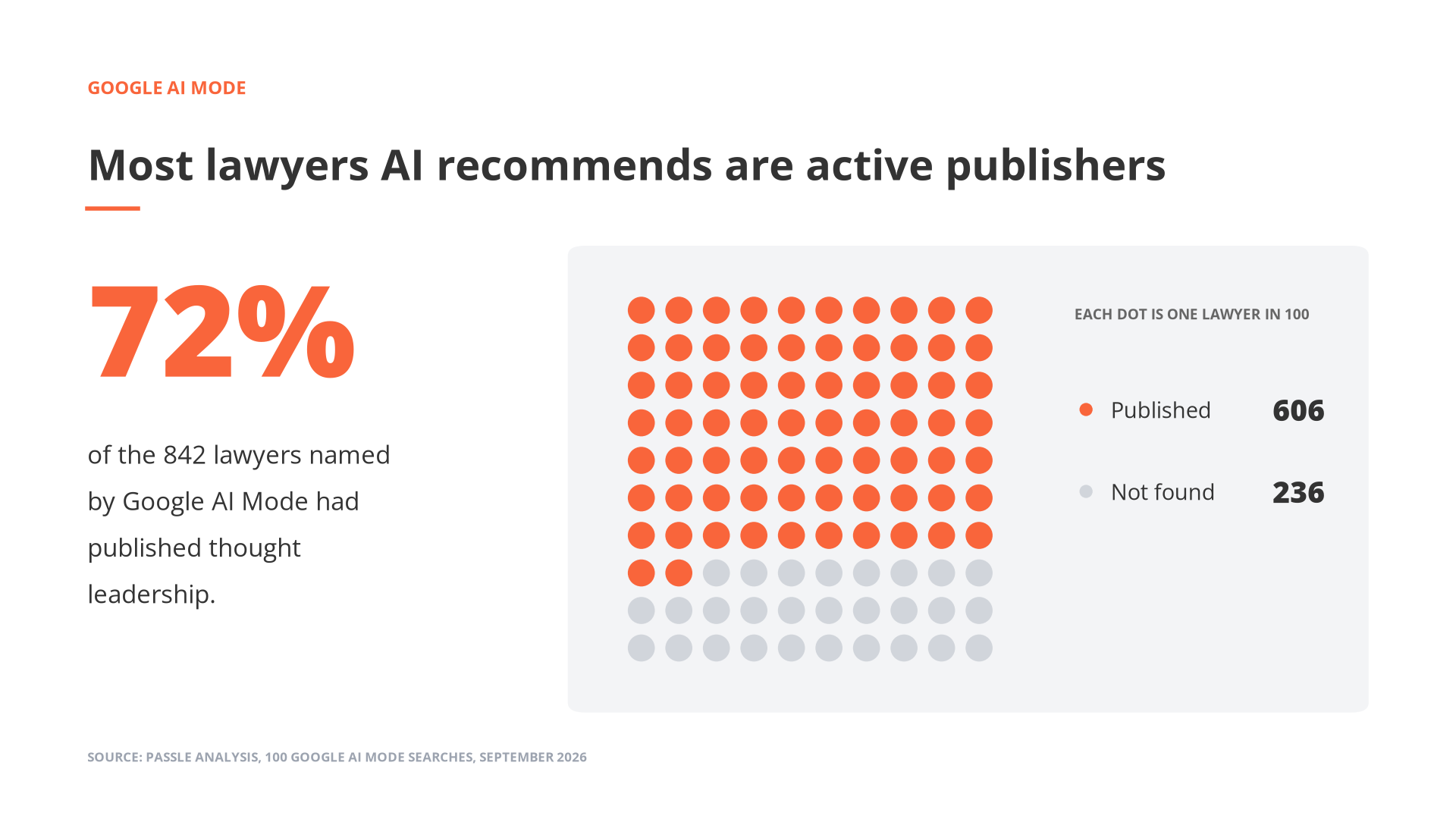
Most of the lawyers that AI puts forward are active publishers. This little experiment demonstrates the importance of having your experience and knowledge demonstrated through thought leadership online.
A similar experiment with a smaller data set (n 150) found that to be 70-76% in lawyers returned via Claude.
What the research suggests
In addition to the above study, we also went ahead and did a quick review of academic work related to Generative AI search optimisation.
Our simple experiment is supported by more comprehensive research from Princeton on Generative Engine Optimisation (GEO), where researchers directly tested what kind of content AI engines prefer.
The researchers built a benchmark of 10,000 queries drawn from real Bing, Google and Perplexity user searches, and tested nine different content optimisation strategies against it. They found that including citations, quotations from relevant sources and statistics significantly boosted a source's visibility, by over 40% across a range of queries. They also tested the approach on Perplexity, a live AI engine, and saw visibility improvements of up to 37%.
Put simply, AI engines appear to favour content that reads like genuine expertise, and that is exactly what good legal thought leadership provides.
What firms should do
Publish consistently, under named lawyers. AI engines recommend people, not just firms. Content clearly attributed to individual lawyers helps link their name to their expertise.
Be specific about practice area and place. Clients ask for "a data protection lawyer in Leeds," not just "a lawyer." Content that addresses particular sectors, jurisdictions and developments gives the AI a clear signal of who knows what.
Write with substance. Draw on the elements the GEO research found effective: concrete figures, references to cases and legislation, and clear, quotable analysis. Avoid generic marketing copy.
Keep it current. A steady flow of timely commentary on new rulings and regulations shows ongoing expertise, rather than a profile that has gone quiet.
/Passle/53d0c8edb00e7e0540c9b34b/MediaLibrary/Images/2026-01-12-10-16-56-904-6964ca18ab784af100f11853.jpg)
/Passle/53d0c8edb00e7e0540c9b34b/MediaLibrary/Video/Transcoded/2026-09-28-14-16-36-230-Testimonial1-IrisJonesv2b/thumbnail/2026-09-28-14-16-36-230-Testimonial1-IrisJonesv2b.0000001.jpg)
/Passle/53d0c8edb00e7e0540c9b34b/MediaLibrary/Images/2026-09-28-12-27-53-400-6aba5d49a556c8efb06a2f76.jpg)
/Passle/53d0c8edb00e7e0540c9b34b/MediaLibrary/Images/2026-09-23-14-41-53-663-6ab3e53102670829c84a0009.png)
/Passle/53d0c8edb00e7e0540c9b34b/MediaLibrary/Images/2026-09-28-12-41-37-152-6aba6081c648437644653430.png)