



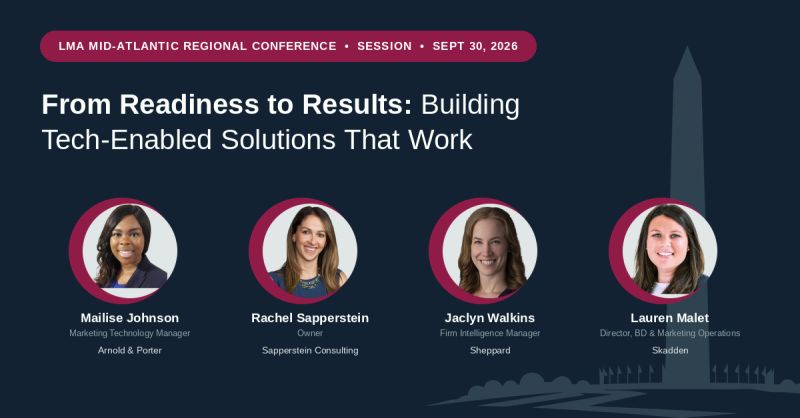
Every marketing and BD team has a story about a tool that launched with great fanfare and quietly faded six months later. At the LMA Mid-Atlantic, four marketing technology and operations leaders with experience in AmLaw 200 firms set out to explain why. The panel consisted of:
Mailise Johnson, Marketing Technology Manager at Arnold & Porter
Rachel Sapperstein, Owner of Sapperstein Consulting
Jaclyn Walkins, Firm Intelligence Manager at Sheppard
Lauren Malet, Director of BD & Marketing Operations at Skadden
The speakers walked through their Readiness Assessment and Execution framework for attendees to use when evaluating new technology, then offered case studies from their own firms. A copy of the full diagnostic is attached below.
Why initiatives stall
User resistance: 57% of firms in ILTA's 2025 Technology Survey named user resistance as their biggest hurdle to adopting new technology, and Prosci's research found that AI resistance in particular stems from insufficient training.
Solution: When you are in the procurement stage, start planning how to reinforce post-launch.
Not anchoring change in culture: If a new technology is going to change every day, habitual workflows, then it needs to be tied to a cultural change ie. explaining the why: ‘we want our clients to better understand our offerings’, ‘we want our lateral investment to pay off,’ ‘we want to measure and increase the saturation of practices with clients.’ etc.
Solution: Find change champions; senior lawyers who stand by the initiative as a matter of culture.
Limited Capacity: With the level of growth major law firms are experiencing, Marketing and BD team growth seems like a solution to a limited capacity. However, with immense team growth comes new ideas and projects too.
Solution: Use the ‘Net New' rule; before adding new tech, ask what old process is being replaced, improved, or taken off your plates by adopting it. If nothing, not now, is a perfectly acceptable answer.
Measure value, not just adoption
More often than not, metrics on the adoption of a platform is what legal marketing teams would use to determine if a rollout was successful: clicks, number of pitches, number of RFPs answered. The panel argued that in addition to focusing on quantitative adoption metrics, teams should be asking better questions to understand and measure the qualitative value:
- What value is this initiative meant to create?
- How will we know if we are successful?
- Did it change a client relationship? If so, in what way?
- Did it give us information we didn't have before?
The readiness assessment
- Goals and governance: Is there agreement on the goal, and are decision rights and escalation paths defined?
- Workflow assessment and design: Are the underlying workflows documented and consistent, or do they need to change?
- People, capacity and culture: Does the team have the capacity to absorb this change right now?
- Technology and data: Is the infrastructure and data behind the initiative in place?
- Stakeholder alignment: Can everyone describe the goal the same way and agree on what success looks like?
Each initiative should then be plotted across impact and readiness:
Execute with accountability
Readiness tells you whether you can do it, and accountability is how you actually get it done and sustain it. Procurement is not a one-time event, and implementation needs to change to how the team operates.
- Clarify the goal and how success will be measured
- Plan for the readiness risks you already know about
- Pilot before broadening
- Embed the work into business planning and reporting
- Review, escalate and reinforce on a regular cadence
Case Studies:
The panelists then showed what this looks like in practice.
AI Prompt library. One team built a centralized library of pre-written prompts for tools like Copilot and ChatGPT, built specifically for the marketing department. It saved people from rewriting the same prompts for recurring tasks, let anyone contribute, and gave less tech-savvy colleagues a low-stakes way in, which mattered because some were hesitant about AI in particular.
Lateral Experience. Before an experience management platform, lateral experience lived in bios, deal lists and Word documents on someone's desktop, sometimes never saved to the DMS. The biggest risk was not messy data, it was not knowing the data existed, so pitches missed strong credentials or rebuilt narratives from scratch. The team treated it as an operating model problem first: deadlines, approvals and decision rights, including who decides what can be used externally. Then they defined required fields, so everyone shared the same definition of "complete." Only then did they pilot a solution. AI now helps draft narratives and extract structured information, but a person reviews every record and stays accountable for accuracy. Weekly check-ins, example records and testimonials from pilot users carried the broader launch.
Relationship intelligence pilot. The last case study tackled a familiar frustration: an attorney asks "do we know anyone there?" and marketing scrambles across CRM entries, other tools and email to piece together an answer. The firm piloted a relationship tool with about 25 participants for warm introductions, event targeting and tracking alumni. Users liked the interface and found the data more current. But the data depended on attorneys opting in, and opt-out was not an option, so coverage stayed incomplete. Rather than push for an enterprise rollout, the team used the pilot as a decision tool: they kept the same license count and kept working on participation. What helped most was getting in front of partners at their meetings and sending the opt-in email while they were in the room, instead of letting it get lost in their inboxes.
Readiness Assessment and Execution Framework Attached Below

/Passle/53d0c8edb00e7e0540c9b34b/MediaLibrary/Images/2026-10-14-09-22-13-024-6acf49c5944aac193a981bb9.jpg)
/Passle/53d0c8edb00e7e0540c9b34b/MediaLibrary/Images/2026-10-22-11-14-29-774-6ad9f015ed262a90b1bf36f6.jpg)
/Passle/53d0c8edb00e7e0540c9b34b/MediaLibrary/Images/2026-10-19-13-24-47-415-6ad61a1fdc6374f637024697.jpg)
/Passle/53d0c8edb00e7e0540c9b34b/MediaLibrary/Images/2026-10-13-16-00-13-704-6ace558d477453bcaa2eba35.jpg)
/Passle/53d0c8edb00e7e0540c9b34b/MediaLibrary/Images/2026-09-28-10-59-02-989-6aba4876c6484376446500cc.png)