
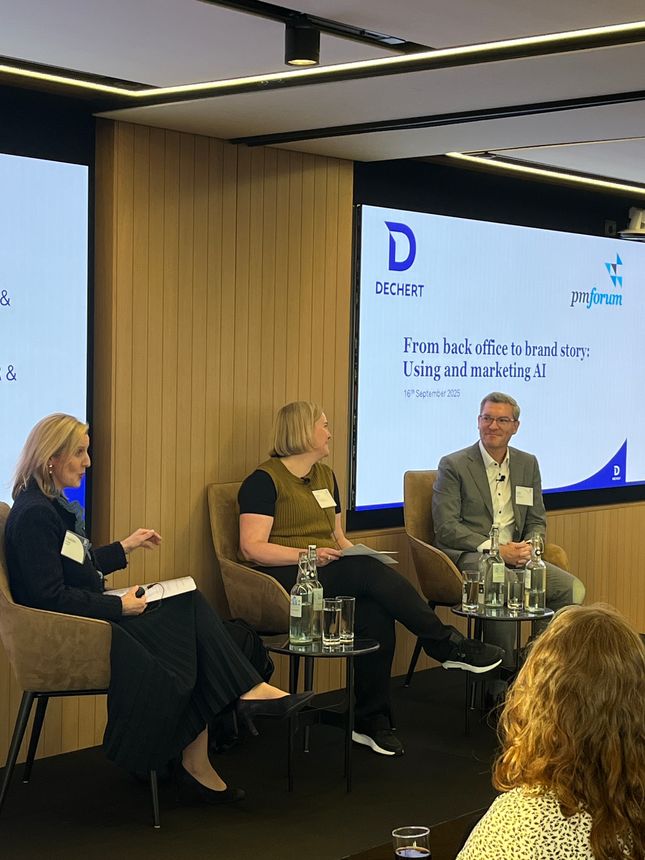

This week, I joined a PM Forum session at Dechert’s London office, brilliantly chaired by Charlotte Sansom (Dechert). Speakers Rose Hall (Herbert Smith Freehills Kramer) and Craig Annis (A&O Shearman) compared how their teams actually use AI beyond “faster drafting”. They discuss governing workflows, pricing conversations and client expectations. Below, I've shared some of my key takeaways from the panel.
The legal marketing AI landscape
Three years after ChatGPT’s debut, leading firms aren’t debating if they’ll use AI - they’re debating how to standardise its use across people, processes and pricing. The panel’s clearest signal was that tools (Harvey, Copilot, ChatGPT, Chorus Docs) are embedded, they pointed out the next edge is governed workflow redesign.
“It’s not about the tech. It’s about the people and the processes.” — Rose Hall
1) From quick wins to repeatable workflows
Personal productivity is now table stakes: drafting, editing and meeting support are routine, as long as habits stick (start Copilot at the top of the meeting, not halfway). Vendors are quietly baking in AI too: Chorus Docs ingests RFPs/RFIs and auto-summarises requirements and dates, cutting manual leg-work and mistakes. The most interesting shift is timesheets → directories. A home-grown “timesheet writer” checks billing-narrative rules to improve recovery, then composes first drafts for directory submissions by aggregating what lawyers actually did.
“It will look at all the timesheet entries… ‘we advised on privacy… employment… here’s where we added value.’ It’s a strong first draft.” — Rose Hall
2) Brand voice at speed (without sameness)
Teams are producing on-brand content faster with Harvey/Copilot, including alumni reports, press releases and internal comms. These are seeded with tone-of-voice and persona prompts so the copy sounds like the firm (and the author) from the first draft. Some firms are also pressure-testing pitches by “arguing” with AI personas, including a sceptical partner, to refine narratives before the real debate.
“We put it in the persona of a partner… to pressure-test our arguments before we go into the room.” — Craig Annis
Meanwhile, decks are getting lighter. AI trims word-heavy slides to headline points and speaker notes, so that presenter can tell the story, and not just read the slides.
3) Faster learning; sharper decisions
Some advice from the crowd suggested that Notes LLM (Google) turns reading lists, articles, and videos into short, podcast-style digests you can absorb on the move. It’s handy for staying current on new legislation or AI-in-marketing trends without adding another hour to your inbox.
On decision speed, AI is proving its worth in triage. An agency selection that normally took ~3 hours by hand was replicated in under three minutes using Harvey AI — with the same outcome.
“I uploaded three proposals… Harvey did it in less than three minutes, the same work took me 3 hours — and we landed in the same place.” — Craig Annis
4) What clients ask now: proof, not platitudes
Client questions have turned slightly pointy: Which tools are you using? How are they monitored? What efficiency have you measured — and ultimately, how does that affect price? The answer isn’t just fewer hours. AI adds capability (deeper analysis, different strategic routes), not only speed, so expect a gradual rise in fixed-fee/productised components. The panel also felt that the billable hour will endure.
“Any pricing conversation that starts with ‘you’re using AI so it must be cheaper’ is flawed.” — Rose Hall
Calibrate by risk: agree where a light-touch, AI-assisted review is acceptable—and where full traditional workflows (and deeper human review) remain essential.
5) Culture, talent and governance
Make AI socially acceptable in day-to-day work. We should normalise small cues like “aided by my friend Harvey” in drafts or email chains to remove stigma and encourage sharing of tips. It’s also a talent signal: candidates now ask about AI alongside mission and culture, and firms that use AI (not just talk about it) stand out, for now. Finally, treat MarTech ≠ LegalTech: align decision rights, testing standards and KPIs across functions so both run on one operating cadence.
The session was really well received with some brilliant advice that can be used straight away in BD and marketing teams in professional services.
/Passle/53d0c8edb00e7e0540c9b34b/MediaLibrary/Images/2026-10-14-09-22-13-024-6acf49c5944aac193a981bb9.jpg)
/Passle/53d0c8edb00e7e0540c9b34b/MediaLibrary/Images/2026-09-28-10-59-02-989-6aba4876c6484376446500cc.png)
/Passle/53d0c8edb00e7e0540c9b34b/MediaLibrary/Images/2026-10-08-10-14-29-755-6ac76d050b30ba925ae8bc36.jpeg)
/Passle/53d0c8edb00e7e0540c9b34b/MediaLibrary/Images/2026-10-08-07-04-41-374-6ac740898f60cb75fde15df0.jpg)
/Passle/53d0c8edb00e7e0540c9b34b/MediaLibrary/Images/2026-10-08-07-04-41-241-6ac74089ce624e48d6cc6df6.jpg)