


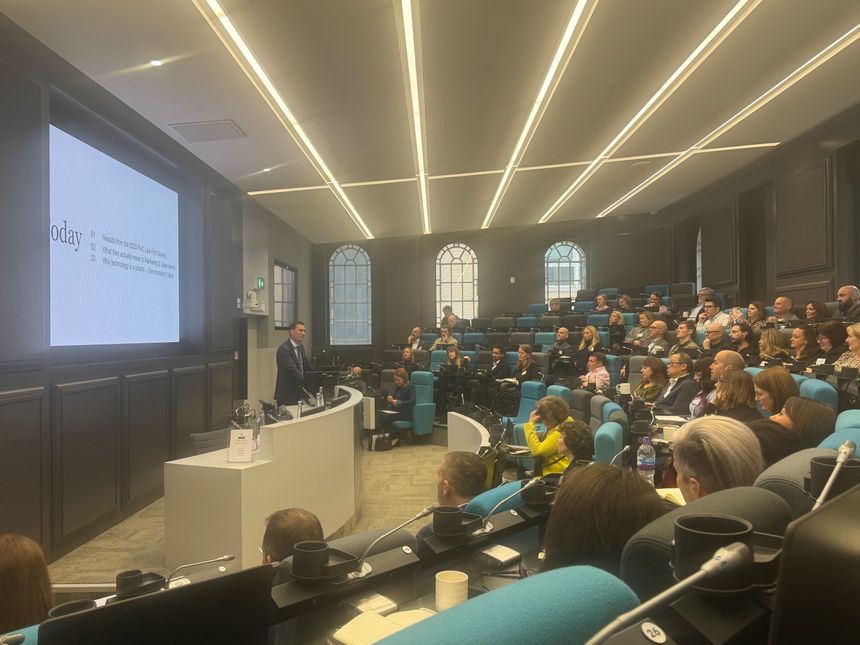

If AI is saving time, why aren’t margins thriving? That was Alex Liddle’s (Director, Legal Innovation, Legal Technology, Legal AI, PwC) challenge at the PSMG Annual Summit. Many firms claim to be “using and monetising AI,” but the numbers tell a tougher story. Closing that gap means changing how we price outcomes, how we move work through the system, and how we prove impact to clients.
The state of play (through a sales-and-marketing lens):
- Tech is the top priority. In PwC’s latest law firm survey, “improve use of technology” stayed out in front. Two things ticked up year-on-year: standardising/centralising processes (pitches, creds, know-how) and improving marketing & sales. That linkage matters, as better process + better tech = faster, clearer client experience.
- AI adoption is widespread, but uneven. Most firms are at least trialing tools (Harvey, Copilot, etc.). Some claim they’ve implemented at scale and are monetising. Yet a chunk of top firms still see a negative impact on revenue margins. If AI is creating efficiency, why aren’t margins lifting? Expect clients to ask the same question.
- The chargeable hour pressure is real. Savings bands have shifted up (more work landing in the 11–20%+ efficiency range). Clients will look for this to be reflected in how you price, not just how you work.
Where the work goes next:
Think volume vs. risk, not “AI vs. no AI”:
- Low-risk, low-volume: automate (alerts, FAQs, chat).
- Low-volume, high-risk: expert-led, often self-service support for in-house teams with clear escalation.
- High-volume, high-risk: clients will try to go in-house with AI + process to keep teams busy.
- What still goes out? The chunky, high-stakes matters (M&A, disputes) where track record and risk handling decide the mandate, and where pricing and proof win.
What this means for marketing & sales:
- Speed of response is a competitive advantage. Standardise the steps from horizon scan → draft → approval → send. Automate the admin, so lawyers spend time on judgment, not workflow.
- Clients are asking for visible AI. One company even told its panel: use AI, take risks, or lose your place. Show adoption, don’t just say it.
- Demonstrate value in numbers. Pipeline, next steps, win plans, cross-sell, tracked and reviewed. Alex’s mantra: “If it’s not in Salesforce, it doesn’t exist.” Move from CRM as an address book to PRM (Prompted Relationship Management): signals → suggested outreach → measurable revenue.
Pricing: stop reverse-engineering the billable hour
If you pass AI savings through the old hourly model, clients will simply ask for the discount. Instead:
- Price the output, not the minutes. Fixed prices for defined artefacts (NDAs, SPAs, DD reports), with risk bands and service levels.
- Use volume tiers and proofs. Try it out with 10 pilot clients, agree quality and risk, then scale with discounted unit pricing.
- Decide your margin strategy. Take a short-term hit to win share and learn fast, or hold price and compete on speed/quality with evidence.
Talent & “the juniors” question:
AI will erase some repetitive work, so training shifts from doing every step to understanding the why. Teach frameworks (e.g. SPIN - Situation, Problem, Implication, and Need-payoff), and review criteria. Train a new muscle: prompting well and critiquing outputs against client needs, evidence, and tone of voice.
Five takeaways you can implement straight away:
- Stand up a “response spine.” One playbook for alerts/blogs: source list → draft → review → segment → ship. Measure time saved and redeployed billables.
- Make PRM real. Choose one buying signal (leadership change, market move, new hire). Set automated nudges and draft outreach. Track meetings and next steps.
- Publish one fixed-fee SKU. Pick a repeatable deliverable. Define scope, SLAs, risk notes, and a volume tier. Socialise it with two anchor clients.
- Run the pipeline like a business. Weekly 30-minute call, where opportunities are ordered by close date and stage. Every line has a dated next action, or it gets one.
- Evidence the value. For each initiative, show: hours saved, additional billables unlocked, cycle time reduction, meetings created, and revenue closed.
/Passle/53d0c8edb00e7e0540c9b34b/MediaLibrary/Images/2026-10-14-09-22-13-024-6acf49c5944aac193a981bb9.jpg)
/Passle/53d0c8edb00e7e0540c9b34b/MediaLibrary/Images/2026-09-28-10-59-02-989-6aba4876c6484376446500cc.png)
/Passle/53d0c8edb00e7e0540c9b34b/MediaLibrary/Images/2026-10-08-10-14-29-755-6ac76d050b30ba925ae8bc36.jpeg)
/Passle/53d0c8edb00e7e0540c9b34b/MediaLibrary/Images/2026-10-08-07-04-41-374-6ac740898f60cb75fde15df0.jpg)
/Passle/53d0c8edb00e7e0540c9b34b/MediaLibrary/Images/2026-10-08-07-04-41-241-6ac74089ce624e48d6cc6df6.jpg)