

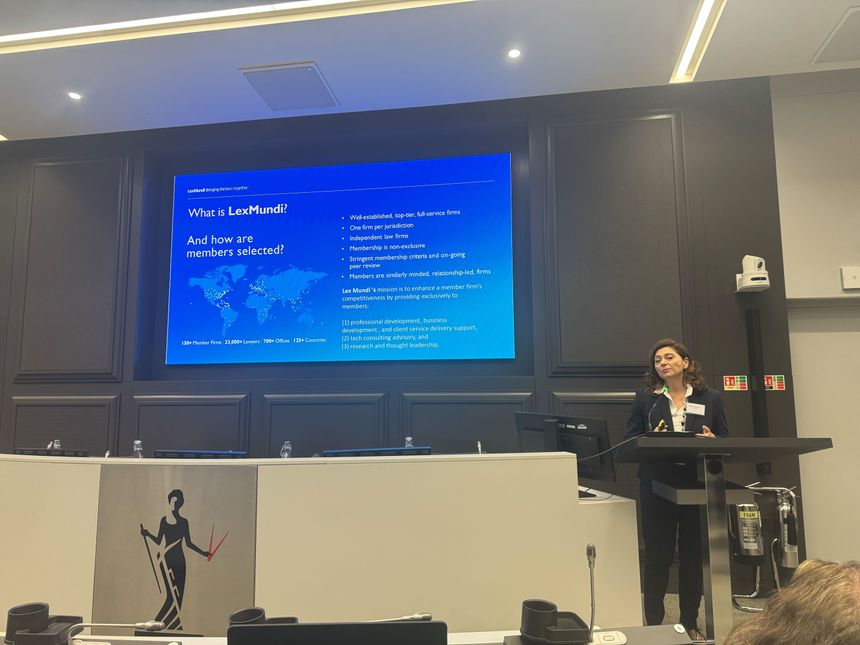

Helena Samaha didn’t give another “AI is coming” talk. She zoomed out from a global network of 150+ independent firms and asked a tougher question: can today’s leadership, talent model, and operating habits carry firms through the next five years? Her hypothesis was we could only do so if we rebuild how we lead, learn, price and project-manage, because clients and juniors have already moved.
The view from Lex Mundi
Lex Mundi are a network of independent, market-leading firms in 125 countries, deeply “indigenous” to their jurisdictions and selected for quality and market position.
How they see change: Through a Think Tank (leaders + next-gen lawyers, global spread) and a revamped Leaders Programme built with a top business school, focused on resilience, innovation, and execution.
What’s actually changing
- Clients are sprinting with AI, with in-house teams piloting and scaling faster than many firms. Some are now training their law firms on AI and demanding visible use of tech, tighter pricing and PMO (Project Management Office) discipline.
- Routine work will level out. Think “washing-machine moment”: once tools are good enough, basic deliverables stop differentiating. Advantage shifts to delivery, pricing, and client alignment.
- The apprenticeship model is breaking. Gen Z lawyers are not buying all-nighters and rote repetition as the price of learning. They want meaningful work sooner, modern tools, and clear development pathways.
- Leadership needs new muscles. Entrepreneurial resilience (risk, iterate, get back up), real innovation (beyond slogans), and project management you can show in a pitch, and not just a promise.
- The partnership model is under stress. Expect experimentation, with private equity taking influence, the rules loosen. Alternative structures, shadow boards, long-term incentives for non-partners, and cross-disciplinary teams could become more prevalent.
What clients want (and will pay for)
- Business solutions - Outcome clarity, transparency, and cadence over hours and hierarchy.
- Proof in delivery - Visible project management capabilities, progress tracking, and risk controls.
- Pricing that matches reality - As AI lifts efficiency, clients expect models that reflect it, including fixed outputs with clear scopes, risk bands, and volume tiers.
Talent: from “do every step” to “learn the why”
- Replace repetition-as-training with frameworks and coaching (how to think, decide, and communicate).
- Give juniors a real voice (e.g. shadow boards) and broader, multi-disciplinary exposure.
- Invest in continuous up-skilling across the firm, especially leaders (psychometrics, coaching, crisis readiness).
Monday-morning moves
- Make PMO visible. Put a one-page delivery plan in every major pitch: scope, milestones, communications rhythm, risks, and roles.
- Publish one outcome-priced SKU. Start with a repeatable product (e.g. NDA/SPA module). Define scope, SLAs, volume tiers, and QA.
- Stand up a Gen-Next shadow board. 8–12 rising lawyers + ops/tech. Give them two strategic questions per quarter and a standing board slot.
- Redesign early-career learning. Swap busywork for guided AI use + review frameworks (what “good” looks like, why, and how to improve).
- Run a client co-build. Pick one anchor client to design an AI-enabled workflow together (alerts, triage, playbooks). Share gains, and lock in stickiness.
/Passle/53d0c8edb00e7e0540c9b34b/MediaLibrary/Images/2026-10-14-09-22-13-024-6acf49c5944aac193a981bb9.jpg)
/Passle/53d0c8edb00e7e0540c9b34b/MediaLibrary/Images/2026-09-28-10-59-02-989-6aba4876c6484376446500cc.png)
/Passle/53d0c8edb00e7e0540c9b34b/MediaLibrary/Images/2026-10-08-10-14-29-755-6ac76d050b30ba925ae8bc36.jpeg)
/Passle/53d0c8edb00e7e0540c9b34b/MediaLibrary/Images/2026-10-08-07-04-41-374-6ac740898f60cb75fde15df0.jpg)
/Passle/53d0c8edb00e7e0540c9b34b/MediaLibrary/Images/2026-10-08-07-04-41-241-6ac74089ce624e48d6cc6df6.jpg)