


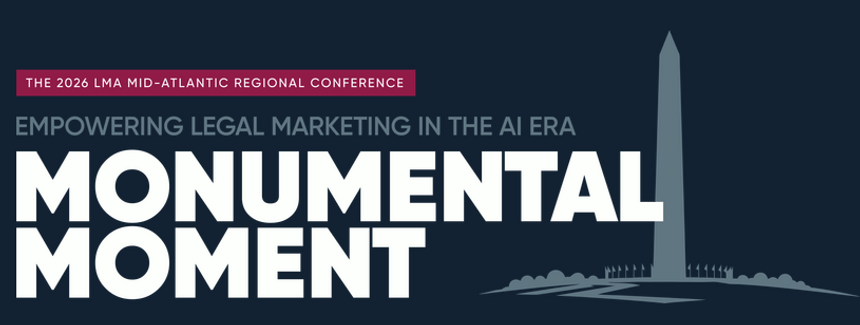

The LMA Mid-Atlantic Conference opened at Hogan Lovells Cadwalader in Washington, D.C., under this year's theme, Monumental Moment: Empowering Legal Marketing in the AI Era.
It is a fitting theme considering the seemingly ever-increasing rate of AI innovation and investment into the legal industry. In March, Legora raised $550 million, tripling its valuation in five months to $5.55 billion to fund its U.S. expansion. In May, Anthropic released a dozen Claude plugins built for the legal sector. Just a few weeks ago, Harvey raised $550 million at a $15.5 billion valuation and said 80% of the Am Law 100 now use it. Eight days later, OpenAI launched Astra for Law, a GPT-6 configuration for legal research and drafting, with Thomson Reuters Harvey and Legora among its first API customers.
This poses a dilemma for law firms that traditionally bill clients in 6-minute increments. For each doc review, deposition summary, or research that these AI tools speed up, that is less money in these firms' pockets. Theoretically.
In practice, it is a little more complicated. Clients are noticing the efficiencies AI can give their outside counsel and ask to share in them. However, the time AI saves lawyers from the nitty-gritty work frees them up for more of the higher-value strategic work that clients actually want to pay for. With GC's asking more and more questions about how their outside counsel use AI, lawyers, worried about how clients may respond if they give the wrong answer, are often choosing not to give any answer instead. That silence is where marketing and BD can step in.
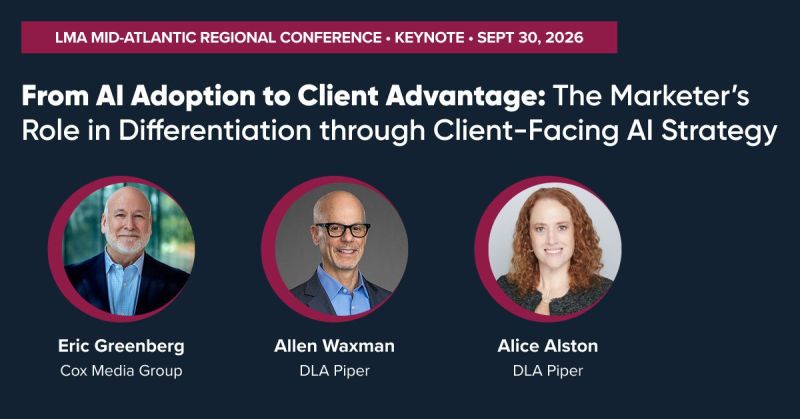
The opening keynote brought together both sides of that conversation to discuss what clients expect from outside counsel in the AI era, and how firms can turn AI adoption into a real client advantage. Alice Alston, Marketing Manager at DLA Piper, moderated a discussion between:
- Eric Dodson Greenberg, EVP, General Counsel & Corporate Secretary, Cox Media Group
- Allen Waxman, Of Counsel and Head of Knowledge & Innovation, DLA Piper
Key takeaways from their conversation:
- The tools are table stakes. What sets a firm apart is how it uses AI and how well it explains their value to clients.
- Clients want firms to start the conversation. In-house teams are overwhelmed and would welcome a firm that shares what it's learning, even without all the answers.
- Pricing needs a conversation, not a formula. The billable hour is not going away soon, and the best substitute right now is an honest discussion between the client and the relationship partner about what feels fair.
- Marketing and BD have a central role. Helping lawyers find the words for their AI story is the same coaching legal marketers have always done, applied to a new subject.
For anyone who wants to read more into each of these, see my full notes below:
1. How AI adoption at law firms is viewed by in-house counsel
Most firms are proud of how much they have invested in AI. Whether a firm runs Harvey, Legora or something else, the tools all do a good job. The difference is in how they are adopted: the governance, the workflows built around them, and the conversations with clients about what value actually looks like. Allen made the point that unlike in law firms, lawyers inside a company are cost centers. Plenty of in-house lawyers are overwhelmed by the choices and the pressure to do something effective with AI, and a firm that acts as a thought partner on that is offering something most competitors are not.
Eric gave an example of getting an email at 5:05 on a Friday with an AI summary of a court decision that just came down. Earlier this year, he said, there was a stigma around sending that. He sees it the opposite way. Without AI, he would have gotten something more polished a week later, and it would have cost him money. Instead, he could forward it to his CEO and board that evening and show they were on top of it, with a more polished summary the next week. To Eric, that is not a cheaper version of legal work, it is a new service.
2. How to approach the conversation
On when firms should raise AI with clients, Allen's answer was "early and often." Things are moving so fast that a check-in from six months ago is already dated, and business development is ultimately about getting to the next conversation.
Eric was blunt about how rarely law firms reach out and initiate the conversation. He writes regularly about AI and has been open about wanting to talk about it, yet zero law firm lawyers have called to discuss how their firm is using AI. He understands the hesitation, having been a big law partner himself: lawyers worry it will feel like marketing, or that it will turn into a conversation about rates. His reframe was that lawyers see AI as a trap door to rates, while he sees it as an open door to value. He does not want a meeting to hear about new offices in Dubai, but would take a meeting on what the firm is doing with AI and what it is seeing from other clients five times a week.
Allen added a point about lawyer psychology that resonated in the room. Lawyers are trained to have an A-plus answer, and that mindset gets in the way here, because nobody has an A-plus answer on AI yet. Saying "we are figuring this out, and we want to figure it out with you" is a stronger position than staying quiet until there is a perfect one.
3. The billable hour and the conversation that replaces it
Pricing came up as the "third rail" of the AI discussion. Allen pointed out that the billable hour has been declared dead for 25 years and yet is still the way law firms operate. Eric called it the Twinkie of the legal profession.
Law is fundamentally a relationship business, and the way to capture the value of AI efficiency may be through the inefficiency of human conversations that strengthen the relationship. No one will find the ‘perfect’ new pricing algorithm, so a worthwhile substitute is a conversation between the client and the relationship partner about what feels fair. With clients increasingly sending discount demands and guidelines that say they will no longer pay for certain tasks AI can do, getting ahead of those conversations will have more say in how efficiencies are shared.
4. Where marketing and BD come in
Alice brought the discussion back to the room of legal marketers by asking: what role should marketing and BD play? Eric replied with a stat from Harvey users saying one of the most compelling things about the product was its client service. If the companies trying to disrupt law firms have figured out the relationship piece, firms need to remember that the human relationship is their advantage. The bigger the client, the more anxious they tend to be about AI, especially public companies feeling pressure from boards and CEOs. When a client is worried or unsure, that is an opening. Telling that story and coaching lawyers for hard conversations is what marketing and BD do.
Final thoughts: what clients will expect in two years
To close, Alice asked the panelists what clients will expect from firms' AI strategies.
Eric's answer was that clients will expect a firm's accumulated knowledge to be available to them through AI, on top of the judgment of the lawyer advising them. Allen agreed, adding that much of the work AI removes was never the exciting part anyway. What it frees up is time to bring the data together and brainstorm how to solve the client's problem.
The message from both sides was consistent. Clients are not waiting for firms to have AI figured out. They want firms to start the conversation, be honest about what they are learning, and bring ideas that make them smarter. That puts legal marketers right in the middle of it: helping lawyers tell the story, find the vocabulary, and pick up the phone.
/Passle/53d0c8edb00e7e0540c9b34b/MediaLibrary/Images/2026-10-14-09-22-13-024-6acf49c5944aac193a981bb9.jpg)
/Passle/53d0c8edb00e7e0540c9b34b/MediaLibrary/Images/2026-10-22-11-14-29-774-6ad9f015ed262a90b1bf36f6.jpg)
/Passle/53d0c8edb00e7e0540c9b34b/MediaLibrary/Images/2026-10-19-13-24-47-415-6ad61a1fdc6374f637024697.jpg)
/Passle/53d0c8edb00e7e0540c9b34b/MediaLibrary/Images/2026-10-13-16-00-13-704-6ace558d477453bcaa2eba35.jpg)
/Passle/53d0c8edb00e7e0540c9b34b/MediaLibrary/Images/2026-09-28-10-59-02-989-6aba4876c6484376446500cc.png)