




If you work in professional services marketing, chances are you’ve wrestled with "purpose." We’ve all seen the sweeping statements on homepages and pitch decks – the kind that promise to change the world and somehow say very little.
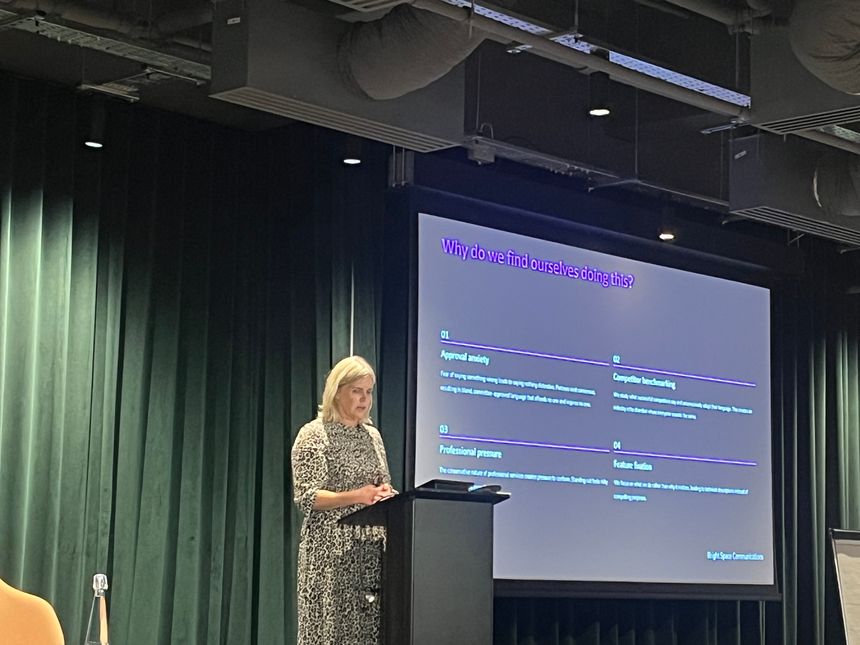
At the PM Forum Annual Conference last Friday, I was able to hear Ingrid Brown tackle the problem head‑on. Her talk, The Purpose Paradox, explored why so many firms feel compelled to declare a purpose, yet so few manage to live it in a way that’s useful, believable, and commercially effective.
The paradox in a sentence
Many firms rush to publish a purpose; far fewer integrate it. Ingrid’s multi‑year review of leading law and accountancy firms suggests roughly half now claim a purpose. Only about a quarter can back it up with a clear, coherent statement – and just a tiny handful truly embed it across the business. The result: sameness at the top‑level story, and very little differentiation where it counts.
“Don’t claim it if you can’t live it.” – Ingrid Brown
How we end up sounding the same
Ingrid’s diagnosis will feel familiar to most marketing and BD teams:
- Risk aversion - We default to safe, formal language because it ‘sounds professional.’
- Service sameness - Everyone offers similar services; we try to differentiate by renaming, stacking, or subdividing, which adds complexity but not clarity.
- Silos - Brand, marketing, sales, and practice groups operate on different timelines and incentives, producing incoherent narratives.
- Approval theatre - Without engaged stakeholders, the path of least resistance is to copy category language and tweak the adjectives.
- Content glut - When messages are interchangeable, clients push on price and our content fades into the background noise.
She illustrated the point with a video skewering the classic “About Us” brand story – the kind that promises community and authenticity while, as the punchline goes, the company is busy polluting a water table.
What purpose is (and isn’t)
Purpose isn’t CSR or ESG gloss. If it sits only in a responsibility report, it won’t guide day-to-day decisions. Keep it to something you can genuinely own and avoid lofty promises like “saving lives” when your role is narrower. Treat purpose as a practical North Star that directs priorities, hiring, client service, and measurement; otherwise it’s wallpaper. In mature categories, the “why” quickly becomes generic, so differentiate through your origin story (why you started and the need you set out to meet) and your distinctive how (the ways you deliver value and look after people and clients).
Case studies that make it real
- The BBC: A long‑standing purpose expressed simply – inform, educate, entertain – and woven into how the organisation plans and reports, not just how it markets.
- Tony’s Chocolonely: An impact‑led model (end child slavery in chocolate) integrated into brand, supply chain, packaging, and metrics. It’s not “a chocolate brand with a cause”; it’s a cause with a chocolate business model.
- A North‑East law firm: By rediscovering an authentic founding belief – access for all – the firm rebuilt its EVP and values, clarified client promises (making law understandable, removing fear), and saw hiring improve without having to compete solely on salary. Purpose became a daily operating idea, not a poster.
A practical way to start
You might discover that you are not truly purpose-led, and that is okay. You can still build a sharp commercial story. Ingrid’s guidance is to start by mapping where you create value across your stakeholders: clients, your people, investors or owners, and the wider community. Use the STAR test for your central narrative so it is Simple, True, Authentic, and Relevant. Interrogate the origin and the how by mining founder's intent and lived delivery practices, then interview clients and frontline teams. Pick a lane and measure it; if you claim it, show it with behaviours, investments, and metrics over time. Embed it by expressing purpose or a business value proposition in ways that guide employer brand and onboarding, service design and client experience, content pillars and campaign ideas, and leadership behaviours and recognition. Finally, write like a human. Professional does not mean pompous, and plain, specific language beats empty superlatives every time.
Monday‑morning moves
- Run a two‑minute homepage test: Ask five colleagues to summarise the firm’s promise in their own words. If the answers don’t match, the story isn’t clear enough.
- Collect three ‘proof points’: Pick one claim you make and list the hard evidence (decisions, policies, numbers) that back it up.
- Interview two clients: Ask what feels distinct about working with you – and what feels the same as everywhere else.
- Draft a one‑paragraph manifesto: In plain English, finish these lines: We exist to… We don’t do… You can count on us for…
- Kill one cliché: Ban a tired phrase from your next campaign. Replace it with a concrete promise.
The takeaway
Purpose isn’t what you say; it’s how you show up. Whether you uncover a genuine mission or craft a tighter business value proposition, the goal is the same: a story you can prove, that people can feel, and that helps clients choose you for something more than price.
As Ingrid put it, it’s time to break the mould and be braver – more business‑to‑human. That’s where authenticity starts, and where effectiveness follows.
/Passle/53d0c8edb00e7e0540c9b34b/MediaLibrary/Images/2026-10-14-09-22-13-024-6acf49c5944aac193a981bb9.jpg)
/Passle/53d0c8edb00e7e0540c9b34b/MediaLibrary/Images/2026-09-28-10-59-02-989-6aba4876c6484376446500cc.png)
/Passle/53d0c8edb00e7e0540c9b34b/MediaLibrary/Images/2026-10-08-10-14-29-755-6ac76d050b30ba925ae8bc36.jpeg)
/Passle/53d0c8edb00e7e0540c9b34b/MediaLibrary/Images/2026-10-08-07-04-41-374-6ac740898f60cb75fde15df0.jpg)
/Passle/53d0c8edb00e7e0540c9b34b/MediaLibrary/Images/2026-10-08-07-04-41-241-6ac74089ce624e48d6cc6df6.jpg)