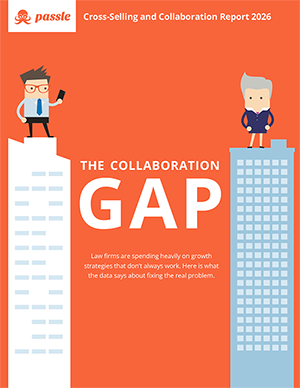




Authored by Rohan Massey, Managing Partner of Ropes & Gray’s London office and Tom Elgar, co-founder of Passle for Bloomberg Law.
Every firm runs on an economy of collaboration and trust. It underpins client relationships and, when invested wisely, compounds into growth. For all the talk of systems and strategy, collaboration in law firms still depends on something stubbornly human: confidence that a colleague will deliver for your client as well as you would.
In different law firm cultures and environments, trust and collaboration must be built attorney by attorney through visibility. As firms grow through mergers and lateral expansion, where hundreds within a single firm may carry the title of partner, focus must be given to creating, nurturing, and protecting visibility between attorneys.
Global firms now span dozens of jurisdictions, with practices that cut across borders, industries, and regulatory systems. This scale can dilute culture and collaboration where it’s not strong, as well as further complicate internal visibility.
Visibility and collaboration are arguably the most valuable assets in any partnership, but they aren’t line items on the balance sheet. When they flow between practice groups and across offices, they compound like interest. Visibility, with the partners knowing and understanding each other’s practices, becomes liquidity, and collaboration becomes the yield.
The awareness challenge. In law firms, cross-selling can be equally a sales challenge as an awareness and knowledge challenge. Attorneys who feel fully knowledgeable about their colleagues’ practices are far more likely to introduce additional attorneys into a client team. To further underscore the evolving nature of growth within law firms, it’s important to recognize that expansion is no longer solely organic.
A critical step when growing by lateral hiring is the integration that follows successful recruitment. Effective and enduring integration ensures that new talent and capabilities are fully embedded into the firm’s culture and collaborative networks, maximizing the potential for trust, visibility, and cross-selling success.
When lawyers publish relevant, insight-driven commentary, they not only reach clients—they make their expertise visible to colleagues inside the firm. A key part of any lawyer’s professional development should be the encouragement to find and express their own perspectives, and to regularly publish and share insights on issues affecting their area of practice.
If awareness and trust are the cultural foundations of cross-selling, visibility is its market data. Yet most firms still lack reliable ways to measure how collaboration develops, who is engaging with whom, which relationships are strengthening, and where isolation persists. In addition to the type of data that lives in CRMs, more firms are turning to new forms of “trust analytics,” mapping how lawyers read, share, and comment on each other’s work to visualize where collaboration is growing.
These “collaboration maps” function as a kind of balance sheet for the trust economy. They show where social capital is concentrated, where it’s stagnant, and where new investment is paying off. The goal isn’t to mechanize relationships, but to replace guesswork with evidence.
Early indicators of progress. Too many collaboration programs bombard their firms with endless counterproductive content. In practice, what works is a focused approach, where a handful of well-judged, relevant messages show real understanding and, in turn, build trust.
Each small act, opening, sharing, and commenting is a microtransaction in the trust economy, a point of visibility and an expansion of knowledge and awareness, and each is a signal that one lawyer recognizes another’s relevance to a client’s needs. Individually, these moments are modest. Collectively, they trace the health of collaboration across a firm.
Read the full article here.
/Passle/53d0c8edb00e7e0540c9b34b/MediaLibrary/Images/2026-10-14-09-22-13-024-6acf49c5944aac193a981bb9.jpg)
/Passle/53d0c8edb00e7e0540c9b34b/MediaLibrary/Images/2026-10-22-11-14-29-774-6ad9f015ed262a90b1bf36f6.jpg)
/Passle/53d0c8edb00e7e0540c9b34b/MediaLibrary/Images/2026-10-19-13-24-47-415-6ad61a1fdc6374f637024697.jpg)
/Passle/53d0c8edb00e7e0540c9b34b/MediaLibrary/Images/2026-10-13-16-00-13-704-6ace558d477453bcaa2eba35.jpg)
/Passle/53d0c8edb00e7e0540c9b34b/MediaLibrary/Images/2026-09-28-10-59-02-989-6aba4876c6484376446500cc.png)