



There is no shortage of discussion about AI in legal marketing. What’s harder to find is clarity about what firms are actually doing differently because of it.
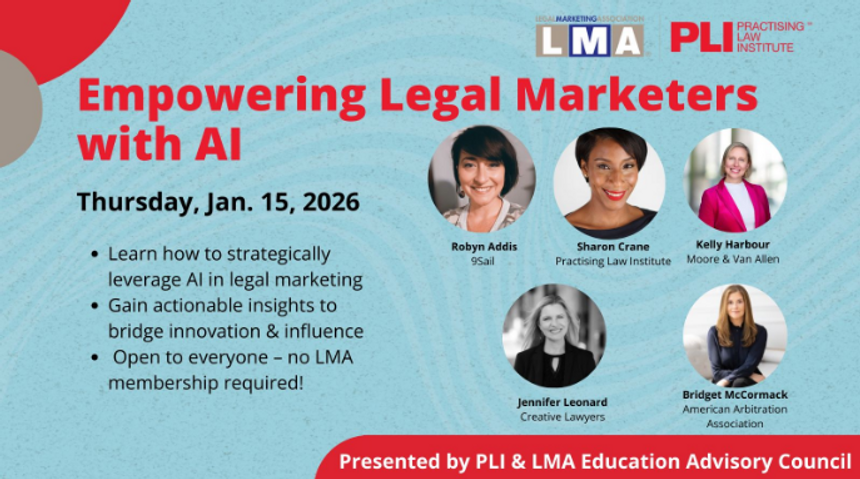
That tension came through clearly during The Legal Marketing Association webinar: “Empowering Legal Marketers with AI – Bridging the Gap Between Innovation and Influence" moderated by Kelly Harbour, Chief Marketing & Business Development Officer at Moore & Van Allen, and featuring:
- Robyn Addis, Chief Revenue Officer, 9Sail
- Sharon Crane, President, Practising Law Institute (PLI)
- Jennifer Leonard, Founder & CEO, Creative Lawyers
- Bridget McCormack, President & CEO, American Arbitration Association
Rather than predicting the future, the conversation stayed grounded in present conditions: where AI is already being used, where it is falling short, and where legal marketers are being asked to step in. Throughout the conversation, attendees were polled to gauge their sentiment towards AI adoption and usage in their firms. (See poll results below).
Quick Summary: While many law firms are talking a big game about experimenting with and using GenAI, a lot of legal marketers are left without clear guidance on the firm's strategic focus; and/or how they can use it themselves. Firms that use AI to empower legal marketers to surface actionable outcomes that deliver client value are the ones that will truly pull ahead.
AI “Aha Moments”
To start, each speaker shared a recent personal AI “aha” moment, offering a practical look at how AI is working for them in real-world situations rather than in theory.
- Kelly Harbour shared an example of using AI to narrow down shoe options for a new suit, saving time by getting to a short list quickly instead of searching across multiple retail sites.
- Robyn Addis described using Claude to help with annual goal setting, building on what she had already achieved into concrete priorities for the year ahead.
- Sharon Crane shared an example of uploading a dense new appliance manual to NotebookLM so it can be interacted with via natural language questions rather than reading it line by line.
- Jennifer Leonard shared how she used Claude to digest veterinary discharge papers into plain English, helping her track her dog’s recovery over time.
- Bridget McCormack described using AI both to troubleshoot a hotel appliance quickly and to analyze a surge in personal injury lead-generation ads she was seeing online.
Jennifer pointed to how quickly AI’s capabilities have advanced, noting that tools that struggled in law school exams just a few years ago are now performing at or near the top of the class. That shift matters because it directly affects how work gets done. AI is now capable of handling tasks that were traditionally part of junior-lawyer training, which puts pressure on two core elements of the law firm model: the billable hour and leveraged labor. If firms are experimenting with different ways of delivering work, marketing teams will be expected to explain those differences in ways clients can recognize.
Poll 1: “Where is your firm in its GenAI Journey?”
- 44% – “We're experimenting in pockets, and it's somewhat or mostly aligned with a strategy."
- 31% – “We're using GenAI throughout the firm; uses are in alignment with firm strategy.”
- 18% – “We're experimenting in pockets and does not seem to be aligned with a strategy.”
- 5% – “Experimentation is ad hoc and bottom-up.”
- 2% – “We're not doing anything with AI yet.”
Robyn was direct that there is no ‘right’ place to start; firms at every stage are still learning and iterating. In her view, what matters is using AI enough to understand what it can and cannot do. She described how in-house counsel who use AI to educate themselves before calling outside counsel, can surface firms they didn’t previously know handled a particular issue. In that environment, visibility depends on whether a firm’s expertise is legible to the tools clients are using. For legal marketers, experimentation with AI in workflows, automation, or content is not optional, because firms that aren’t learning how AI surfaces information risk being invisible to clients who do.
Poll 2 (Select all that apply): “How are you using GenAI for marketing and Business Development?”
- 80% – “Drafting press releases, practice content, bios, social media posts”
- 74% – “Research / competitive intelligence”
- 50% – “Business development strategy and coaching”
- 36% – “Drafting pitches”
- 18% – “Predictive Analytics”
- 7% – “Not sure”
- 4% – “Matter Coding”
Sharon challenged that if AI is expected to handle a significant share of junior-level work, then firms can’t rely on traditional “learn by doing” models anymore. Law schools and firms alike will need to rethink what it means to be practice-ready. That starts with 1L classes that go beyond foundational legal doctrine and includes real exposure to technology, data, and AI tools, alongside ethics. She extended that logic to business services and marketing teams as well: if AI is expected to absorb 75–80% of junior-level tasks, then training has to move upstream toward higher-value work such as strategy, critical thinking, and relationship-building. Legal marketers will need enough hands-on experience to evaluate AI output and decide whether it’s useful or wrong, which means more interactive, simulation-based, and experiential learning.
Poll 3: “Which of these is currently your biggest GenAI struggle?”
- 46% – “Strategic: I am missing the bigger picture as to how Gen AI can be used for our competitive advantage and/or how to communicate that to the market.”
- 26% – “Personal: I don't know how or when to apply it.”
- 18% – “Structural: I don't have the authority to use it the way I think I / the firm should.”
- 10% – “Cultural: There isn't enough buy-in to use it more widely.”
Bridget described how AI is already changing the mechanics of dispute resolution on the advocacy side. As an example, Bridget described the American Arbitration Association’s rollout of a narrowly scoped AI arbitrator for document-only construction cases, powered by multiple AI agents and supported by human oversight throughout. In her view, these developments don’t remove the need for judgment; they shift it, requiring lawyers and business professionals to focus less on managing information and more on framing questions, exercising discretion, and maintaining trust as AI becomes embedded in the process. Firms expecting measurable gains in procedural efficiency, case management, and administration will need to explain these changes in terms of improvements in how disputes are resolved for clients.
Conclusion
Taken together, the polling and the panelists’ examples point to the same reality: AI is already embedded in how legal marketers work day to day. However, its role in driving growth, visibility, and client value is still unevenly defined. Most firms are experimenting. Many are producing more content, faster. Far fewer have connected those efforts to clear outcomes that clients and firm leadership can recognize. Strategy is emerging as firms use AI to change how work is delivered, how expertise is surfaced, and how value is communicated.
The opportunity now is for legal marketers to move from activity to evidence. To use AI not just to execute, but to make the firm’s strengths more visible, its collaboration more effective, and its client impact easier to explain. Firms that empower their marketing teams to do that are the ones starting to pull ahead.
/Passle/53d0c8edb00e7e0540c9b34b/MediaLibrary/Images/2026-01-12-10-16-56-904-6964ca18ab784af100f11853.jpg)
/Passle/53d0c8edb00e7e0540c9b34b/MediaLibrary/Images/2026-10-08-10-14-29-755-6ac76d050b30ba925ae8bc36.jpeg)
/Passle/53d0c8edb00e7e0540c9b34b/MediaLibrary/Images/2026-10-08-07-04-41-374-6ac740898f60cb75fde15df0.jpg)
/Passle/53d0c8edb00e7e0540c9b34b/MediaLibrary/Images/2026-10-08-07-04-41-241-6ac74089ce624e48d6cc6df6.jpg)
/Passle/53d0c8edb00e7e0540c9b34b/MediaLibrary/Images/2026-10-08-07-04-41-183-6ac74089d24614eebffa86bf.jpg)