


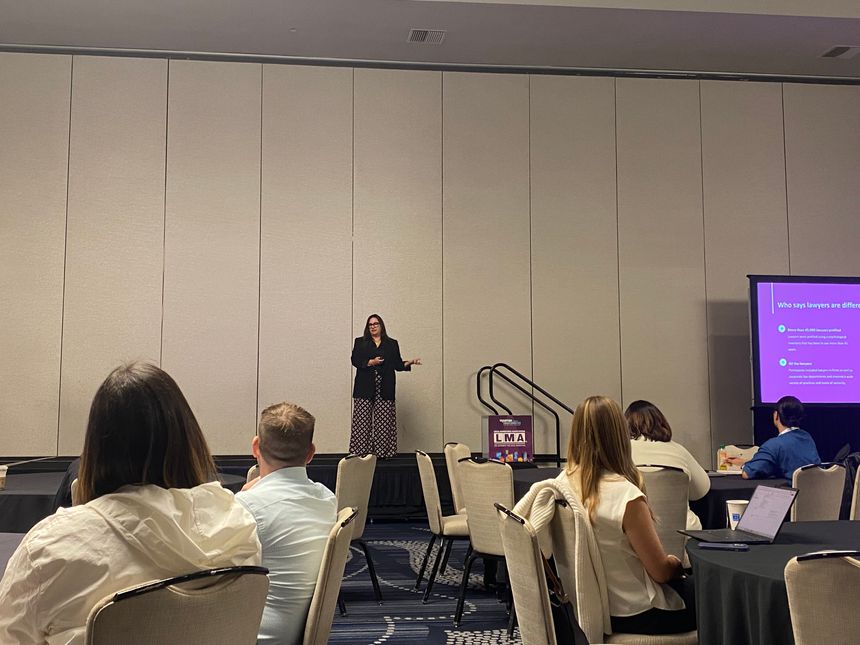

Most change management frameworks were not built with lawyers in mind. That is the problem Julia Montgomery, Director of Practice Enablement at King & Spalding, focused her breakout session on at the LMA Annual Conference. She started with a simple premise: lawyers are not a typical audience, the data proves it, and your approach needs to reflect that.
Drawing on behavioral science and two decades of research by Dr. Larry Richard using the Caliper personality profile, Julia walked through why traditional persuasion backfires in legal settings and what to do instead. The Caliper profile measures 21 personality traits. Across age, gender, practice type, and generation, lawyers consistently score as statistical outliers on seven of them. Julia focused on three that make change management uniquely difficult.
Trait One:
The general population averages 50 out of 100 on skepticism. Lawyers score 90.
Defined as being judgmental and requiring demonstrated proof, high skepticism means that telling a lawyer something will help their practice is not enough. They need to see proof that is specific to their practice and workflow. Live demos beat recorded ones every time. Their own data beats industry benchmarks every time. Peer champions matter even when the proof is compelling because a respected colleague will always land harder than a marketer making the same argument.
“Lawyers are more inclined to say no right out of the gate. So ask them a question that makes it easy for them to say no. That's the answer you want, and that moves the needle.”
Trait Two:

The general population averages 50 out of 100 on resilience. Lawyers score 30.
Resilience, defined as the ability to bounce back from failure or perceived failure, is where many technology rollouts quietly die. A lawyer who has a poor first experience with a tool are likely to conclude that the tool does not work or that they were misled, and not give it a second chance. That means thorough training before launch, group sessions, desk-side coaching, and drop-in check-ins after rollout. It also means repeating information at least seven times across varied channels, not because lawyers are not paying attention, but because that is the minimum needed for information to land. Support desk tickets are a useful diagnostic tool: pull the data on what questions are coming in and address those gaps proactively before they become reasons to disengage.
“You really need to try and get this right the first time when you are working with lawyers, because it's exponentially harder to get a second go at it.”
Trait Three:

The general population averages 50 out of 100 on resilience. Lawyers score 89.
As Julia put it simply, part of autonomy for lawyers is thinking “you are not the boss of me, you cannot tell me what to do, I get to decide what's best for my practice, my business, my clients.” General solutions feel irrelevant. Directives feel threatening. The way through is not to argue with that instinct but to accommodate it. That means doing your homework on each individual before the conversation, framing everything around personal benefit, and using their own time records to surface the specific repetitive tasks where a tool could create real time savings. Ask the question with their data in hand: ‘is that the amount of time you want to be spending on that?’
“You go to them with data about them specifically, you ask a question – not start by telling them something, and you make it easy for them to say no.”
The Rainmaker Exception

Rainmakers carry an additional outlier trait that other lawyers do not, scoring in the 90th percentile. Ego drive is the need to win and convince others, independent of personal belief in the argument. Combined with their higher average resiliency score, rainmakers become most effective change champions available. Once a rainmaker is on board with an initiative, their ego drive kicks in and they will advocate to their peers with conviction, even if their own enthusiasm is limited. Julia's advice: plant a rainmaker champion in any meeting you expect to go sideways, and you will not need to argue the case yourself.
The Psychology of Influence
Montgomery drew on Robert Cialdini's work to offer three social influence principles that work particularly well with lawyers:
Social proof. Lawyers want to do what lawyers like them are doing. The rapid adoption of AI in legal is partly explained by this: no one wants to be the last firm that has not figured it out. If respected peers are using something, others follow.
Scarcity. Lawyers are competitive. Framing a pilot as having limited seats creates urgency and, counterintuitively, desire. Something available to everyone is easy to ignore. Something limited is worth competing for.
Reciprocity. The brain keeps score. When someone does something considerate, an obligation is created. Asking for time in a way that makes it easy to say no, and then delivering something useful, builds goodwill that pays dividends when you need buy-in.
These three principles combine into what Montgomery called a strategic playbook. Find a rainmaker, get them enthusiastic, and record a short video testimonial. Use that video to announce a limited-seat pilot. When a lawyer calls to get in, tell them you will check on availability, then call back to let them know you were able to squeeze them in.
The Donkey Kong Strategy
Plan your rollout like a video game. Start with the easy levels: the people who are already curious, open, and likely to engage well. They will give you useful feedback, become early champions, and generate the social proof you need for harder conversations later. Save the most resistant individuals for the final level. By then you have data, champions, and a track record. The holdouts are no longer fighting a new idea. They are fighting a growing consensus, which is a much harder position to maintain.
Final Conclusions
Legal marketers are often trying to apply general-population change management to a population that is categorically different. The tools that work on most audiences, asserting benefits, sending one clear announcement, relying on logic and data, tend to bounce off lawyers entirely. The alternative requires meeting people where they actually are: skeptical by default, averse to failure, fiercely protective of their autonomy, and highly responsive to what their peers are doing. Understanding those traits is how you persuade a persuader.
/Passle/53d0c8edb00e7e0540c9b34b/MediaLibrary/Images/2026-01-12-10-16-56-904-6964ca18ab784af100f11853.jpg)
/Passle/53d0c8edb00e7e0540c9b34b/MediaLibrary/Images/2026-10-08-10-14-29-755-6ac76d050b30ba925ae8bc36.jpeg)
/Passle/53d0c8edb00e7e0540c9b34b/MediaLibrary/Images/2026-10-08-07-04-41-374-6ac740898f60cb75fde15df0.jpg)
/Passle/53d0c8edb00e7e0540c9b34b/MediaLibrary/Images/2026-10-08-07-04-41-241-6ac74089ce624e48d6cc6df6.jpg)
/Passle/53d0c8edb00e7e0540c9b34b/MediaLibrary/Images/2026-10-08-07-04-41-183-6ac74089d24614eebffa86bf.jpg)