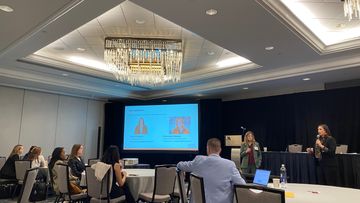


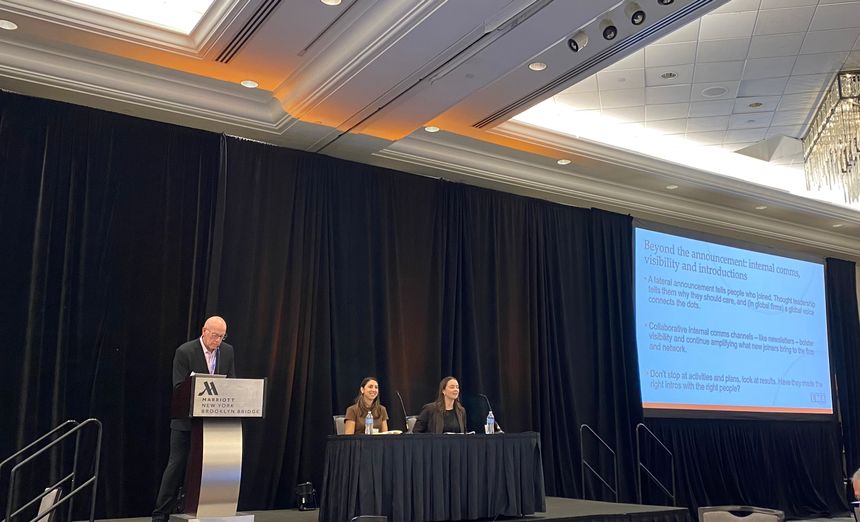

I was especially excited about this panel moderated by Ken Wineke of Introhive because it brought together experts from two firms of very different sizes tackling lateral integration:
Jillian McKenna - Director of Marketing, Business Development, and Client Services, Verrill
Stephanie Siok - Communications Manager, HSF Kramer
Recently, we have been hearing from our clients and reading about firms putting enormous amounts of time and money into recruiting a lateral partner. Case-in-point: when the room was asked who had onboarded a lateral partner in the past year, pretty much every hand went up. That said, regardless of firm size, lateral integration is something firms of all sizes are still grappling with; when the room was asked who would say it always went to plan, most hands came down.
Both firms have been living this. Founded in Maine, Verrill has deep roots in New England and has grown to nearly 200 attorneys across nine offices through lateral groups and combinations. In 2026 alone, Verrill has announced ten more lateral attorneys, mostly associates and counsel, and the pattern says a lot about where the firm is heading. HSF Kramer, meanwhile, launched in June 2025 from the merger of Herbert Smith Freehills and Kramer Levin, creating a global firm of more than 2,700 lawyers. Since then, the firm has been on a US hiring push, adding partners in New York and Washington, D.C., and planning a Texas office as part of a goal to double its US revenue.
Many of the examples Jillian and Stephanie gave echoed what I heard at Passle's lateral integration roundtable in September, especially how much thought leadership matters in showing where a new lateral fits. That said hearing both perspectives side by side showed how many teams have to pull in the same direction to make one lateral hire succeed. Whereas Jillian sees integration through relationships, data, and client service, Stephanie sees it through announcements, visibility, and internal engagement. Below are four areas the panel covered, with how a mid-sized firm and a global firm each handle them:
1. Data: the client list is only the starting point
A lateral’s client list does not tell you who else at the firm knows those clients. Once conflicts clear, Jillian’s team cross-references the list against firm systems to find clients the firm already serves. They let the existing relationship partners know a lateral with experience at that client is joining, then set up a client team, formal or informal, so the conversation starts right away.
At a global firm, those connections may sit in another country. Steph described two partners who joined her firm’s Washington, D.C. office and were quickly connected with competition colleagues in Brussels and London.
To measure progress over the first year, Jillian looks at:
- Financial data: Introductions to existing clients, new clients brought in, and whether existing firm timekeepers are working on the lateral’s matters.
- BD activity: Interactions and introductions, which her team has started tracking over the last couple of years.
- Feedback from colleagues: Check-ins with practice group chairs and colleagues as well as the lateral, since a lateral may paint a rosier picture of how integration is going.
2. Communications: give partners a reason to reach out
Steph makes sure the global CEO’s voice is in every lateral press release, so even a single hire in one office connects back to firm strategy. The announcement is only the start. Those two antitrust partners were writing for the firm’s quarterly newsletter soon after joining, and their articles brought in inbound interest from reporters.
Jillian said thought leadership also solves an internal problem. Partners often find it awkward to pitch a new colleague to their clients. Sending a relevant article with a short note offering an introduction is a natural way in, and a useful client touchpoint at the same time.
Internally, Steph’s firm runs a newsletter called Collaboration that highlights cross-border matters and profiles each new lateral, including a fun fact. Partners have reached out to new colleagues because of something they read there.
3. Collaboration: enable the introductions, do not force them
Jillian plans partner retreat seating chart by chart, looking for business overlap and similar personalities. Two partners she seated together at a retreat later told her they had found a new best friend. She has also talked practice groups out of turning retreat dinners into working lunches, because the informal conversations are where relationships get built.
When a whole group joins, the biggest risk is a firm within a firm. When an environmental group joined Verrill’s Boston office, the firm took part in some of the group’s existing traditions at first and learned its goals, then brought it into firm processes over time.
The room named two barriers that keep partners from introducing laterals to clients: worry that the new colleague will not match their level of client service, and competition between senior partners. Jillian’s approach is to start with the partners most open to collaboration, set up meetings where they hear the lateral’s own commitment to client service, and use those early wins to bring the rest along.
4. Beyond the first 90 days
Jillian shared three examples of integration work that continues long after onboarding:
- Succession: A partner of 30 years had avoided succession planning, so the firm brought in a lateral as her successor. By framing the transition as protecting her legacy, not replacing her, the firm moved her key client relationships over about 14 months.
- Client interviews: About a year after a solo practitioner joined, Jillian visited one of her clients, who said nothing had changed. Within ten minutes it was clear he did not know the network he was now connected to. A conversation about his business, followed by a labor and employment blog rather than a hard sell, led to a new matter.
- Recognition: Verrill now hands out medals at its all-attorney meeting, including for successful integrations. Jillian expected the partners to find it cheesy. They love it.