



Growth means different things depending on where you sit in a law firm. For lawyers, it's often about winning new work and deepening client relationships. For marketing and BD teams, it's about building the infrastructure, content and hiring strategy that makes that growth possible at scale. Bridging those two perspectives is increasingly becoming a role in its own right.
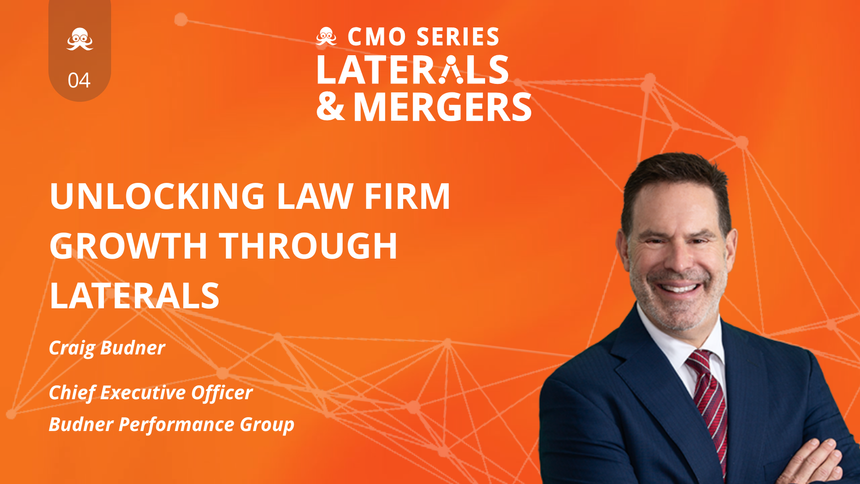
As we continue to revisit standout episodes from the main podcast, today on CMO Series: Laterals & Mergers, we're looking back at a conversation Charles Cousins had with Craig Budner, former Global Strategic Growth Partner at K&L Gates, now CEO of Budner Performance Group. Craig explored what that bridging role looks like in practice, and how it drove growth across an international firm.
Charles and Craig dive into:
- What a Global Strategic Growth Partner actually does
- The thinking behind launching the K&L Gates Client Conversations podcast
- Where the biggest growth opportunities lie for an international law firm
- How marketing and BD teams can support lawyers to build client relationships at scale
- What makes a strong lateral hire
- Key advice for firm leaders looking to grow their firms
Transcription
Charles: Hello, and welcome to the Passle Podcast, where we talk about all things professional services, business development and marketing, and how you can be more authentic and effective at both. I'm Charles Cousins, and today I'm joined by Craig Butler, global strategic growth partner at K&L Gates.
Charlie: This episode is brought to you by CrossPitch AI, the new cross-selling tool from Passle. Cross-selling should be the easiest way for law firms to grow, but most firms struggle. Why? Lack of awareness, lack of trust, and frankly, fear of selling. The result? Missed revenue. CrossPitch AI fixes that. It breaks down silos, helps professionals connect, and delivers timely, relevant insights to the right people, inside the firm and out. There's no heavy rollouts, just switch it on and try it today. Head to crosspitch.ai to book your demo and make cross-selling happen. Now back to the podcast.
Charles: How are you doing today, Craig?
Craig: I'm great, Charles. Great to, great to talk with you.
Charles: Excellent. And, interesting title, Global Strategic Growth Partner. It's not one you see often, so maybe we can kick things off with you telling us a little bit about what your role covers.
Craig: Sure. The title used to be longer and more prescriptive, and we added a little mystery to it.
Charles: Yeah.
Craig: But it basically covers our, what we call, client growth team. I manage our 85 to 90 professionals around the globe who support the marketing, media relations, client development, client engagement efforts on behalf of the firm. So that's a piece of it, and the second piece is our lateral program. So the growth of our lawyer group with both lateral hiring and the process around that and the integration of our laterals.
Charles: Yeah. And it's not in your title, but you're also a practicing lawyer, hey?
Craig: I am. I am. It's more of a consigliere role now.
I maintain some great client relationships. Um, the day-to-day work is done primarily by others, but I do practice and try to help with big picture strategy.
Charles: Nice. But that's really cool for today, actually, 'cause it means you're, you sort of sit with two hats on. You can see things from the sort of BD and marketing side, but also the fee earner side, so that's really cool.
Craig: Yeah. They let a practicing lawyer in the traditional CMO store, and so it is an interesting perspective, because I was and have been a consumer of resources for our client growth team.
Charles: Yeah. Yeah. And actually, one of the things, actually, I was a bit nervous about this call today because you obviously host the K&L Client Conversations Podcast, so I'm a bit of a podcaster as well. Maybe we can kick things off with the sort of core strategy behind launching the podcast and how you got that started.
Craig: Well, it, it really was about thinking about how many interesting professionals that we work with at K&L Gates and, really trying to understand how they got to their positions of leadership. Yeah. It's not exclusively general counsels. I've done CEOs, I've done law school leaders, I've done professional services leaders of different types. And so it's really trying to pull out of these great people what makes them great, what challenges they've had over the course of their career, and how they've overcome those and how they kinda carry those with them. And I think what I'm trying to do is demystify what it means to be successful in our world, and from a number of different perspectives.
Charles: Yeah. Yeah, that's really neat. And in terms of the outcomes of that, have there been any sort of moments that made you think, "Oh, actually that was, that was, that was a great idea. That was really worth it, worth us putting time and effort into doing that podcast"?
Craig: Oh, yeah. I mean, it's a long form podcast, so we you know, they're 45 minutes to sometimes up to 90 minutes.
Charles: Yeah.
Craig: And, you really... They're not scripted and we've pulled out some really interesting factors. Recently I had a woman, a trans woman who, 67 years old, but came out as trans as a 63-year-old. Before that had been a firefighter in New York, a CFO of a publicly traded company, has children and is still married to the same woman for the last 29 years. So it's really interesting to think about how to navigate being trans in today's world. It was fascinating and got a lot of wonderful feedback.
Talked to the dean of the first woman of color, dean of a top 30 US law school. Right, whose entire pedagogical career has been around race anxiety in particular right after George Floyd. So really an interesting set of reflections about how the mind works, when dealing with issues of racism. And I think that was fascinating. So we get all, we get all types of nuggets from these things from these great people because, you know, they've led such varied and interesting lives, and I just get to, you know, hear about them.
Charles: That sounds good fun, actually. Just, just chatting to interesting people about interesting topics. That sounds like a good recipe.
Craig: It is.
Charles: So I guess bringing it back to, a little bit more, more your sort of role at K&L. So as one of the leads on the strategic growth, what would you say are the, the main opportunities at the moment for growth at an international law firm? Or what are you and your team working on at the moment?
Craig: It's probably different for different firms. K&L Gates is the combination of a number of regional firms that came together over, mostly a five-year period, 2006 to, you know, five to seven-year period, 2013 or so, while we added Greenfield offices as well. And so these were regional firms that punched above their weight class, if you will.
Charles: Yeah.
Craig: And the real benefit for them was not to stifle their entrepreneurialism, but was to come together as a coordinated unit. So getting our 46 offices and all of our practices coordinating so that really the opportunity for us is to have conversations with our clients, you know, back to the podcast idea. Where we listen to what it is that really is on their minds and having a coordinated approach. I think a lotta, a lot of lawyers instinctively go to talking to clients about what they know well. Yeah ... but at a firm like ours where we really cover the globe and pretty much every practice. It's critical to making sure that our partners understand what solutions they can provide to their clients, so that they can authentically solve their problems as opposed to just selling them something that they wanna sell them. So I think that's a big low-hanging fruit, if you will put effort on behalf of our firm, raising the literacy of our partners in terms of what solutions they can provide so they're not scared to ask those open-ended questions about, you know, what keeps the GC up at night.
Charles: Yeah, yeah. So a lot of that I guess is building relationships or having your fee earners be good at building relationships. And actually I watched your interview with Mo Bunnell. Big shout-out to Mo Bunnell, author of The Snowflake System. Oh, yeah. A good friend of Passle. But you talked a lot about that, I think it was at the start of the pandemic about how those client relationships are more important than ever. So I guess that leads on nicely, what can you do or what can marketing and BD folk be doing to support their lawyers to develop those client relationships?
Craig: Well it's really, and, and yes, a well-deserved shout-out to Mo, who is really one of the great thought leaders in the space.And, and I've gotten a lot of my ideas about how to structure our client growth team from Mo, who's not only a good friend, but a wonderful resource. You know, the idea around helping the partners is really,figuring out what it is that should be the strategic focus of the partner or group. Yeah. Who are the contacts that they have, what stage of the process Mo talks about in Snowball System, you know, the stages leading up to raving fans, and then providing them some examples of ways to have those conversations. So as you know, Charles, we've had, I bet, 75 virtual round tables in the last 18 months.
Charles: Yeah.
Craig: We used to do them in person. We're starting again. I actually am moderating a round table in person tonight in Dallas, Texas
Charles: Fantastic
Craig: Around labor and employment issues. So we're starting to get back in person but really using vehicles like that so that the clients feel heard, they feel heard about the issues that they actually care about, and the lawyers can think strategically, hear that feedback, and think strategically about, "Okay, well, what, what's my real next ask?". You know, I took the person to dinner. What's the goal from that? Yeah. Is the goal a conversation about a solution we can provide them? What could that be? And so really helping guide our partners in that process, and also kind of think ahead, what are the issues of the day that you hear over and over from clients? You know, ESG's a hot one now.
Charles: Yeah, yeah.
Craig: Obviously, that covers so many different areas. But what are those hot button issues that our partners really need to learn about? How do we get them that competitive intelligence so that when they get in a room and somebody's talking about that topic they can be facile in the discussion?
Charles: Yeah. Yeah. No, no, that's interesting. I guess one of my questions, based on what you said in support of the lawyer, is how do you go about doing that at scale when, you know, you're a law firm the size of, of K&L Gates? How can you or might not have the answer, but how are some ways you can do that at scale?
Craig: It's a great question, and it is a realignment, when I took over. You know, I'm not a CMO. I haven't been trained to be a CMO. I was trained to be a lawyer. And so I sought feedback from our entire group when I took over two and a half years ago or so. And the feedback I got is that people wanted to cross over into other areas. They didn't wanna stay in a limited lane. They wanted to learn about a lot of different areas. So one of the ways we have to scale is having that 85 professional team really understand all of our practices, our regions, the various tasks that go on inside our group, even if they don't perform those tasks.
Because the partner doesn't want to look at a roster and say, "Who do I call about this?" They wanna call somebody, and that person gets them to the right person. So limiting the number of conversations that occur so the partners feel served. We also have a fair amount of scaffolding around our regional operations. So Australia, of course, is a big island. So we have a structure in Australia that really works directly with our Australian partners. Same with all of our Asia offices, and Europe, and the United States. And then within that, we try to create centers of excellence. So, these would be the things that get repeated over and over. Maybe it's event planning, maybe it is social media, how we put ourselves out there. Maybe it is the coaching around lateral integration and the assistance we give the laterals in their business development efforts.
But those centres of excellence help scale because the people on the team are doing those things over and over, and they're constantly sharpening the knife, if you will, in terms of the performance in that area. So that's a broad topic, obviously, Charles. Yeah. But it's, those are a few of the ways I think we try to scale.
Charles: Yeah, I think that's a great example, that center of excellence, that idea of establishing the best practice and a process. I'm an athlete from an athlete background, so, yeah. I like to operate. I'll find a process that works and stick to that. And I guess when you're trying to do something at scale like that, when you've got a best practice and a process, then it's probably a bit easier to scale out. That's right. So you, you touched on lateral highlight hiring a bit just then. But when we spoke to you before, you talked about this, when do you think lateral hiring is, is the right move, and what are the sort of qualities you're looking for in the person that you're bringing in?
Craig: Another great question. I think lateral hiring is appropriate when there's an authentic match between the prospective lawyer and the opportunity. So I think from a firm perspective, you have to know what you are. You have to know what defines success. So when I took over the lateral hiring program about five, six years ago, I looked at what had succeeded and what hadn't succeeded and why it hadn't succeeded. And so for us, because we are a fully integrated global firm. There are no, you know, some of our competitors are Swiss firms that have, you know, different profit centers.
We don't have that. So, the real success stories typically that come out of our lateral hiring program have to do with the hire, understanding how to use the broader firm to collaborate. If they just come to our firm and bring over their existing work and, and you know, kinda maintain what they've done before, it really doesn't usually work as well. They really need to stretch themselves, and part of stretching themselves is making sure their partners, you know, the partners at K&L Gates, understand their skillset. What solution are they uniquely providing? And because about a third of our work is sourced in one office by a partner and actually performed by another partner from somewhere else in the world.
Charles: That's an interesting point, and it reminded me of something that, that one of my mentors said to me, uh, a few years ago. He said, "Charles, you don't necessarily need to know everything about everything. You just need to know someone who does know the right expertise." So it's about, I guess, creating that network of expertise. So you just need to be an expert at your one thing and lean on the expertise around the firm. So that's a really cool idea. So I guess to wrap things up, we end podcasts, all of our podcasts in this way. What's the one piece of advice you'd want to offer people working to, to grow their firms? And we purposely keep this quite open-ended.
Craig: Well, I think you need to, you need to know who you are and grow to strength. So, I think a lot of firms do a great job of understanding who they are and, and leaning into what they are as opposed to covering every single area.I would say if I were, if I moved to another firm, I've been at the same firm for 31 years, so I'm not inclined obviously to move around. In fact, I'm one of the few I know who've been at the same firm their entire career. But if I was giving advice to another firm, I would say, look at your client relationships. Figure out if you've got the right people leading those efforts. Are they leading them on behalf of the firm? Are those relationships sticky? Do they have multiple practices and multiple offices working on those matters if it's a larger firm? Because the more sticky those relationships get the less likely the partner is to pull out and disrupt that client relationship on behalf of the firm. So I think that's an item I would probably say if I were talking to another firm about what I would focus on.
Charles: Yeah. Brilliant. Cool. Well, that's all we've got time for today. But Craig, thanks very much for your time today. It's been a pleasure to chat to you and pick your brains. And, hopefully we'll catch up in person very soon.
Craig: Absolutely, Charles. Always a pleasure to talk to you, and keep up the great work at Passle. You guys are doing a wonderful job.
Sam: Thanks for joining us for the Passle Podcast CMO Series. If you'd like to catch more episodes, you can see us at blog.passle.net. You can also subscribe to catch fresh episodes as soon as they come out.
/Passle/53d0c8edb00e7e0540c9b34b/MediaLibrary/Images/2026-01-12-10-16-56-904-6964ca18ab784af100f11853.jpg)
/Passle/53d0c8edb00e7e0540c9b34b/MediaLibrary/Images/2026-10-08-10-14-29-755-6ac76d050b30ba925ae8bc36.jpeg)
/Passle/53d0c8edb00e7e0540c9b34b/MediaLibrary/Images/2026-10-08-07-04-41-374-6ac740898f60cb75fde15df0.jpg)
/Passle/53d0c8edb00e7e0540c9b34b/MediaLibrary/Images/2026-10-08-07-04-41-241-6ac74089ce624e48d6cc6df6.jpg)
/Passle/53d0c8edb00e7e0540c9b34b/MediaLibrary/Images/2026-10-08-07-04-41-183-6ac74089d24614eebffa86bf.jpg)