

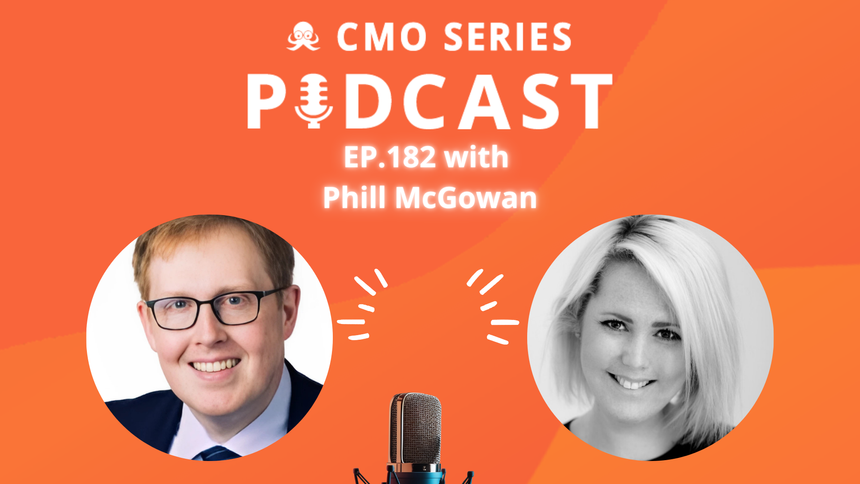

Executing an effective thought leadership strategy is essential in professional services marketing, yet many firms continue to struggle. By understanding and implementing the right approaches, firms can not only cut through crowded markets but also build lasting credibility.
In today’s episode of the CMO Series Podcast, Charlie speaks with a former guest on the series, Phill McGowan, who has led marketing and communications at top law firms including Jenner & Block, Crowell & Moring, and Reed Smith. Now, through his consultancy, Phill McGowan Marketing, he helps firms deliver impactful, data-driven campaigns.
Phill joins us today for a masterclass in building successful thought leadership campaigns, from distinguishing between flagship Capital “C” campaigns to more agile, lower-case “c” initiatives. We’ll also explore how to navigate shifting markets, secure leadership buy-in, and create content that stands out.
Phill and Charlie dive into:
- Phill’s journey into legal marketing and his first time seeing impactful thought leadership
- Common mistakes versus best practice in law firm thought leadership
- The implications and opportunities of a shifting market on thought leadership
- Understanding capital ‘C’ and lower-case ‘c’ campaigns and their essential elements
- Advice for firms on securing buy-in and leadership support for further investment
- Practical tips for CMOs looking to build a sustainable thought leadership strategy
Phill shares more in a new series of articles exploring different types of campaigns, their use cases, and why thought leadership is the real test of marketing and BD performance today. Read the first article here.
Transcription:
Charlie: Hello and welcome to this episode of the CMO Series podcast where we talk all things marketing and business development in professional services. Now we all know that thought leadership has become a cornerstone in professional services marketing, and when done well, it can be one of the most powerful ways to cut through a crowded market and build lasting credibility. In this episode of the CMO Series podcast, we're very lucky to be joined by former guest on the show, Phill McGowan, who has led marketing and communications at top law firms, including Jenner & Block, Crowell & Mooring, and most recently Reed Smith. Now through his consultancy, Phill McGowan Marketing, he's helping firms deliver impactful data-driven campaigns. Phill joins us today for a masterclass in building successful thought leadership campaigns, from distinguishing between flagship capital ‘C’ campaigns to the more agile, lower case ‘c’ initiatives. We'll also dive into how to navigate shifting markets, secure leadership buy-in, and create content that stands out. This episode is brought to you by Cross Pitch AI, the new cross-selling tool from Passle. Cross-Selling should be the easiest way for law firms to grow, but most firms struggle. Why? lack of awareness, lack of trust, and frankly fear of selling the result missed revenue. CrossPitch AI fixes that, it breaks down silos, helps professionals connect and delivers timely, relevant insights to the right people, inside the firm and out. There's no heavy rollouts. Just switch it on and try it today. Head to cross pitch.ai to book your demo and make cross-selling happen. Now back to the podcast. So welcome, Phill.
Phill: Charlie, it's great to be here. Thank you for having me.
Charlie: Phill, before we get into the details, can you just tell us a little bit about your journey in legal marketing and in particular, was there a moment or a turning point where you saw the real impact of thought leadership being done well?
Phill: Well, certainly Charlie, so, you know, I started my career in journalism and then as a government communicator, so that informed a little bit about sort of my point of view into legal marketing, I’ve been in this space for about a dozen years. I would say kind of the first real impact I saw on thought leadership, this was 2016, so this is right after Trump's election win. I think that because it was unexpected, you know, clients were urgently trying to understand the regulatory space of a new administration, and so within a few days after the election results, the firm conceived a campaign called First 100 Days, it was a webinar series, and it was launched just a couple of weeks after the election. It ended up drawing about 1800 existing and new clients, and it really sort of demonstrated to me the need to be responsive on the merits at a time and place of choosing for clients who need information to be able to anticipate that, and that can help drive engagement and reinforce client relationships.
Charlie: Yeah, that's a really powerful example and I think a great highlight of how being responsive and putting content out there that's relevant and timely can really drive those results, and I guess from your perspective, Phill, where do law firms most often go wrong with their thought leadership? And conversely, what approaches do you see consistently cutting through?
Phill: I would say that too much thought leadership is stuck in the rear view mirror. So you have clients that are already paying law firms to deal with their current issues and so these clients are eager to know what's around the corner and how emerging issues are gonna affect their business. So, you know, they're not looking for a recap, to put it in practical terms, they don't need a year in review as much as they need a forecast for the following year. I think the second point, Charlie, is that they don't need War & Peace. You don't need to bang on forever. You don't need footnotes. The best thought leadership is concise, it's forward-looking, it's actionable. It's content that's helping clients to prepare, not just to reflect. Folks don't have time to reflect. Lawyers think that publishing thought leadership is the end of the road, I think that's kind of the third and final point to this. You know, they've birthed their baby, they think that they're done. They're not. It's really actually only the beginning. There's a whole sort of activation component to campaigns and is really that activation piece that is gonna determine the success or the failure of a campaign, the ability to engage the market. Lots of people don't know your firm, so how are you engaging the market abstractly, but also how are you engaging specific clients and also being able to cross sell within your business to create awareness about issues. You're looking to help drive business. And I think that too many lawyers sometimes just think that, oh, well, I've published my piece of thought leadership and that's enough, and now you then have to do something with it. You know, there are a couple of examples that I've seen in the space from law firms that I think are experimenting and doing well. Davis Wright Tremaine came out with a campaign earlier this year on the new administration, and you know, it's a comprehensive multimedia outlook. It's detailed, it's layered, it's got executive orders, it's got, you know, legal and political developments by federal agency, but also has webinars. The insights are also organized by practice capability, so there's a strong organizational foundation, but it also allows clients to kind of choose their own adventure based on what they wanna read on. Bird & Bird came out with a set of trends and predictions for 2025 on tech and communications, and there's nearly 140 predictions. Now, I think what I like about this one is that each of the predictions are one, two, or three paragraphs. You're not sort of buried in a sea of background and precedent, it's, let's just get on with this. Give me what I need and let me move on. And then I would say third Charlie, I do have to talk about my old firm, Reed Smith, is that, you know, Reed Smith came out last year with the AI explain campaign, and it was really built for speed and for responsiveness. And so AI regulation was changing so quickly that long form articles or long winding videos that was gonna be proved to be impractical. So the idea is let's go to podcasts. Let's go to client alerts, let's go to blog posts, let's go to quick videos. Let's get to market quickly. Maybe the production values aren't the highest. But it's again, responsive to the moment to what clients need, and I think that's a consideration over and above sometimes the need for absolute polish on campaigns.
Charlie: Yeah, so the takeaways that I've got from that, Phill, are thought leadership should be future facing, that kind of forward looking piece so you're not just reflecting back in the rear view mirror as you mentioned. Concise and kind of to the point, so you're getting it out there in a timely fashion. And then I really like the point around this is ongoing. It's not one and done. You're not writing that big piece of thought leadership, publishing it, and that's it. It's gone into the abyss. It's kind of how you follow up, how you build that into a broader campaign and I love those three examples that you've just given there. Those three firms that have done that in different ways. And I think actually the point you just made around the kind of different media, the podcast video written pieces, it's kind of, that whole mix, I think it’s a really good example of how to cover all bases and get that knowledge out there in a way that meets the audience, I guess.
Phill: Yeah, no, it's really about, again, meeting people where they are, when and how they want to read content, and so, you know, as you get more into thought leadership campaigns, you start thinking more and more about the audience and how you're fine tuning for those audience preferences.
Charlie: The market's obviously changed a great deal over the past five to 10 years. How would you say that shift has reshaped thought leadership, and what would you say are the best opportunities for law firms today?
Phill: I think that we're entering a new era of merit-based business development. We are coming out of COVID. I think we're in a place where some firms do events, they do social events really well. Obviously in the B2B space, relationships matter so much, but I think that, and you hear this from GCs, relationships are changing, thought leadership has become a clear kind of number two factor in how clients evaluate firms. So relationships being one, but thought leadership being second. You also have a great number of B2B buyers that are spending the majority of their time, 80% plus, on reviewing and considering firms before they reach out and make contact. So the way that the game is being played, the way that clients are analyzing and engaging with firms, they're changing. It's more merit based. And then we talked earlier about how people are consuming information, how that's also changed. So you don't want the voluminous 10,000 word report. As they say in the UK, you want things short and sharp. You want variety and, and you want to be able to have some content for people who are on the train listening to a podcast or they're watching a five minute video, people are looking for answers. They're not necessarily looking to explore. And so how do you shape your content in ways where people can find it, they can quickly assess the value of it and they can move on. You see this a lot from the big four, from McKinsey, from Bain, particularly sort of how they visualize and textualize their thought leadership. It's easy to scan, easy to digest, and you can move on. I think there's a lot there that can inform how firms are engaging in this space.
Charlie: Yeah, I really thought that the merit-based business development was a really interesting concept that you spoke about, and also absolutely the kind of bite-sized, digestible chunks of content that people can consume, meeting them where they are. Phill, you've spoken before about the difference between capital ‘C’ campaigns and what you call lowercase ‘c’ campaigns. So can you just talk us through how you define each of those, and crucially, how do you decide which path to take?
Phill: Certainly. So let me just step back for a second, Charlie, because I remember a few years ago talking to a marketing and business development team about campaigns that need to do thought leadership campaigns. And then I got off the call and a lot of BD’s came to me and said, Phill, we really like the idea, would really like to do campaigns, but oh my God, that is so overwhelming. The idea of creating a campaign, driving it all the way through. They were thinking kind of large scale, multi-month efforts, and it was just, they couldn't imagine it. So then I came back with a two-tiered model to make the process more practical and make campaign execution more doable. So the first type is the capital ‘C’ campaign, and it's kind of what you envision sort of as the flagship campaigns. These are large scale initiatives. They've got dedicated sub-brands and they take months of planning. And really the driving force behind a Capital C campaign is that you're looking to position your firm as a market leader on a high priority client issue. So obviously you're thinking about what is the business case? Do I have a critical mass of lawyers if I were hired to go and support clients? Okay, and then what are the emerging issues around them? And then you think about that and you move and you go to market. Let's say that you want to be lighter on your feet. Let's say that you want to build a campaign that's for speed and responsiveness around timely developments. What does that mean? I wanna get to market next month, not six months from now. So your lower case ‘c’ campaigns are the right approach. For your quicker, more responsive campaigns, and typically they're built around client alerts, blog posts, and webinars, the things that firms are already doing, and it's really about creating an order or schedule of them, putting some branding around them, tagging them in consistent ways.
Then see how they evolve. Because you're hoping that these campaigns that are built for speed and responsiveness are informed by the news cycle and the social cycle. What is going out in the space, and then how is the firm providing insights off of that?
Charlie: So the, the capital ‘C’ campaigns, it's more about those longer, bigger flagship campaigns where you are looking to position your firm as a particular thought leader in a particular space, and you've got the budget and the time to do that over a longer period, whereas the lower case ‘c’ campaigns is much more about those responsive, timely, getting them out to market in line with the new cycle. So that absolutely makes sense. And I, and I guess with those kind of bigger flagship campaigns that you were talking about. What would you say are the non-negotiables and where do you see firms either overcomplicating things or failing to invest in the right areas when they, when they do those?
Phill: I see five non-negotiables, Charlie, let me go through them in order. You need visible champions, so you need lawyer leaders who understand the value of a campaign, whether big or small, and will help motivate contributors to get to the finish line and then to activate campaigns, it's absolutely necessary. The second is editorial discipline. Writers, lawyers can't go rogue in how they approach a campaign. That doesn't mean that you can't have versatility and creativity, but you need marketing and BD teams to help provide some rigor about how to go to market and thinking about those audience considerations. Third is cross practice collaboration, like rarely do you create a campaign about an industry that doesn't cut across a whole bunch of different practice disciplines, and in fact, the more that you're able to provide for that, the more the client is like, okay, you've now addressed every practical consideration about an issue that's coming up. The fourth I've already mentioned, this is activation. Again, how once you get your campaign across the finish line, how are you engaging with clients? And then what are the KPIs that you're using to show the ROI on campaigns? And we'll talk about that a little later. And then the fifth, and this is a bit obvious, is the business alignment. That obviously there are priorities for the business about how you go to market and which practices and in what areas, and are your campaigns aligned to those priorities. I would say that the biggest mistake is over investing in content creation and underinvesting in activation. So it is fantastic if you can be a first mover on an issue, it really gives you an advantage. That advantage is lost if you don't actively get content in front of the right clients and prospects. And then another mistake is waiting to get to market. So let's say that you're working on a campaign, it's not quite right, we need one more article to make this whole. Sometimes you just have to get to market. You have to strike while the iron's hot, and if you don't, then somebody else will, or your effort will just fizzle and then it will never happen. Leadership support is also essential because it's helping to drive internal awareness. So a big piece about thinking about a campaign is that you're marketing to your clients broadly, but some of those clients are your partners, and so you want the validation of leadership, the signal to lawyers that campaigns matter. Campaigns start bottom up. You get an enthusiastic collection of lawyers that are rallying around an idea. You wanna seize on that energy, but the enthusiasm alone isn't enough. You need lawyers who view the project to the business lens. Who are you trying to reach and what are we ultimately trying to sell? Sort of underlying to the issue that we are talking about in the market.
Charlie: Those five non-negotiables you listed out there, Phill, have invisible champions, those law leaders, the editorial discipline, the cross practice collaboration, the activation piece, and then crucially that business alignment. I think super useful takeaways for anyone listening to this podcast and a great place to get started I think with those larger campaigns. Moving on to those smaller, lower ‘c’ campaigns, so they're kind of faster, more responsive. What's the trick would you say to moving at pace while still keeping the content fresh and distinctive and offering the value through that content to clients and prospects?
Phill: Certainly. I mean, one observation is that, and I think about this in a non campaign perspective, you know, there are some traditional blogs out there where there is one lawyer contributor who is tapped for a week or a couple of weeks to then write something, and you write something about the market. I think about campaigns is that you are activating a team and then the specialists, as they see a development in their specific area, they are going to market with that, and they're doing that in collaboration with the rest of the campaign team. So that's one important characteristic. The second is that when these contributors are writing content quickly and going to market, they're not only sharing that content on social, but there is a PR play. If you're doing things right and you're on the news cycle and the social cycle, well then that means you can provide that commentary in media outlets. And so now you're then expanding your audience potential to help drive traffic back to your website, back to your piece of content. So, moving fast is an advantage in and of itself because others may be sending out content as well, but your differentiation is really the pace of it, and then your ability to broadcast social pr, you want to amplify your outreach.
Charlie: Yeah. Fantastic. Some great points there to consider and once you're in that new cycle and you’re on the socials and PR comes into it and you can kind of jump on that as well, then you are amplifying your voice even further, which is obviously the point of all of this. Just coming back to one of the points you made earlier around getting those visible champions, those lawyer leaders, how can you successfully secure buy-in? I know it can be a challenge within law firms, but how do you win that support from leadership? And are there any kind of quick, quick wins or metrics that can help build that trust and the appetite for further investment in thought leadership campaigns?
Phill: Let's talk about KPIs, and I think that you need to be realistic about KPIs and you're thinking about top of the funnel activities, mid funnel and bottom of the funnel. Is there a structural uplift and website traffic to your contributing lawyers and to the practice areas that involved. From an SEO standpoint, how are you winning on certain keywords on search versus other known competitors in the space? And then further down into the funnel, how are you getting clients to follow up with you? Are they inviting you to pitch? Do they want CLEs on related issues? Are you just having one-on-ones with them? Is that ultimately sort of turning into work? So I think that there's a whole measure of KPIs that you can set kind of from the top to the bottom of the funnel where you can see like, okay, how are the lawyers helping to activate the campaigns alongside marketing and business development, and where is that moving the needle or not, and how you can adjust.
Charlie: Super helpful. Thank you, Phill. Just going back to your point around asking the managing partners, what are their clients thinking about? What are they interested in, what's helpful? We ran a survey a couple of years ago with GCs, and 77% of them said that they spent more than five hours a week staying up to date with thought leadership, and they're really hungry for that content. So, I think an important point to keep in mind is speaking to the clients and finding out what it is they want from you as a law firm. And finally, Phill, it's been so interesting to speak to you about all of this, but if you could give three practical tips to CMOs looking to build a more effective and sustainable thought leadership strategy using this model of the capital ‘C’ and the lowercase ‘c’ initiatives, what would those three tips be?
Phill: I think you're aligning your thought leadership with business priorities. And again, that sounds a little captain obvious, but you're gonna have a lot of different groups that might be captivated by the notion of doing a campaign. You can't invest equally in campaigns across the board. What are the tiebreakers? Where are you gonna put more investment versus less? And obviously, business priorities really matter in that context. The second is that you're building ownership by creating content franchises that position the firm as a go-to authority, like you want to be not just known for your capabilities as a law firm, how helpful is it to be known for a topic, a topic where you are a first mover to create that differentiation to then win new business. The third is measuring what matters. You know, and this is again the tracking of meaningful KPIs and then holding the lawyers accountable for activation. You know, ultimately these steps transform thought leadership from one-off marketing activities. The goal is to create a consistent driver for business impact, campaigns are a way of accelerating that effort.
Charlie: Fantastic, some brilliant practical advice there that folks listening can hopefully take back to their firms. Phill, you are also writing a series of, you could call it a mini campaign, where you are describing all of this and laying out how firms can practically go about developing these sorts of campaigns. So we will share a link in the podcast description to those articles as well. But before you go, I just wanted to see if you are up for doing a little lightning round with us so we can just find out a bit more about Phill McGowan and what he gets up to outside of work.
Phill: Let's do it Charlie.
Charlie: Awesome. What's your go-to way to unwind after a busy day?
Phill: I'm thinking two things. So I'm a basketball guy, so I love to shoot free throws 'cause it's repetitive. I'm not competing against anybody. I could just focus. Sometimes I go for a jog and turn on a podcast and I don't even listen to the podcast. I'm just letting my mind wander. So it's a great reset on both accounts.
Charlie: Nice. Love both of those. And what's a book, podcast or resource that you would recommend to anyone working in professional services marketing right now?
Phill: So I was recommended this book a few months ago. It's a very quick read. It's called Originate Business Development for Lawyers. So let me step back for a second. So too many lawyers think or want to position themselves as I could do everything, any place all the time, and really the premise of the book is around how can lawyers differentiate themselves by practice, by industry, by the type of clients that they want to engage with. And then it's instructive for marketing and BD staff because then they can understand like, how can you then effectively market these lawyers? So, you know, differentiation is the name of the game and, and it, it has some really fundamental insights.
Charlie: Great, I've made a note of that one. Where's your favorite place to visit and what makes it so special to you?
Phill: I think it's London because it's a little foreign, but it's also very familiar. So my wife and I, before we got married, we've traveled there. We have since brought our family there. I've had reason to make lots of business trips there and I've built a lot of great relationships and quite frankly, I think London is just a lot more approachable for us than New York. Maybe because we're dog people and we think it's great that you can take your dog on the train.
Charlie: Fantastic. What's the best piece of advice you've ever received?
Phill: Two pieces of advice. One is from my dad, which is always seek out new cultures. So if you have an opportunity to work in a different market and you don't have a family, go for it. Like figure out how the world works in other places. I think a second piece of advice I've gotten from a long time friend in the legal world is that you don't have to accept every piece of advice that you're given. So I'm not saying that you should not accept tough, candid feedback from the people that matter most in your circle, but you don't have to hang on to every piece of advice in the moment. Take what you get from people. Process it and let it help you, and for the things that don't let it go.
Charlie: Very thoughtful, love both of those. Excellent. So last question, do you have a favorite way to use AI? Is there a prompt or maybe a tool that's recently surprised you?
Phill: So not really sort of surprised me. What I would say is that I'm trying to get into the habit of, is that if I have a meeting with a client or someone else, I'm always going to AI and asking, who is this person? Give me a rundown on this person. So I'm just trying to get into the habit of like, how do I find out more information about people without having to go to five different websites. Another trick for which I use AI is that, you know, sometimes you're like, you're thinking about a process, you're brainstorming and you're writing things down, but you don't have a fully formed thought, and so I throw those things into ai. Actually, I might use different AI platforms just to throw a set of incomplete set of process points, brainstormings in there. And then I get a whole bunch of ideas back and I don't pick up those thoughts and just say, oh, I'm gonna run with it. I'm using AI as a sounding board to get me to sharpen my thinking.
Charlie: Fantastic. Yes. More great advice there on yeah, how to get the most out of ai and definitely I agree with you that finding the background around people chatGPT can be super, super helpful for that. So thank you Phill, thank you for joining us today.
Phill: It has been a pleasure, Charlie. I really appreciate the opportunity.
Charlie: Yeah, no, it's been great to have you on again, and as I said before, we'll share more content from you on the podcast description for any folks looking to find out more about how to develop those different types of campaigns that we talked about today. So thank you all for listening, and we'll see you on the CMO Series podcast next time.
/Passle/53d0c8edb00e7e0540c9b34b/MediaLibrary/Images/2026-10-14-09-22-13-024-6acf49c5944aac193a981bb9.jpg)
/Passle/53d0c8edb00e7e0540c9b34b/MediaLibrary/Images/2026-10-13-16-00-13-704-6ace558d477453bcaa2eba35.jpg)
/Passle/53d0c8edb00e7e0540c9b34b/MediaLibrary/Images/2026-09-28-10-59-02-989-6aba4876c6484376446500cc.png)
/Passle/53d0c8edb00e7e0540c9b34b/MediaLibrary/Images/2026-10-08-10-14-29-755-6ac76d050b30ba925ae8bc36.jpeg)
/Passle/53d0c8edb00e7e0540c9b34b/MediaLibrary/Images/2026-10-08-07-04-41-374-6ac740898f60cb75fde15df0.jpg)