

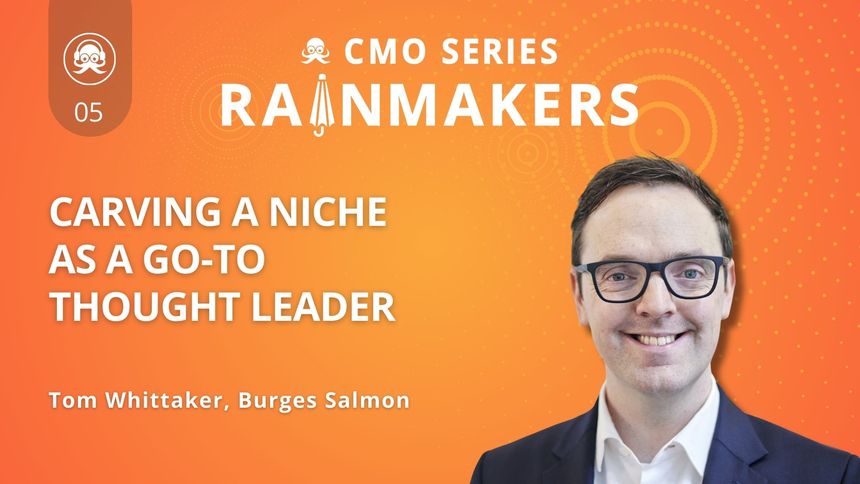



Standing out in a crowded market increasingly depends on carving out a clear niche and owning it with confidence.
In this episode of CMO Series Rainmakers, Sarah Strachan is joined by Tom Whittaker, Director and Head of AI (Advisory) at Burges Salmon, to explore how lawyers can build authority by becoming the go-to voice in an emerging area. Tom shares how an early interest in writing evolved into a focused thought leadership strategy, positioning him at the forefront of AI regulation long before the space became crowded.
They discuss when thought leadership first clicked for Tom, how he identified an opportunity in a fast-moving regulatory landscape, and the importance of consistency and clarity in building credibility.
Tom and Sarah cover:
The early stages of Tom's career, and the moment he realised that writing and thought leadership could play a meaningful role in his development
How he began positioning himself in the AI space before it really gained traction
The shift from specialising in AI to becoming the person clients and government bodies actively seek out
How thought leadership has helped build a profile and generate new opportunities
How to keep insights timely and build visibility in a fast-moving regulatory landscape
How to encourage a culture of writing, collaboration and knowledge-sharing inside the firm
Practical steps for lawyers looking to carve out a niche
Transcription:
Sarah: Hello and welcome to this episode of CMO Series Rainmakers, where we are joined by Tom Whittaker, Director and Head of AI at Burges Salmon, to explore how lawyers can carve out a niche and become the go-to thought leader in their field. Tom's career shows what can happen when curiosity, consistency, and clear communication come together.
What began as an interest in writing has evolved into a focused thought leadership approach that has positioned him as a trusted voice on one of the fastest moving areas in the market. In our conversation, Tom shares when thought leadership first clicked for him, how he recognised the opportunity in emerging regulation and the steps he took to build visibility long before the space exploded.
He talks about the kinds of content that create real business impact, how he stays relevant in a fast-changing landscape, and how he encourages a culture of writing and collaboration across the firm.
Charlie: This episode is brought to you by CrossPitch AI, the new cross-selling tool from Passle. Cross-selling should be the easiest way for law firms to grow, but most firms struggle. Why? Lack of awareness, lack of trust, and frankly, fear of selling the results missed revenue. CrossPitch AI fixes that it breaks down silos, helps professionals connect and delivers timely, relevant insights to the right people inside the firm and out. There's no heavy rollouts. Just switch it on and try it today. Head to crosspitch.ai to book your demo and make cross-selling happen. Now back to the podcast.
Sarah: Welcome, Tom.
Tom: Hi, Sarah. Great to be here.
Sarah: Fantastic. So would you mind first starting by talking us through the early stages of your career and when you first realised that writing and thought leadership could play a meaningful role in your development?
Tom: Yes, certainly. So I trained and qualified at Allen & Overy and I qualified into the litigation department, and I clearly remember early days of where there was the opportunity to write for the client-facing litigation newsletter, and I saw that as a really good opportunity for engaging in various areas of law, depending on how the cases were coming through in developing out my writing style, thinking about it from a client perspective, and then also as a way of just developing my writing skills and then engaging with other people within the department as well. I saw that internal networking is particularly important at that early stage of that career, trying to learn as much, see as much, and absorb as much as possible.
Sarah: Brilliant, and often something that we see with lawyers, I'm really keen on getting your thoughts on and asking you a follow-up question on how did you overcome the early hesitation that many lawyers seem to have about putting themselves out there publicly?
Tom: Well, if you say yes and get involved, then it's hard to allow that hesitation and that concern to really take over. You just need to get stuck in with it. You know that if you are in the right workplace with the right people, with the right culture, they're there to support you and to help you. One of my early things has always been to have a red pen with me so that I am ready for when colleagues mark things up for me, and when I mark my own work up and when I mark up others work.
So I very much see it as whenever I'm getting constructive criticism on things, I see that very much as a positive. And just writing that thought leadership and getting that constructive feedback from other people should only be seen as a positive thing, because in due time and due course, you see that the amount of red on the page, or the amount of track changes in the Word document, or wherever you write, ultimately reduces over time as you flex your muscle and improve what you can do.
Sarah: Definitely. It is really important to get started, take on feedback, and it was great that you had the opportunity to do that early on in your career as well. So what initially drew you to AI regulation and how did you begin positioning yourself in that space before it really took off?
Tom: So I'd spotted a case. I think it was on one of our litigation analytics platforms called Tendaris, which is all about misrepresentation in the financial services sector regarding the contracting for AI. And it struck me that there was something to it, where actually it was starting to raise potentially novel issues and if you moved from the deterministic systems that were in question there to non-deterministic systems, where in effect you, you know what the inputs are, but you're not quite sure how they get the outputs, then that could really start to challenge various concepts in law such as reasonableness, rationality, foreseeability, and so on.
And so I found that as soon as I'd spotted that one, I just started looking and then you start to go down that rabbit hole. But also you then start looking from a different perspective of looking at existing case law, or looking at existing advice that you're providing, and you're thinking, well, what if, for example, you were using something which was autonomous, or what if you were doing it for another purpose? And then you start to see how the analysis changes. And it was really by lots of luck as well that the EU was starting to then produce content about potential by regulation.
And then ultimately it produced its first draft of what's now the EU AI Act, back in April 2021. And it was because of that, that I started writing about anything that was starting to come through, and then you started to realize that once you were looking in the right places, actually there was a decent flow of news stories that were coming through. And because I was using Passle and writing short posts, it meant that I could quite quickly turn around some of that content as well, so that I could really start to build up some momentum behind my writing on AI regulation.
Sarah: Fantastic. So you started looking, then started having a look at different perspectives and different articles that you could add your thought leadership to. In terms of looking in the right places that you mentioned, are there any resources that you use on a regular basis?
Tom: So I'd suggest that listeners take a look at Society for Computers and Law, in particular, their website that has a range of useful articles in there, not just related to AI, but one in particular is an article that I wrote with a fellow AI committee member regarding some of the top resources related to AI more generally, but also AI and the law. So that has a series of different things, whether it's books, people to follow on LinkedIn, podcasts, newsletters, and so much more. And hopefully that also reflects that people like to read and engage and learn in different ways. So really it's a case of finding the right medium for you to be able to engage with so that you can read into and enjoy learning about AI.
Sarah: That's a really helpful resource. I think sometimes lawyers don't understand that you don't have to start from scratch, there's a lot of resources out there that you can then take a look at and add your legal expertise to. So looking at taking thought leadership to the next level, how did you make the shift from specializing in AI to becoming the person clients and government bodies actively seek out for this kind of work?
Tom: So ultimately all of this has been a long-term approach, and not one where I had perfect foresight at the beginning. I certainly started with a real interest and curiosity in the area, and then it was one of those areas which, I'm gonna start mixing metaphors here, but let's say it's snowballed from those early stages where you find that if you start writing about one area, you start writing about a few other areas and then you start engaging with content from a few different places, and then you start to pick up those conversations with different colleagues or different people in the market, and you start going to different conferences. And suddenly you start to build out all of these different ideas, all of these different networks of different people and then you find you start to build out those connections that way.
There is an element where you have to look out for opportunities and then you have to proactively go after them. So certainly we found that responding to some government consultations helps put us in contact with really useful people who were then thinking about similar issues that we were particularly interested in and that we were working on. And it's really from there that you start to have those further conversations, then one thing may ultimately lead to another. But it's very hard to know exactly where some of these things are going to lead over time, which really helps underscore the importance of consistency and perseverance with all of this.
Sarah: Yeah, it's really interesting. I know when we previously spoke, we spoke about that snowball effect and how consistency has an impact on then raising your profile. Do you know roughly how long it took before you started seeing traction with the thought leadership you were creating?
Tom: I would say it was about two, well, it depends, two years if you're thinking for external engagements, but it was pretty quick in terms of internal engagement and finding that there were others around the firm who I could speak with on this and we would deliver training together and do other thought leadership with each other. But it wasn't really until two and a bit years but that really is because it started to coincide with the timing of Chat GPT’s launch, EU putting out further proposals around EU regulation as well.
So again, there's an element of luck about those external factors and when they hit as well, and so I'd say you can start to get some immediate returns on these things, but it's hard to foresee exactly what they will be and where they will be. And I certainly find that you write certain things expecting that it will have a really good uptake, but maybe it doesn't actually have as good uptake as you were expecting. Then the vice versa is also true, which is that sometimes you publish certain things which you think is maybe a bit niche, but actually loads of people are particularly interested in it. So, you just have to keep thinking about what your audience is interested in, thinking about what you are interested in, and just continue away at it and you will start to find what sticks.
Sarah: Brilliant. Yeah, it's definitely important as we spoke about to get started, but then stay consistent as well. And how would you say that thought leadership has helped you build your profile then? Has it generated opportunities for you?
Tom: Yes. I think the first, and to me most important thing, is that it starts to give you clear name recognition, both internally and externally, so that when people think about the areas of my practice, they're likely to think either AI or they're likely to think disclosure. So disclosure being in the context of inquiries, regulatory investigations, and litigations where one party needs to search for review and produce documents to another party. But I would also say that with some of these things, it's about building out those connections with people who start to put you in connections with other places as well, so it is through writing Passles.
First of all, I find that I can engage with colleagues in the firm to help do the research, to help do the drafting, help think about it from their specific specialist or sector expertise and from their audience and their clients' perspective. And then when that gets published, that starts to hit a few different channels, so for example, goes through to mixology, goes through to LinkedIn, and suddenly you start to see different people engaging with it. But it's only when you start to then develop out those conversations by sending somebody a message or having a coffee with somebody, that you start to hear about what's going on in the market.
And actually, as much as about writing is important and speaking is important, the most important thing probably is to listen, so that you understand what your audience is interested in, what their needs are, how they want to consume the content, but also then to work out what's going on in the market. And so it's by making those initial connections through Passles and follow ups, that's then led to the involvement in particular working groups, or that has led to specific types of work that's come in. Or often I find as well it may be that the work doesn't come in to me, but because I’ve helped build this brand for Burges Salmon and AI, then the work starts to go into colleagues as well. Ultimately, all of it being beneficial to the firm as well.
Sarah: Fantastic. And as we know, AI evolves very quickly, so I'm really keen to know how you keep your insights timely and build visibility in such a fast moving, regulatory landscape. And something we quite often hear from lawyers is to stay consistent, obviously you have to write a certain amount of content. So I'm really keen on hearing how you actually filter out, almost the white noise when there's so much information out there in the market. How do you make sure you're writing high quality content and not just content for the sake of it?
Tom: So in my experience, there was certainly a bit of a learning process. And certainly those times where I felt as if there's a lot of white noise going on in the market, both in terms of the underlying events that were potentially worthy of, or suitable for a piece of written content, but also in terms of what others in the market were then writing about. And so there is that element of, it's only through doing that you will really learn about what's right, but it's also only through listening to your clients and to your audience, and also thinking about things from a critical perspective, that you work out what your message is and what the most efficient and effective way of communicating that message is going to be.
So, for example, I look across at what other law firms do. There are some absolutely brilliant analytical pieces out there, or thought leadership pieces with real insight, but there's still a surprising number of incredibly long PDFs, often with loads of random images where I am still skeptical as to whether many people really get much benefit out of those. And so it's only by really being critical of those ones where I've thought, well, let's try and tailor my message and my approach this way. So in terms of how to then keep up given the fast moving nature of AI, so I find that if I focus Passles on being relatively short, objective, neutral updates, that means actually it's a lot faster to be able to turn around spotting the update and then being able to produce it. Second, I'm incredibly lucky to have a brilliant group of colleagues who are interested in these areas. And because AI is everywhere all at once and cuts across so many different sectors, it probably isn't right for me to try and write everything. It's right for those specialists and my expert colleagues to be writing on these things as well.
So the second thing there is, you know, spread the love and spread the workload from it. So I'm grateful to them for that. And the third angle, in terms of keeping up to date with all of this, is that you keep in mind what your clients are really after so that you can really focus on what that signal is over the noise, and so that you really focus in on what's important to them, and so that you can really spend your time wisely around that. And that'll obviously change depending on who the listeners are, and what their respective audiences are and their markets are as well. But again, you can only really develop that through learning and through doing.
Sarah: Fantastic. So focusing on timely updates, keeping it digestible, but really importantly, keeping this content client-led is what differentiates you in the market. I also really like the comment you made about your colleagues, and a comment you made earlier about not only building your brand, but building a brand for Burges Salmon. So I'm really keen to know inside Burges Salmon, how do you encourage a culture of writing, collaboration, and knowledge sharing around emerging areas like AI?
Tom: So it is part of people's objectives in order to have that external engagement, but also to have other related objectives, such as around building knowhow. So certainly I find that when you write Passles or other thought leadership pieces, actually what you're doing is multiple things, hopefully in one go. So, you are researching, you are drafting, and you could just leave it as an internal piece to share with colleagues, but if you can, why not also draft it in a way which is suitable for external audiences so that in a way, you are killing two birds with one stone, for want of a much better phrase.
And it may be that you are drafting something that's internal, but then you just can remove some of the additional analysis and notes, and insights that you have from the external version so that you've got something which is suitable for internal know-how or for when you need to speak directly with clients, but then you've also produced something that is useful externally. So having clear objectives for all of us, myself included.
Second of all, there's that a cultural piece of encouraging colleagues to keep sharing ideas, sharing thoughts, sharing insights, to make sure that we all have visibility over what's going on, but also to then have that proactive approach of saying, well, could I write about this? Or could I go to this event? Or would this be of interest? And ultimately, I was gonna say, no ideas are bad idea, there are some ideas that are probably pretty bad, but on the whole it's better to try and share those ideas, and it's better to try and enable colleagues to get an idea of, well, who is our audience? What is the market? What are the topics that we are going to write about and that we're interested in, that colleagues and clients are interested in, so that ultimately they're able to spot those opportunities, follow the right resources, and that they're able to share some thoughts about where they can be proactive and engaged.
And then ultimately it's also about enabling them in terms of how they go about that. So, we have our internal style guidance around how to write, what tone it should be, how to structure, how to phrase the opening, and phrase the title and more, so that colleagues feel as if they're not just going from a complete white blank page, but that they have some guidance and direction behind it. And ultimately what we're trying to do with a lot of our colleagues is that they will build up that repertoire, so that it becomes second nature to them as well, and that they can continue to engage and produce.
Sarah: Fantastic. That's really good advice, and it sounds like you've got a very good structure built internally at Burges Salmon. I've never actually heard the idea of drafting something internally for colleagues that then gets tweaked and used externally, I think that's really clever and obviously it is a very efficient way of doing it as well. So that's really good advice for our listeners there. So we are nearly at the end, we've just got one last question for you, Tom. I’m really keen to get your insight for lawyers who are looking to carve out a niche or raise their profile. What three practical steps do you recommend for them to get started and stay consistent?
Tom: So, first of all, follow your heart or your gut. I can't remember which is the right analogy, but go with the thing which the topic, which you're particularly interested in, because that's what you are likely to really read up about, and stay engaged with, and want to do further analysis and thoughts around. The second point is speak with colleagues. Most law firms should have a structure and a culture where you are encouraged to go and develop your thoughts, your understanding, your knowledge to go and develop out these markets and these fee earning opportunities.
And ultimately, it's your colleagues who are likely to have additional insight, additional thoughts, be able to help guide you through it, but also that they can provide you that support as well that you need across it. And then the third aspect for all of this and around being consistent, is to try to reflect on what you are doing. So first of all, hopefully you will be able to turn things around relatively quickly so that you build up some momentum, but make sure that you then take a moment to then go, well, what's worked with it? What's not worked with it?
And if you compare and contrast to what others in the market are producing, what's worked or not worked well in those cases, and so that you can start to jot down on a page, what's your style guide? What's your approach? Who is your audience? Who can you imagine speaking to or writing this for? And hopefully that will just give you really clear guidance and direction behind what you are doing to ultimately make this all second nature.
Sarah: Brilliant. Those are really useful insights. So, thank you so much, Tom, for joining us on the CMO Series Rainmaker Podcast. I think that was a really interesting episode for our listeners.
Tom: Thank you ever so much for having me. It's been great.
Charlie: You can follow the Passle CMO Series Podcast on your preferred podcast platform. Thanks for listening, and we'll see you next time.
/Passle/53d0c8edb00e7e0540c9b34b/MediaLibrary/Images/2026-10-14-09-22-13-024-6acf49c5944aac193a981bb9.jpg)
/Passle/53d0c8edb00e7e0540c9b34b/MediaLibrary/Images/2026-10-19-13-24-47-415-6ad61a1fdc6374f637024697.jpg)
/Passle/53d0c8edb00e7e0540c9b34b/MediaLibrary/Images/2026-10-13-16-00-13-704-6ace558d477453bcaa2eba35.jpg)
/Passle/53d0c8edb00e7e0540c9b34b/MediaLibrary/Images/2026-09-28-10-59-02-989-6aba4876c6484376446500cc.png)
/Passle/53d0c8edb00e7e0540c9b34b/MediaLibrary/Images/2026-10-08-10-14-29-755-6ac76d050b30ba925ae8bc36.jpeg)