





Building that long-term leverage can be difficult with short bursts of visibility. You need to consistently show up, make yourself known, and build relationships before you need them.
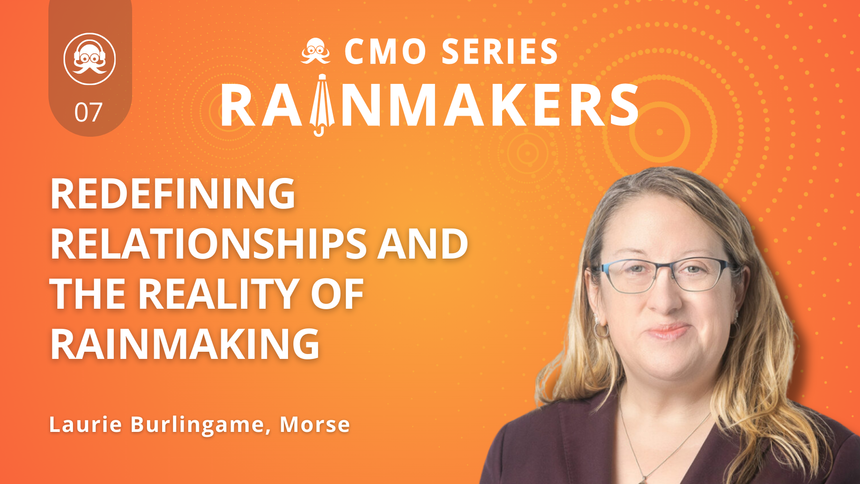
In today’s CMO Series Rainmakers episode, Alex Haidar is joined by Laurie Burlingame, a Corporate Partner at Morse, who shares her grounded view on what rainmaking really looks like in this current legal market as proactive networking becomes more crucial than ever.
With a background that spans science, an MBA in finance and accounting, and nearly two decades in Big Law during the explosive growth of Boston’s life sciences sector, Laurie has built her practice at the intersection of technical complexity, capital, and client trust. She shares her hard-earned advice on the importance of valued relationships, having a clear understanding of shifting client expectations, and why thought leadership is a non-negotiable for leaders.
Alex and Laurie discuss:
Her scientific approach to client problem-solving
The effect of AI on shifting client expectations
How to maintain momentum and stay top of mind with clients
The importance of cross-selling to build trust internally
Structural differences between Big Law and smaller firms
Effective networking to build long-term relationships
Transcription:
Alex: Hello everyone. On today's episode of CMO Series Rainmakers, we speak with Laurie Burlingame, a Corporate Partner at Morse Law, who brings a sharp, commercially grounded view of what rainmaking really looks like in today's legal market. With a background that spanned science, an MBA in Finance and Accounting, and nearly two decades in big law during the explosive growth of Boston's life sciences sector, Laurie has built her practice at the intersection of technical complexity, capital, and client trust. Her deliberate move was informed by both her emphasis on valued relationships, and a clear understanding of shifting client expectations. Today, Laurie shares her hard-earned advice on building relationships before you need them, staying relevant when deals slow down, and why consistency matters more than short bursts of visibility. We will delve into what clients value now, how firm structure shapes incentives and behavior, and why thought leadership is a non-negotiable to become an indispensable, trusted advisor.
This episode is brought to you by Cross Pitch AI, the new cross-selling tool from Passle. Cross-selling should be the easiest way for law firms to grow, but most firms struggle. Why? Lack of awareness, lack of trust, and frankly, fear of selling. The result? Missed revenue. Cross Pitch AI fixes that. It breaks down silos, helps professionals connect, and delivers timely, relevant insights to the right people inside the firm and out. There's no heavy rollouts, just switch it on and try it today. Head to crosspitch.ai to book your demo and make cross-selling happen. Now, back to the Podcast.
Alex: Laurie, welcome to the Rainmakers Podcast.
Laurie: Thanks so much, Alex. Really happy to be here today.
Alex: Yeah, happy to have you. Now, Laurie, you've taken, I guess you could say, an unconventional path from science to an MBA and then into law. So, I'd love to learn more about how does that background shape what you think in terms of value, risk, and problem-solving with your clients.
Laurie: Yeah, I think that, you know, I spent probably like five years in science before I actually went into business and law, and so I have a really unique understanding of the life sciences industry, and the risks and the complexities associated with that industry. Unfortunately, it's a really capital intensive industry and there's almost never enough money to get the R&D done that you want to get done. So, I bring that sort of understanding to client problems and understand that, you know, the last thing that people want to do is overpay for legal services. They want the right advice or the best advice they can get, but they don't want to be spending money that they could put in towards research and development, towards lifesaving drugs, or lifesaving medical devices. So, that was always top of mind for me. I love this industry because I love what they're doing. I once had a client who developed a miniature-sized device that used to take three or four rooms in a hospital into one room, and it was responsible for treating a lot of pediatric-type cancers in a more efficient manner, and with less secondary chance for secondary cancer later on. So, these sorts of things that I've seen really want me to be able to help them in the most efficient way possible to help drive forward things that matter to me, and I think matter to society.
Alex: Yeah. That's awesome. And I know we've talked about how you mainly work with those emerging and growth stage companies and they're, like you said, under a big cost pressure. So, I guess you kind of touched on it, that clients are pushing back a little bit on the, maybe the cost of legal services, but what else are clients pushing back on right now and what does that mean for how lawyers should shift the way they operate going forward?
Laurie: Yeah, I mean, I think they also want to have an advisor that they trust that someone's not trying to just sell them something extra, but that they really need it. And the other thing is, you know, people are now being advised by ChatGPT, whether or not we like it, they will be asking questions of ChatGPT or other AI devices. And so, they were telling them what they should or should not be doing. Sometimes that advice is right and sometimes that advice is not right. So for example, on a recent deal, I had someone, ChatGPT tell them, that they didn't need this analysis around parachute payments because the payments were gonna come, the large payments were gonna be post-closing of a merger. But that advice is actually incorrect. The post 12 months of a merger, you still count the payments that could come in. And so, if we hadn't explained to them the consequences of not doing this type of analysis and potentially getting a 20% excess tax charge on those excess payments, they probably would've told us not to do it, right? But I think that there is a need to guide clients to, we're not just trying to make this work for you, we actually are trying to help you achieve the goals that you want. And I think that, Alex, that only really comes with trust, that people trust that you're doing the right things.
For example, you know, if you have a services agreement and you tell someone it's gonna cost $50,000 to analyze that services agreement, I think you're probably not gonna get as much trust if you're like, well, it's probably gonna be 5K, right? And it might be more if there's something really complicated. I think that you need to help people understand that you are going to meet their objectives, and a way to meet their objectives is to understand what really matters to you, in a contract or a transaction. Do you wanna fight every point or do you wanna just get your key points, right? It really is important to understand because I think sometimes as lawyers we're like, yeah, we have to win every point, 'cause being type A most of us, but the reality is that may not be the client's desire, right? They may want to get something done quickly without excessive risk to them, or they might be willing to take more risk because it's a strategic area that they really need to get into. And the only way to really know what level to do is to delve into what they want, and I think sometimes lawyers are adverse to sort of get into the business context. But I do think it's really important to understand the business context and what your particular client wants, under all circumstances.
Alex: Great. That's a really interesting example about, you know, clients using AI and the lawyer now is not just taking on the matter at hand, but also trying to deal with the client's, I guess, skewed understanding from what AI is telling them. That's really interesting and I hadn't really thought of that. Now, I think we had also spoken about, obviously, the life sciences sector in Boston over the last 20 years, and basically in my lifetime I know it really boomed and then recently it kind of slowed, and then maybe it picked up during COVID, and then recently slowed. So, I guess when the market slows or your industry slows, what does effective rainmaking actually look like day to day? And what are some practical steps lawyers can take to maintain momentum and stay front of mind with their clients?
Laurie: Yeah, it's a great question, Alex. I think that definitely there was a boom time, I think in 2021, I wasn't leaving my kitchen table 'cause I had so much work to do, so there was nothing additional that I could do. When things slow down, I think it's important to realize that you still need to get yourself out there and be visible. Whether it be writing thought leadership pieces on, what are particular things to look for in certain agreements? What is the fundraising climate like right now? How do you do your best pitches? How do you decrease costs in this, sort of, environment advising on what legal things clients should keep up on? So, there's that thought leadership piece and there's just pinging people, right?
It's a great time to actually meet up with clients, to grab coffee, to grab lunch because they too might have more free time. Try to figure out what it is that they're concerned about, how much cash do they have left? Can you introduce them to anyone to help them? Have they thought about other sources of funding, such as grant funding, clinical trial funding, royalty funding? So there's a lot of things that can be done, it's more of turning yourself to be more outward facing and interacting with clients in any way you can. I think it's also a good time to go to events that you may not always go to, networking mixers, talking on panels if there's that possibility or you like talking on panels. But, I think that what we're seeing is that the number of contacts you need to not only get a new client, but also to keep a client, they're increasing, increasing a lot. It used to be three or four, and now it's 10 to get a new client, right? And even then it could be more, that's just an average. So, you really do need to be out there, talking with people, making yourself known, especially in such a crowded space and Boston life science market, it's a really crowded market for lawyers.
Alex: Now, if I can just go off of what you said there, right, about how many, you said touchpoints to get to a new client, and how you really need to stay visible and in front of them, how does that translate into where law firms are looking, in terms of where they're getting their business, and cross-selling, and trying to focus on building the relationships they have with their existing clients?
Laurie: Yeah, exactly. I think a lot of firms will say the best source of business, right, is actually cross-selling to clients in the firm that are doing some business, but not doing all the business that the firm offers. So I know that's a big buzzword, about cross-selling. I think sometimes, you know, people say that that's there, but actually there's not a lot of thought brought into how to do it. One struggle I had found when I was in a bigger law firm is that, you don't actually know who owns the client sometimes, you have to do a lot of digging, and then you may not know that person who actually has the direct client relationship. You try to talk to them and then they actually have to trust you as a person to wanna introduce you to them. So, not only do you have to have the outward client facing skills, you also have to have the inward client, in that your other partner skills to build the trust and relationship to bring that work in. So, I think it only works sometimes, right? I think that there's a lot of pressure on people to keep clients that they have, especially given the metrics that there are in big firms right now about productivity and revenue generation. So, the fear is if someone introduced you to your client and something goes wrong, right? That client may no longer trust you, and so then your sort of productivity and revenue numbers are on the line.
So, I saw a lot of that, kind of, pushback in some big law situations, which is unfortunate because quite frankly it is one of the best ways to get clients is to just introduce them to somebody else. So, I think what lawyers have to do is they have to find those trusted people within the firm, right? If you're a corporate lawyer, who do you trust in employment? Who do you trust in ERISA? Who do you trust in tax? And really build that strong internal funnel that you understand and build these cross-functional teams where you're willing to bring in people early and start, you know, pounding the pavement on cross-selling as much as possible. Of course there are different strategies too, I mean, smaller firms you may be looking towards, let's look for those segments of clients that are being underserved by larger firms or that they really can't afford the larger firms because they don't have the revenue right now. So, you know, that presents different challenges. The different challenges are, okay, your name may not be as known in the market because you're a smaller player, but you can offer them a much cheaper price point, even with many more years experience than who they might get as their primary person in a larger firm. So, it's sort of finding ways to make yourself relevant to those folks and targeting that exact market segment.
Alex: Right. I mean, there was so much there, especially about, like you said, that level of trust between lawyers and something a lot of the bigger law firms are really struggling with is having that trust of knowing, first of all, knowing who else at the firm might be able to help on a certain client, but also not wanting to step on anyone's toes. I guess having worked in both, and you spoke about it there a little bit, but how does the firm structure change in between big law and a smaller firm, in terms of who gets rewarded for rainmaking and how that business is really built?
Laurie: Yeah, I think probably in the smaller firms so far in my experience, there's less real concern about who's getting credit, and more towards, there's few of us here in general so we all really need to work together to get things done for the client. I mean, in my current firm, there's not three people I can go to for employment, there's one or two, I mean, not like 30, there's like one or two people I can go to, right? So, I think that trust building is a little bit easier because you know exactly who your peers are and who's gonna help you to do it. I think in big law the hierarchy makes it very difficult. And also, like I said, I'm not saying there's not metrics in smaller firms, there are metrics, but I think it's not as rigid metrics. It’s that understanding that you could have a down month and then the next month could be better, right? So, I just think that when you have a large number of people and you're spread over multiple geographies, that also adds a barrier. The people that you may wanna introduce them to are in California and you're in Massachusetts, and somehow you have to convince the California people that you're trustworthy out in Massachusetts. So, it can just be a lot more difficult than if you have a small office and you know who everyone is because you see them every day or every three days, and you go to meetings with them more often.
Alex: Yeah. If I can shift a little bit now, I'd love to, I mean, you could take away a lot of what you've said as advice, but if you were to summarize one piece of advice you would give to a lawyer who's starting out in their career who wants to build long-term leverage, and not just hit those short-term numbers, what would it be?
Laurie: I mean, a hundred percent Alex, it would be, you have to be out there networking. Quite frankly, I feel that I failed that, sort of, bridge when I was a junior associate. I was just focused on the doing and getting stuff done, and I feel like in billing hours. And I think the advice that I sort of got was maybe not the greatest advice, that that's what you should be doing, as opposed to going out to events and building your own stuff. I mean, obviously those people who win in the marketplace, if you wanna stay in any form of law partnership long term, are the people who have the business. They're gonna be the most sought after, and the most able to move to new opportunities are the ones to stay in opportunities because they have the power and the leverage. And so it really is important to be comfortable with networking and finding the source of networking that works for you, right? So, I think the other thing is when you think of networking, everyone thinks of these big conferences and being able to introduce yourself to 300 people and hand out business cards. Well, that probably works for some people, but not everyone.
You may be more comfortable with doing small lunches or one-on-one lunches, you may be more comfortable with zoom meetings, but you may be more comfortable joining a woman's network if you're a woman and getting known that way. But you have to find some way to do it. And I know it's really hard advice because when you're on an associate number of hours and you don't have much control over when the work comes in during the day, like a lot of times I remember would come in later in the day. So then, if you wanted to go out to something in the night, it would be very difficult 'cause you had to turn something around quickly. But there is a need to find a way, and it might be tacking on with a more senior associate or a partner saying, help me, help me, tell me what to do, please take me to something, right? Building those relationships where people are comfortable doing it, because I think, I mean honestly, that is the one piece of advice that I think is a hundred percent. You have to build relationships. This business is all about relationships.
Alex: Yeah, and I couldn't help but remember when I met you at the LMA Boston panel, you shared a great example of, just that basically. You didn't feel like you worked right in those big conference settings, and instead, you'd rather like to go build a personal relationship one-on-one with someone. And clearly, you know, it worked and it's something we can all learn from, do what works for you.
Laurie: I completely agree, Alex. For me, the smaller things are better. I've done the big conferences and I feel like it doesn't provide much ROI. Some of the more successful events, for example, I feel are I did a woman in bio outing in our box at the Red Sox game. I thought that was super successful, I still keep in contact with probably half of the people that went to that game. I've gotten business out of three of those people that went to that game. So, you know, I think that type of event where it's fun and you feel comfortable in that setting. Just find what you like to do and run with it.
Alex: Awesome. Well, Laurie, it's been an absolute pleasure talking with you. I'm really glad we were able to connect, and thanks so much for joining the Rainmakers Podcast.
Laurie: Thanks so much for having me, Alex. I appreciate it.
Alex: Awesome.
You can follow the Passle CMO Series Podcast on your preferred podcast platform. Thanks for listening, and we'll see you next time.
/Passle/53d0c8edb00e7e0540c9b34b/MediaLibrary/Images/2025-06-24-15-50-59-531-685ac963d81bf11b7522dd8e.png)
/Passle/53d0c8edb00e7e0540c9b34b/MediaLibrary/Images/2026-02-19-10-59-38-400-6996ed1aed31acc93b1374e7.jpg)
/Passle/53d0c8edb00e7e0540c9b34b/MediaLibrary/Images/2026-02-06-09-51-38-685-6985b9aad97369bdf1cfdab6.png)
/Passle/53d0c8edb00e7e0540c9b34b/MediaLibrary/Images/2026-02-16-11-30-26-181-6992ffd2534f9d645f278236.jpg)
/Passle/53d0c8edb00e7e0540c9b34b/MediaLibrary/Images/2026-01-26-00-33-49-963-6976b66dc26ba4a239c0742b.jpg)