
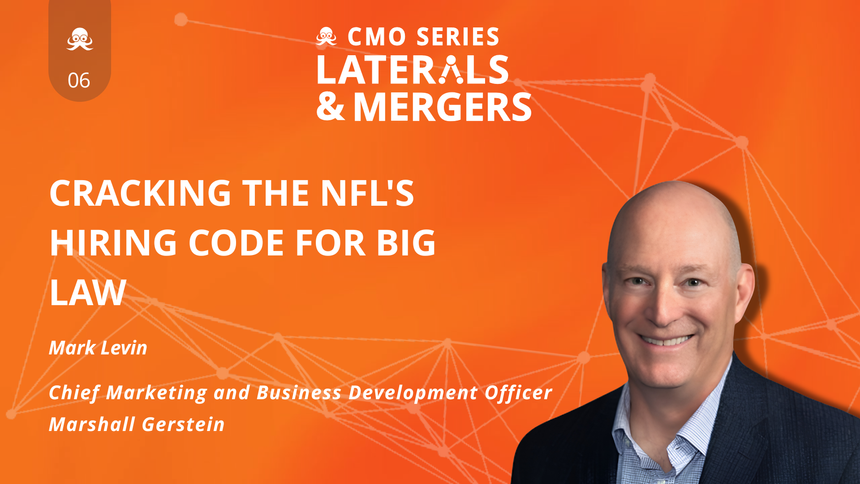


Lateral hiring is currently at an all time high and the cost of getting it wrong runs into the billions, so why are firms still making critical hiring decisions without using the right tools to get it right.
This week on CMO Series: Lateral and Mergers, we are pleased to share this brand new episode. Eugene McCormick is joined by Mark Levin, Chief Marketing and Business Development Officer at Marshall Gerstein, Chicago's largest IP boutique firm. Mark has spent his career studying what makes legal talent succeed or fail, and led him to run a psychometric assessment company working with NFL Combine teams and AmLaw 250 firms.
Mark shares his journey into talent assessment and development, what the legal profession still gets wrong about lateral hiring, and why IP attorneys present a unique challenge for any BD leader.
Mark and Eugene dive into:
- His journey from law into psychometric assessment, and what the NFL Combine taught him about predicting talent
- What the legal profession still gets wrong about lateral hiring
- Why the true cost of a bad lateral hire runs so much deeper than the recruiting fee
- Why IP attorneys present a unique challenge for any BD leader
- What it actually takes to build a business development culture that sticks
- The tools firms need, but rarely use, when making high stakes hiring decisions
Transcription
Eugene: Hello, folks. Welcome to Laterals and Mergers, a new podcast from the Passle CMO Series team, where we focus on the hot topic of lateral hires and law firm mergers. Now, I'm delighted today because we are joined by Mark Levin, who's the Chief Marketing and Business Development Officer at Marshall Gerstein. Now, lateral hiring is currently at an all-time high, and the cost of getting it wrong runs into the millions and sometimes to the billions for the biggest firms. But why are firms still making critical hiring decisions without the right tools? This week we're gonna try and answer just that. My name's Eugene McCormick, and as I said before, I am joined today by Mark Levin, Chief Marketing and Business Development Officer at Marshall Gerstein.
Charlie: This episode is brought to you by CrossPitch AI, the new cross-selling tool from Passle. Cross-selling should be the easiest way for law firms to grow, but most firms struggle. Why? Lack of awareness, lack of trust, and frankly, fear of selling. The result? Missed revenue. CrossPitch AI fixes that. It breaks down silos, helps professionals connect, and delivers timely, relevant insights to the right people, inside the firm and out. There's no heavy rollouts, just switch it on and try it today. Head to crosspitch.ai to book your demo and make cross-selling happen. Now back to the podcast.
Eugene: Now Mark has had quite a career, from being trained as a lawyer to running a psychometric assessment company that worked with NFL combine teams and Am Law 250 firms, and he's even spent his career studying what makes legal talent succeed or fail. Quite a varied background and definitely unique. We're gonna explore Mark's professional journey, talent assessment, development, and what the legal profession still gets wrong around lateral hiring, why IP attorneys are different, and indeed what it takes to build a successful business development culture.
Mark, welcome.
Mark: Thank you.
Eugene: Awesome. We're gonna dive straight in. Can you please tell us a little bit about your path to Chief Marketing and Business Development Officer? Because I think it's fair to say it's, it's not the typical path. Can you tell us about your background, some of the different experiences, and maybe which of those experiences you may draw on day to day?
Mark: So yeah, probably not the normal path. Let's see. After college, I wanted to just go into music management and working with bands and production. I had done that in college. I actually wanted to drop out of Northwestern to continue that, which thankfully my dad talked me out of, and I worked for well, I figured I'd go on the straight and narrow, so I did consulting work after college. I hated that. Went back into music. Managed a couple bands, ran a record label, and then, went to law school during that time as well. And then after law school, went to practice thinking, again, that was the straight and narrow.
Came out of law school at a pretty terrible time in the market. I got into insurance defense law, which I absolutely hated. Ran into my Westlaw account manager on a train and said, "I hate my job. You seem to like yours. Tell me more about your job." And then I, from there, went to work for Westlaw, which became Thomson Reuters or got bought by Thomson Reuters. Thomson, after a while, sent me back to business school. Went to business school at Northwestern, and then, you know, tried to just stay away from law as much as possible, and failed in every realm pretty much. I ran strategy for a couple TR companies in the West Education Group area, mainly in law school spaces. Then from there, I went into business development consulting. I worked with Akina for a while, and then got hired by one of my firms at that point to run their marketing department, and ran marketing at Levenfeld Pearlstein and Neil Gerber & Eisenberg. Got out of that to run a startup for about five years, and that startup was called ‘The Right Profile’, and that's the one you sort of alluded to, which did basically high-risk hiring both in sports and in law.
Eugene: Mm-hmm.
And then yeah, left that when we had our, when my wife and I had our second kid, and got back into law firm business development. So there's the random walk on the whole thing. But all of it gave some pretty interesting-
Eugene: Mm-hmm ...
Mark: background into how to actually do more at a law firm. And, you know, it's funny, there's probably not a day where marketing bands doesn't somehow come into marketing a law firm and understanding how fans work and how you leverage your fan base. And there's also not a day where running a psychometric company and sort of having a knowledge of psychology doesn't come into that as well, so.
Eugene: Yeah.
Mark: Yeah, a random walk that comes into one, one spot, I guess.
Eugene: Yeah. I particularly enjoy, Mark, that your consistent efforts to, A, find the straight and narrow, and B, avoid law, and you've failed miserably in both of them, so I have,I commend you on that.
Mark: I'll never hit the straight and narrow, I guess. Oh, well.
Eugene: Of course. Look, reflecting on your career journey, you just mentioned there about the, you know, you draw on your experience from the psychometric business. You draw on your experience from managing bands. Obviously, your legal training gives you a pretty astute view of what is required from a client perspective, you know, what they need, and also what the lawyer is capable of doing, and it's the sort of perspective most marketing and BD leaders don't think they quite have that. Can you tell us a bit how that shapes the way that you understand, firstly, your attorneys, and B, their relationship with business development as well?
Mark: Yeah, so I mean in the highest level of the whole thing, our entire purpose for being is to serve a client and to help them through their needs. So when you think about, like, why anyone hires us, if we can't convince the client that we are useful for them, that we are going to help them achieve their goals, and that we can do it in a way that, you know, the client's going to understand and feel valued across the entire spectrum, then we're not gonna have a client.
And if we don't have clients, then eventually we're not gonna have a firm. So I think my attorneys are pretty good at recognizing that. But a lot of times, like anything, you get lost in the work and you sort of forget the, you know, the human aspect of it. You keep your mind on the business side of the whole thing and what the numbers are at the end of the day, and for us what those patents look like and how you protect it and how you build a thicket and everything else.
Eugene: Mm-hmm.
Mark: But at the end of the day, you still need to know that the client is feeling valued throughout all that, and that they're understanding why we're doing all these things.
Eugene: Yeah. It's, yeah it's exactly that sort of retaining the human element. And you work with so many subjects like deep, deep subject matter experts in a way which even transactional, traditional, you know, full service law firms aren't doing. It's such a, it's like expertise on a whole different level and minutiae of expertise. So yeah, it's sort of retaining that human element that is still really important.
Mark: Yeah. Well, I mean and sort of tying it back to some of the other experiences, you know, I mentioned leveraging a fan base and understanding your fan base. Like when I worked with bands, there was always that connection, that attempt to build community, that attempt to have other fans bring in more fans, right? So you were able to really leverage who was there and get them involved in the music, and you knew who the super fans were because they were singing along to the song the second time that you ever played it.It just was one of those things that, that you could see who was going to bring others to the show, and it's not terribly different in the legal realm, right?
Eugene: Mm-hmm.
Mark: No one knows your songs necessarily, but you need to understand who the people are who are going to stand up for you and always say, "Hey, you know, Eugene's a great attorney."
Eugene: Mm-hmm.
Mark: "And you have a problem that I know he can help solve." So that leveraging the fan side is always sort of fascinating. Getting people to understand that they're rock stars in their own right is sometimes sort of tough because that's not the way they're wired, but they get it usually.
Eugene: It's interesting as well because you talked about the balance thing, and then obviously you had a running that psychometric assessment company and working with NFL combine teams, and I think you wrote an article in 2015 talking and making comparisons almost that law firms were approaching hiring the wrong way. They could learn lots from the NFL draft. Yeah. It's very topical. Obviously everyone and their dog is hiring at an unprecedented rate. I think Law.com said that the 2024 to 2025 numbers, I think there were 19% more of like lateral hires in 2025, and that was a record year, and 2026 is on track to beat that again.
In your opinion, a decade after you wrote that article, what's changed? Has anything changed? Are law firms still falling into that same trap?
Mark: Yeah. So as far as I can tell, right? My job is not exactly to oversee any of those things, but as far as I can tell, it's pretty similar to what I saw in 2014, 2015. So that article is for anyone who wants to, to dig it up, and there are a few different takes on that. There was an American Lawyer article, a Law360 article. There was a write-up in Crain's or a write-up in Forbes, like different variants on that, but all of them get into the numbers that basically are staggering.You know you think of the NFL as this huge high-risk hiring problem, and it is, and I'll go into that in a second. But the numbers for law as an industry just completely dwarf the NFL. Like there are more, there are more transitional hires and numbers made in law than there are for an entire NFL salary.
So it's big stuff. And so when we ran the right profile, the psychologist that we had involved was a guy named Bob Trotwine. Bob made his name on the Peyton Manning and Ryan Leaf decision. And helped the Colts choose Peyton Manning. And, you know, a lot of listeners will be like, "Well, that seems obvious because who the hell is Ryan Leaf?" But Ryan Leaf was thought to be the obvious first-round draft choice, and Ryan Leaf went on to have a, a career that took him to the San Diego Chargers where he was abysmal and really sort of tore at the fabric of that entire organization and, you know, it took them probably five years to recover. And again, those are just my comments, not anyone else's comments. But -
Eugene: Mm-hmm
Mark: You know, you can run through it and see what your take is on the whole thing too. But those types of decisions, you can see similar things on poor lateral hires too. These are high, high risk, high outlay types of decisions. And unlike NFL teams, they're made on probably even fewer metrics than what an NFL team gets to see. So we worked with teams at the Combine, and at the Combine teams were there looking at physical characteristics. So every day on the field you're seeing drills, you're seeing you know, if you're a quarterback you're seeing passing drills, passing to different receivers who are running different routes. You're seeing, you know, metrics around bench press and runs and, and whatever else it may be.
Eugene: Mm-hmm.
Mark: So there are actual physical things that you can watch. What you don't get to see on the NFL Channels, there are also interviews every single night and there are batteries of psychometric assessments during the day. There are also batteries of PR and media interviews throughout the day too, and each team is watching every one of those interactions. And in all of those interactions, you're getting more and more of a report. So I was lucky enough to have the opportunity to actually sit in on interviews with the Miami Dolphins when they were first using our assessment and integrating that into what they knew about the players and what their interviews were that night.
So I got to see offensive line interviews and take part in those, and they were basically watching film, the coaches watching film and then asking players why they chose certain actions that they did. And they had our assessments in front of them to sort of understand basically what decision-making processes that person might have, what their go-to reactions might be. And then on the flip side, now ask someone about these things. And, you know, there was one that was really sort of fascinating where they asked a kid, you know, "Why did you, why did you go left when the play went right there," right? It wasn't exactly that but what happened? What was the breakdown in communications?
Did that come through from your team? Was that something miscalled in the huddle? What happened? And you can think of the myriad of choices that can come up from that conversation, right? Like you could say, if I said, "Eugene, why, what happened there?" You could say, "Well, it's all my mates," right? Like, "We're in the huddle, they told me everything was going this way-
Eugene: Mm-hmm
Mark: And that's what I followed." Right? If you look, think of that from a teamwork perspective, not so great. Eugene just decided to blame everyone else instead of taking responsibility for it. In this one that I'm thinking of, immediately the player sort of fell on the dagger and he said, "That was just me." And they pushed back, the coaches. They said, "Well, where did that come from? You know, you were beaten on this play. What happened to that?" And he said, "It was me. I misread it. I didn't, it wasn't something that came in wrong from the huddle. That was all me." Okay? So there's taking responsibility for it on the teamwork side of it.
Then what did you do next? He said, "Well, I, I didn't get beaten again." Right? Like, "I knew what that guy was going to do each time. I did not beat the rest of that game." And you sort of went through those types of things to learn more about that player, the way he dealt with adversity, the way he dealt with taking responsibility for a problem, and the way that he reacted to it to become better. So now superimpose that over a traditional law firm, uh, hiring process. So I get numbers in the combine, right? I can, I know what a bench press weight is. I know what the number of catches are, in any of the routes and how well they were run. I know, I know a 40-yard dash time. I know all of these quick things.
Eugene: Mm-hmm.
Mark: And I watched them actually happen so at a law firm, like you obviously didn't watch a lateral perform his job or her job in another place. You get some metrics, right? Like what the book of business might be, but it's pretty much unverified. You don't have that luxury of knowing exactly what's going to happen or how much business is going to come over. You may not discount it as much as you can. And then, a lot of times the actual hiring process, the little bit that you do have for interviews and so forth is really unstructured, right? There's no film that you get to watch and say, "Hey, how did you work with this client?" Right? That, that isn't there.
But you can dive into some of those things, and a lot of times that's done through panel interviews at some firms, not at many. But tell me about this matter that you dealt with. Tell me about a time when you, when you came up with a really different outcome than you thought you were going to. Tell me how you handled that.
Eugene: Mm-hmm.
Mark: It's sort of funny, like Marshall Gerstein does that for a lot of staff panel interviews and so forth, and we've adopted it for attorney interviews as well. But I don't think that many firms actually do that, and a lot of times it's sort of cursory. It takes a back seat to how someone, some champion within the firm may think that that person's actually going to do. And I think at the end of the day, you end up with lateral decisions that still remain, at best, a crap shoot, flip of a coin as to whether somebody's going to be accretive or just a bust.
Eugene: It's a lot of, yeah, it's a lot of gut checks and stuff, and sometimes they're good and they're pretty expensive mistakes when they don't work out.
Mark: Really expensive mistakes, and a lot of times they eat at, at culture. You know at a prior firm there was a no asshole rule, and then that was breached for one of the lateral people that came in, and you look and go, "Huh, I don't think that was worth it in the initial decision." And then as it played out, since no one got along with the new lateral, it didn't really work well at all. It was hamstrung from the very beginning. That cultural piece was never considered.
Eugene: Completely. That culture piece is really interesting, and it's maybe a nice segue because one thing that you and I have spoken about before is that sometimes these attorneys, especially in IP firms, can be quite introverted. For a Chief Marketing and Business Development Officer trying to build, like a genuine BD culture at a firm full of specialists, how do you achieve that? Like what is your reality when you're hiring or you're developing attorneys? Like how do you fight against maybe what is the classic IP profile that you might see in an attorney?
Mark: You know, it's funny. I don't think IP attorneys are necessarily any worse at business development than any other practice. It's really just helping people figure out how they're going to be effective at business development. Helping them find something that fits into their normal way of running their life, into their life to such an extent that it's, you know, it may still be work to do, but at least it's enjoyable work to build business. The beautiful thing about IP attorneys is there is, especially in life sciences and chem and a few other areas, there's so much knowledge that not only are these people who know a lot, but they're also willing to understand what they don't know and sort of pass that along to someone else.
Eugene: Mm-hmm.
Mark: And say, "Hey, marketing's not my thing. It's obviously yours. Tell me how I work on this, and let's figure it out together." And that type of humility doesn't exist in every practice in law. So, you know, but the overall goal for at least in every firm that I've been in is to try to have business development everywhere all at once, so that, you know, if you look at it as a, you know, sort of an overall organization, everyone is one of your salespeople. Every, for us, every tech spec, every attorney, every paralegal, whatever it is. If you build enough of a culture, it's a culture that helps understand what we do as a firm and where we can make those where we can make those introductions to clients or prospective clients and, and actually help people out.
And that does work for us. We'll see, you know, prospective client relationships that come from just beyond the attorney ranks, and that's fantastic. And then we see a lot of those things closed by attorneys, right? It's to help people get to their messaging of what they do and how they can help people, and do it in a succinct enough way that it's not just a lot of blathering.
Eugene: Some of this, you, it's a bit of a something you hear quite a bit talked about now about the, the client-attorney relationship, the firm's relationship, institutionalizing the relationship and things like that. At Marshall Gerstein, where your brand is about that individual IP expertise, and you did speak in the, just in your last answer about leaning on colleagues and sharing knowledge. How do you find that there's a tougher balance in that the attorney owns the client relationship versus the firm owns the relationship, or is it the same as other firms you've worked with? Because there is, there's so much reliance in your firm like in any other on that individual expertise and the trust in that relationship. Do you find that tougher in IP?
Mark: I don't really find it tougher in IP than anywhere else. You know, again, getting to that concept that everyone brings something to the team. I think there is a recognition that there are others within the firm who have that knowledge. And it may be that the person who brings in the business is just really good at understanding what, you know if she's in transactions and meeting people who need help in life sciences, she's good at understanding enough of life sciences to help sell that work to say, "Hey, I have really good people on this point, and here they are." So we have those types of broad relationships that come in. And you know, everyone, everyone mentions cross-selling at other firms and wanting to make it better. We work on that all the time. We have-
Eugene: Mm-hmm
Mark: Partners from one practice group and you would think that, like, you know, I sort of thought of going to an IP firm. You'd just be looking at it going, "Great, I only have one practice group now." But you know, nothing in life is as simple as you would think from the outside. So when you get to an IP boutique, there's still different practice groups with different technologies. So one person who does more of our IP transactions may be selling work for life sciences or for electrical or, you know, touting our AI group or whatever it may be, and they're good at that.
And that expertise, even once it gets to the particular attorneys who are working on that particular technology the best, there's still a recognition for the broader team, and that broader team includes not only other attorneys, but, you know, for us the tech specs, the paralegals, everyone who may help give enough bandwidth to get all of that work across the finish line to the client's benefit.
Eugene: I'm conscious of time, so I wanna ask you one final question, which is this: you've seen firms from the inside, you've built your own business, you've studied legal talent for years. Looking across all of that and the different firms you've worked at, can you tell us what are the characteristics of a firm that you feel is really nailing business development?
Because growth is this, there's an insatiable appetite for growth, and the main way of doing that is business development, it's growing through acquisition, it's hiring more good people, and it's selling more to your existing clients. What are the characteristics of a firm that can do that, in your opinion?
Mark: Yeah. So I think to be successful, especially now, you need to have a certain amount of adaptability and sort of that willingness to recognize that whatever worked yesterday or last year may not be the thing that's getting you any further today or tomorrow. You know, we've had that shift around, around AI basically, and AI search and how people find us. And over the last, well, probably three or four years, really, yeah, probably three years, we've seen so much work just sort of show up on our doorsteps, which is crazy. You know, electronic doorstep, basically. But people calling with legitimate, you know, legitimate business that they need help on cold outreach through email.
And some of that will occasionally be from someone's personal email, and you're looking and be like, this person says that they're, they're the GC of this company- What's going on here? But it's, it's sort of that, that recognition that, um, you know, they're finding us through AI search. They've done all of their vetting through other people. You know, they've, they did all of their research before they ever reached out by email. And that research is, you know, finding us initially, then talking to a colleague, then having that colleague sort of talk to another colleague, and eventually they know everything about us by the time they reach out.
And then for us, it's the vetting side of it and going, "Okay, this person is legitimate. How do we understand them, and how do we get up to the same level of knowledge that they have of us so that that first call, that first outreach is, you know, as good as they expect it to be?" And then, you know, the minute that all of that starts seeming like you have it under control, there's something else that drops in that adds another layer of complexity, and you need to, to understand where you're going. You know, we do a lot of discipline around conferences and making sure that we're sending people to the right places and trying to make sure that we're getting the most out of our time as well, and that gets into, you know, ROI discussions and return on effort and everything else. And it's just, it's all discipline to try to get it done.
But it all starts with that sort of humility of like, "You know, I don't know all the answers, so let's try this, and let's figure this out, and let's... Where we find out that something was not the right way of going, that we adapt to get to the right thing." Yeah.
Eugene: Mark, thank you very much.
Mark: Thank you, Eugene. This was fun.
Charlie: You can follow the Passle CMO Series podcast on your preferred podcast platform. Thanks for listening, and we'll see you next time.
/Passle/53d0c8edb00e7e0540c9b34b/MediaLibrary/Images/2026-01-12-10-16-56-904-6964ca18ab784af100f11853.jpg)
/Passle/53d0c8edb00e7e0540c9b34b/MediaLibrary/Images/2026-10-07-08-46-06-090-6ac606ceca13bbdc45585981.png)
/Passle/53d0c8edb00e7e0540c9b34b/MediaLibrary/Images/2026-09-24-16-11-56-185-6ab54bcc4e2b53dc04f61fda.png)
/Passle/53d0c8edb00e7e0540c9b34b/MediaLibrary/Images/2026-09-28-10-00-52-513-6aba3ad4266cd4c9ede6869c.png)
/Passle/53d0c8edb00e7e0540c9b34b/MediaLibrary/Images/2026-09-30-08-24-37-262-6abcc7451f10327d5d828e21.jpg)