

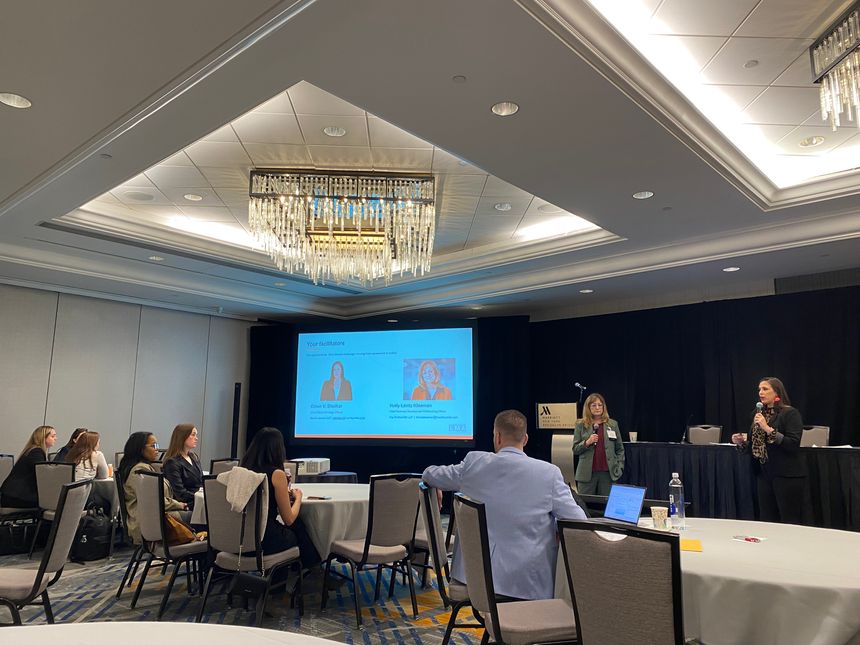

Every law firm has a plan that everyone loved at the kickoff and nobody touched two months later. This workshop at LMA Northeast gave attendees frameworks to assess and keep those plans moving.
Speakers:
- Holly Lentz Kleeman - Chief Business Development and Marketing officer, Fox Rothschild
- Dawn Sheiker - Chief Client Strategy Officer, Morris James
Holly and Dawn worked together earlier in their careers, but at their current firms, they brought two different perspectives to the room: Holly from a firm with 31 offices and thousands of lawyers, and Dawn from a six-office Delaware firm with under 100 lawyers. They walked through three situations most legal marketers would recognize, then had each table work through one of them.
1. The mandate with no parameters
Situation: A mandate to grow a practice or enter a new market with no plan for how the two most important success metrics (revenue and new matters) are going to be achieved.
Holly’s first move is to go back to whoever came up with the idea and ask questions, then meet every committee member one on one before the first meeting. Dawn gave examples of the questions you should ask:
Why are we doing this?
What does growth mean?
Who cares about it?
How will we know it worked?
Early on in your career, the advice is to say yes to everything. Once you have a seat at the table, what got you there will not take you to the next level, and the better question is whether a task is the highest and best use of your time. Even on a smaller team, there are other people in the firm who can have a difficult conversation or make the case for a different approach.
2. The initiative nobody owns
Situation: Firm management wants to cross-sell more practice groups into existing institutional clients, but partners are hesitant to commit and nobody takes ownership of moving it forward.
Because the lawyers involved do not report to marketing, it is easy for them to come up with priorities, but harder to ‘enforce.’ Marketing committees with lawyers on them tend to generate more ideas than action, which is why both Holly and Dawn have disbanded theirs. Holly replaced hers with task forces that have one goal and an end date, and Dawn said that even at a smaller firm, that is how things get done. Her tip was to put the person most likely to say no on the task force, because once they agree, everyone else follows. They also gave the following advice on building accountability with partners who do not report to you:
- Relationships first: Remember birthdays and send a card when someone is having a bad day. People do things for people they know.
- Timelines with owners: Build benchmarks, name owners for each piece, and always ask whether the deadline is reasonable.
- Honesty about workload & progress: If people are not coming to meetings or doing the homework, ask whether you should pivot, reframe it, or table it.
3. The false start
Situation: Everyone agreed on the goal, the plan, and the measures of success. The kickoff went well, but two months later, nothing has happened.
False starts often happen because teams are given the ‘what’ before the ‘why.’ Dawn and Holly both shared lived experiences of false starts; the first was a CRM rollout failure because the team treated it as a technology launch, and the second was an event that only happened to appease lawyers. The scenario on the table was two firms agreeing to a merger, but no clear answer on why the firms combined. If you have had a false start, they shared the following advice on getting a stalled initiative back on track:
- Pause and diagnose: A false start often means the approach or timing was wrong, not the idea. Go back to the basics of why you are doing it, who is sponsoring it, and what resources you actually have.
- Debrief without blame: Tell leadership plainly what went well, where it went wrong, and how it could have been better. What looks like one person’s failure is often missing support from everyone else.
- Continue, change course, or stop: Weigh the pros and cons of each option against what the effort is actually worth to the firm. Sometimes stopping is the right call.
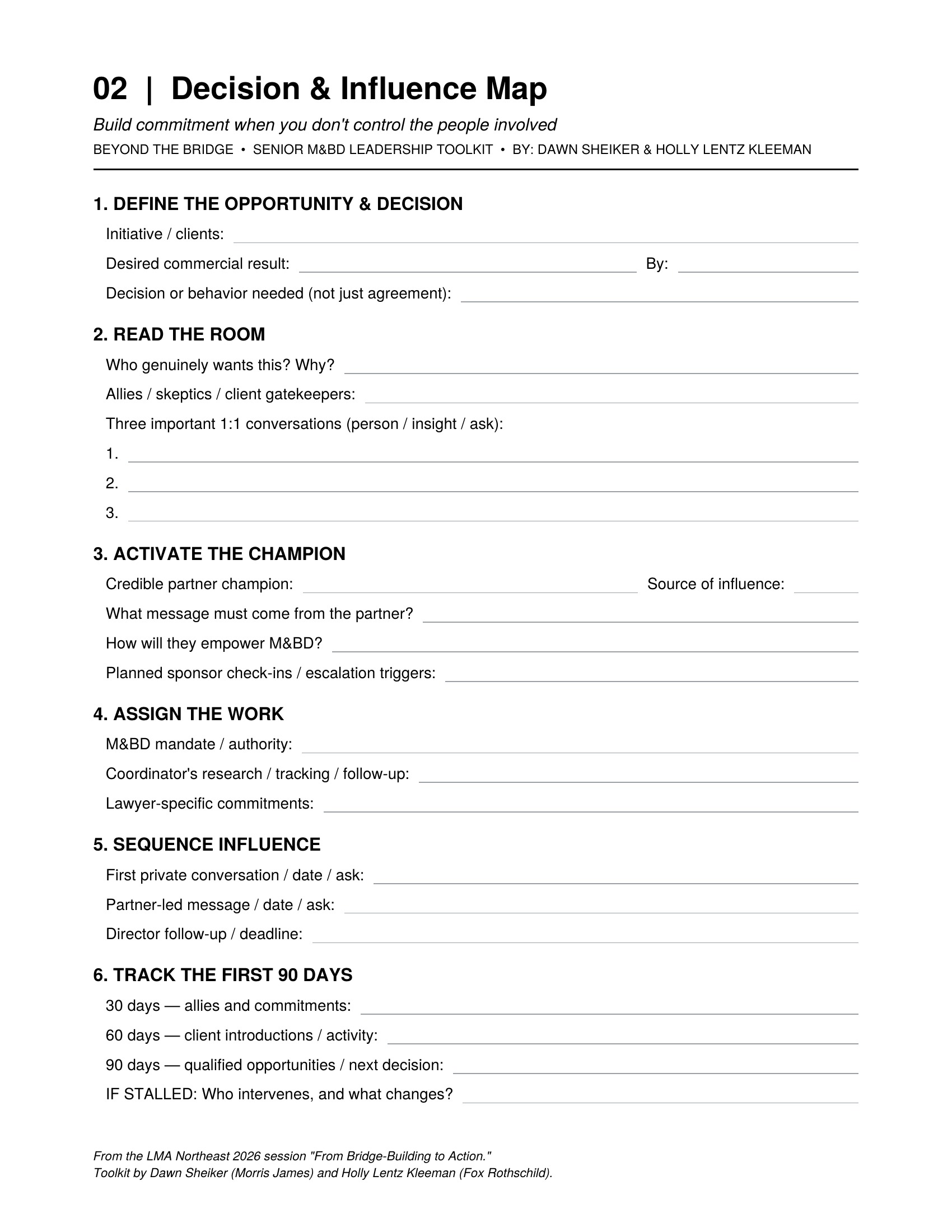
To close, Dawn walked the room through the Beyond the Bridge toolkit she and Holly built, with a framework for each scenario. The one for cross-selling, the Decision & Influence Map, covers defining the commercial result, reading the room for allies and skeptics, activating a partner champion, assigning the work, and tracking progress at 30, 60, and 90 days.