



Creating impactful thought leadership content in a high-pressure, client-driven industry is no small feat, especially when time is tight. But done right, it can unlock career-defining opportunities, from keynote invitations to game-changing client wins.
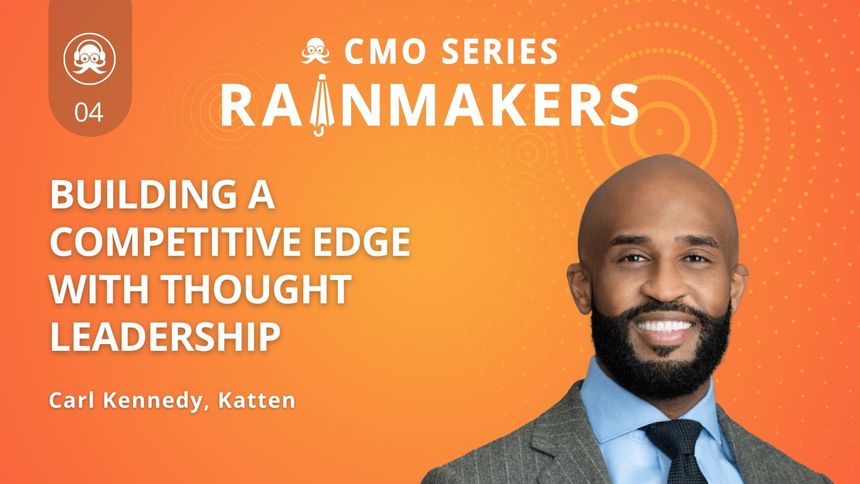
In this episode of CMO Series Rainmakers, Yasmin Zand sits down with Carl Kennedy, Co-Chair of Financial Markets and Regulation at Katten, to unpack how he’s built a standout reputation by consistently delivering timely, authentic thought leadership.
Carl shares the mindset and strategy behind his thought leadership success, including how he balances content creation with client demands and how that effort has led to major speaking engagements, high-profile matters, and a strong personal brand in a crowded market.
Carl and Yasmin discuss:
- The moment Carl realised that thought leadership was worth the investment
- How Carl ensures thought leadership resonates without sounding like everyone else
- What “good” looks like when it comes to expert-led content, and examples of success
- Practical tips for maintaining momentum (even when you’re busy)
- How to embed a culture of thought leadership across your firm
Transcription
Yasmin: Thought leadership isn't just a marketing tactic, it's a strategic advantage. I'm Yasmin Zand, and in this episode of CMO Series Rainmakers, I'm lucky enough to be joined by Carl Kennedy, who's Co-Chair of Financial Markets and Regulation at Katten, and we're going to dive into how he's used content to stand out in a competitive market. We're going to take a closer look at Carl's thought leadership journey, how it's evolved, why carving out time to contribute even in a demanding practice is worth the investment.
Charlie: This episode is brought to you by CrossPitch AI, the new cross-selling tool from Passle. Cross-selling should be the easiest way for law firms to grow, but most firms struggle. Why? Lack of awareness, lack of trust, and frankly, fear of selling. The result: missed revenue. CrossPitch AI fixes that. It breaks down silos, helps professionals connect and delivers timely, relevant insights to the right people inside the firm and out. There's no heavy rollout. Just switch it on and try it today. Head to crosspitch.ai to book your demo and make cross-selling happen. Now, back to the podcast.
Yasmin: So Carl, welcome.
Carl: Thank you. Thank you, Yamin. It's a pleasure to be here. Thank you so much for inviting me to speak with you today.
Yasmin: Of course. Likewise. We're very lucky to have you. We've got a big series of questions that we're gonna interrogate you a little bit, but everybody is dying to know - Carl, we'd love to get a little background about you and at what point in your career did you realize the importance of thought leadership?
Carl: Right. So thanks. Yeah, so I've had a fun but varied journey in my career. You know, some people, they start working at a law firm, or they work at a company, and they stay there for a significant period of their career. I've jumped around a little bit. Not, you know, between firms but also in-house a couple of times, and I've also worked in government. And so the time at which I thought I realized, I came to the realization that thought leadership is really important, is actually one of the times when I was in-house, as opposed to being at a law firm.
Interestingly enough, it was when I was working at a large financial institution, one of the largest here in the US, in-house in their derivatives legal group. And I would receive a lot of really good content from outside law firms and I realized in that moment that I was going to the same firms, because I was getting really good content. It was timely, it was, you know, really well-written and it gave me the sort of CliffNotes version of what I needed to know to do my job. And it was at that point I realized how essential it was for good thought leadership to get in the hands of people who need it, and they need it to digest that information in a, you know, quick, you know, efficient manner so that they could do their jobs more effectively.
And so when I returned to the practice of law as an outside counsel, I realized how important it would be for me to sort of step into that role for ultimately, for firms and individuals who would become my clients. And so that is, and I guess that would be in terms of timeframe. That was around the 2012, to 2016-2017 timeframe is when I realized in-house that, you know, it's really important, that if you're going to be outside counsel, if you're going to be, you know, that sort of trusted advisor to your clients, you need to produce really good content to help them do their jobs.
Yasmin: That's brilliant. And so, Carl, what does producing good content look like to you, because you've been on the receiving end of the good content and now you're delivering the good content. And we're going off the cuff here, but I had to ask.
Carl: Yeah. No, it's being concise. It's being concise. It's being timely. And it's thinking about, it's not just regurgitating what; let's say a regulator, you know, a new rule or some letter or advisory or some guidance that they produce. It's not just restating it in your own words. It's thinking about it from the client's perspective. It's you know, if targeted at a particular type of registration or it's targeted at a particular issue. It's thinking about your client base and how you can tailor it and think through the issues that they will think about it. You know, how does this impact me?
How does this affect me? But you don't need to write a treatise. You need to be concise. And so you need to hit the points upfront. Give them the information they need. It needs to be timely. If something came out a month ago, chances are your clients have already heard from other law firms. They've already digested the information. So you're just, your email, your thought leadership becomes spam. So you need to do it in a timely manner. It doesn't need to be that same day 'cause you do need some time to kind of digest what has been issued and sometimes it won't hit you right away. But you certainly need to be within the, I'd say about the first week or so of that, you know, new publication, that recent event.
You need to do something within that week 'cause that, 'cause that's when clients are going to be looking for information. They're gonna be looking for that helpful advice. Think about how the newspapers work or some sort of major publication. They try to put out information that's timely in a concise manner, and hopefully with a little bit of flair that shows your personality as well. And we'll talk about that in a few minutes.
Yasmin: Yeah, absolutely. So kind of going into flair, right? And of course when you have such a great pipeline of creating content and balancing your client demands, how are you doing that? What's helping you with that balancing act?
Carl: Yeah, it's tough because, you know, if you do it right with thought leadership, you're awfully busy with client demands, because people are reading your content and then they're working with you, they're engaging you because they know that you're a great resource. And so, you know, if you do it well, you're awfully busy and can't find time to do it yourself. You can't do everything. You can't split yourself. And that's where having a really good team of colleagues who are, you know, in the space with you who also share your views around thought leadership, that's where they can become really helpful. So it's building a team of folks who work with you and getting them inspired to write as you do so that there's a constant pipeline of information.
Many times. I will not author things on my own. I'll author them with some of my colleagues, whether it's, you know, other partners or associates at my firm, counsel at my firm. So it's us working together as a team, you know, leveraging each other's sort of strengths, and also when someone isn't as busy, that's an opportunity to produce thought leadership. And so that way when I do have time to jump in to provide my, you know, two or three or four or five cents I can and jump in and enhance an already well-written document, and then I've become again, a co-author of a great piece of thought leadership. So that's generally the way that I balance the demands, I'm able to focus on my client demands and also still produce, because I've helped to create and foster this environment of, you know, producing thought leadership.
Yasmin: That's brilliant. And kind of piggybacking off of that, obviously you've got an incredible team behind you. You've also previously said that content isn't instant, right? It's something that takes a lot of time and it builds over time. Can you tell us about a moment where that steady effort really paid off?
Carl: Yeah, absolutely. So, I'm currently, as you mentioned, you know, a co-chair and a partner at Katten. I worked at another large law firm before joining Katten, and I actually, when I, it was my first law firm experience after working in house and it was there that I started producing, like a weekly digest or like sort of a summary of events and important topics that would be relevant to a particular constituency or the community within my space; in the financial market space focused on specifically on derivatives. And it was there that I started, you know, producing content. And I actually had one client in particular, who would reach out and say how helpful that material was to her in her work.
And at the time she wasn't giving me any real work. I mean, I was maybe getting a small project here and there, a few thousand dollars, nothing much, but it wasn't until I joined Katten and after years of providing her with really good content, sometimes even following up when she would, you know, reached out and say, “Hey, I read this article you produced. It was very helpful. I have some follow up questions”. It wasn't until a couple of years after being at Katten that she reached out and said, “Hey, I wanna give you this really big project because you've been following this X, Y, and Z issue for, you know, for a while you've been providing really good content. And now is the time at my, at my particular firm where we want to take advantage of a new business opportunity and it requires a new registration. And so I'm convinced", her words not mine. “I'm convinced that you're the expert on this, so I wanna hire you”. And so it took maybe about three or four years of constant, you know, producing of good thought leadership, focusing on a variety of issues.
But this one issue in particular that was important of importance to her. She had been following me and following my content, and then eventually, like I said, it turned into a really large project. In fact, that particular year was the biggest project that I brought in. Which, you know, almost a million dollars of business from that one project. And so, you know, it ultimately paid off staying in touch with her, producing that content, being in front of you know, of audience, an audience that, a captive audience that's looking for your information, that really helped, But it wasn't a right, it wasn't like I wrote something and immediately I got that big project. It took a number of years.
Yasmin: Yeah. It's really all about showcasing the fact that you are a consistent person and you are constantly in the know. And being able to do that, as you said, is invaluable, and it just presents a lot of value to your clients. So that's incredible. In light of that also, so you've been consistent. You are obviously reaching out to your clients as well, even if they're not consistently giving you work, but rather keeping them top of mind. With all of that in mind, also, going back to flair, right, and tone, how do you stand out and how are you differentiating? Differentiating yourself in a market? Especially when you're talking about things like derivatives.
Carl: Right. Well, it shouldn't come as a surprise and no surprise. I mean, to you and to others that, you know, the topic of, you know, derivatives and derivatives of regulation is not riveting. It is not like the Superman movie that just came out this past weekend that people are in line to see. So it's not all that enjoyable in terms of content. How do I bring flair? I try to bring some levity to it. I try, I recognize that it's not as exciting, but I try like punchy titles. I try, you know, throwing in jokes, appropriate jokes, but I try to, you know, keep it light in my writing to add a little bit of, you know, enjoyment.
They're not enjoyable topics at all. But for the audience, for those folks who are kind of knee deep in derivatives, regulation and, whatever it is that they do, whether they're a compliance officer or they're general counsel, or they're a business person, you know, they have to read this content. So to the extent I could, you know, add a little levity to it, you know, keep it light, give them the information that they need, focused on how a particular rule or an advisory or guidance impacts them in their day to day. That is the way that I try to, you know, bring my own voice, bring my own personality to it, and the way that I speak and talk to them when I'm advising them. I try to bring that to a more conversational, you know, light tone to the content.
Yasmin: Yeah. You're also a very impactful speaker and you talk with so much engagement, the way that you like you're conversationalist is good. So I can imagine that also helps. I'm also like that. When I'm writing something, I write the way that I talk.
And I think being able to make that connection is invaluable because people associate what you're writing with what you're saying, and they're like, yeah, this is pretty consistent, which is awesome.
Carl: Right. Yeah. I mean, one of the things that, you know, I remember being in law school. I remember, you know, advanced, you know, writing classes in college and I remember people saying that it's inappropriate to write like you speak. But what I found is, when you're writing highly technical pieces that can, you know, kind of go on and on and, ultimately be, you know, I guess in a sense, pull the reader… I mean, push the reader away in terms of how dense the content is. I have found that when you speak, when you write it like you speak, people are actually more engaged.
It pulls them in, it feels like they're in the middle of a conversation, and it doesn't feel as heavy. So, I have found, you know, certainly, you know, a more advanced writer than I was, you know, over 20 some years ago. But certainly I have found that bringing my voice to my writing when it's something like a thought leadership piece, it's totally appropriate. Maybe when I'm writing a legal memo for a client and analyzing something that's not as appropriate, but certainly when I'm looking to engage with people, which is what I do in my thought leadership, I use my, my conversation voice.
Yasmin: That's brilliant. Yeah. Business development unfortunately isn't a technical skill. It's much more about the conversation and the tone that you're bringing to the table, and I love that.
Carl: Yeah.
Yasmin: It sounds like, Carl, it sounds like you've brought a really good culture to this team that you've built as well in terms of, you know, building out this presence of thought leadership for you and your team and what that implies in terms of business development and bringing more work to your practice. For leaders who are looking to do what you've done, right? They're looking to build a culture of thought leadership. What's the first step you'd recommend, especially to people who, you know, they're kind of hesitant about it, right? They're like, oh, I don't have time, or, well, I'm worried about doing this and bringing maybe the wrong sort of vibe to the firm. What would you recommend?
Carl: Yeah, I mean, I think for a lot of people they need to see the sort of the proof is in the pudding. So they need to see that their efforts turn into something. And this goes back to a point that you made earlier about, or a question you asked me earlier about, you know, success for content isn't always, you know, an instant sort of gratification where you see the, you know, you put in the effort immediately and then a month's time you're getting that big project. It's not gonna happen in that way. And so many times it's talking to your colleagues or, you know, me showing my colleagues that, you know, these things lead to successful moments where you're bringing in that big new client or you're expanding that client relationship as a result of your writing. And so many times it's kind of reminding or showing your colleagues that, look, we did this, and, you know, and it's turned into, you know, this amount of, you know, new client work or new client relationships. It's, you know, it's highlighting the successes. I meet with my team regularly many times within a month. We have several meetings, whether it's with partners or with the entire team, partners and associates and counsel. And we sit and we talk about those successes and I encourage my fellow partners to talk about how their presentation, how their attendance at a conference, you know, and they're speaking at a conference or they're producing really good content through Passle or, you know, on our firm's website, how that leads to, you know, a new client. Saw my article, reach out, you know, it turned into this big matter. To show them that it happens. I look at it as sort of a pathway to success. If you can show them that through thought leadership, they'll, they'll become believers. That's just my sort of experience with it. And my colleagues have seen it and many of them are thrilled that like, look, these articles that I write, they're actually turning into something, this public speaking that I'm doing and the, you know, the papers that I'm writing, you know, related to the speaking engagement, they actually do turn into real dollars for the firm and ultimately for them as individuals. So yeah, I mean it's I hate to use a, you know, overuse sort of, you know saying, but it, you know, the proof is in the pudding. And really when you show how the thought leadership that you produce turns into actual dollars at some point, that is usually all it takes to get them engaged and ready to produce.
Yasmin: Oh, that's awesome, Carl. I'm gonna tell everybody, just find, figure out where the dollars are coming from and you'll, you'll win.
Carl: Yeah.
Yasmin: It sounds easy, but you've done an incredible job with it, so I can't thank you enough for taking the time today and joining us on the podcast to share your nuggets of gold and expertise, and hopefully a few folks listening are going to be able to take this away, and kind of develop their own culture at their own firm. So thank you so much.
Carl: No, thank you for this opportunity again, Yasmin. And I really appreciate being a part of the CMO series.
Charlie: You can follow the Passle CMO series podcast on your preferred podcast platform. Thanks for listening, and we'll see you next time.
/Passle/53d0c8edb00e7e0540c9b34b/MediaLibrary/Images/2026-10-14-09-22-13-024-6acf49c5944aac193a981bb9.jpg)
/Passle/53d0c8edb00e7e0540c9b34b/MediaLibrary/Images/2026-10-13-16-00-13-704-6ace558d477453bcaa2eba35.jpg)
/Passle/53d0c8edb00e7e0540c9b34b/MediaLibrary/Images/2026-09-28-10-59-02-989-6aba4876c6484376446500cc.png)
/Passle/53d0c8edb00e7e0540c9b34b/MediaLibrary/Images/2026-10-08-10-14-29-755-6ac76d050b30ba925ae8bc36.jpeg)
/Passle/53d0c8edb00e7e0540c9b34b/MediaLibrary/Images/2026-10-08-07-04-41-374-6ac740898f60cb75fde15df0.jpg)