

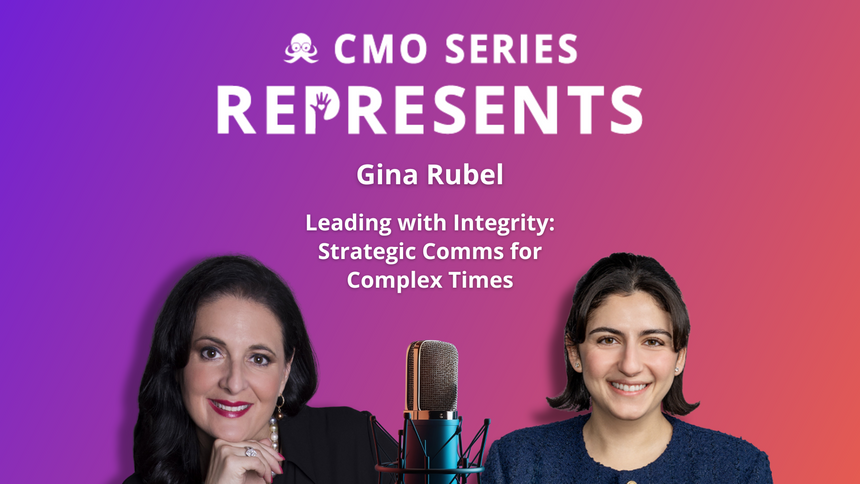


In a time when business leaders are navigating heightened political division, evolving workplace expectations, and the urgent call for inclusivity, understanding how to lead with purpose has never been more critical.
On this episode of CMO Series REPRESENTS, Yasmin Zand is joined by Gina Rubel, CEO and General Counsel at Furia Rubel Communications. Their conversation explores the deep commitment to advocacy, DEI, and ethical relationship-building that has shaped Gina’s leadership and the culture at Furia Rubel.
Together, they delve into the forces behind Gina’s passion, including her work with the Rule of Law Coalition, and examine how leaders can create truly safe and inclusive spaces in today’s legal industry.
Gina and Yasmin dive into:
- The steps CMOs and firm leaders must take to communicate effectively, internally and externally, amid political polarization
- The story behind the Rule of Law Coalition and its significance in today’s climate
- Practical advice for legal marketers striving to lead with authenticity and purpose
Transcription
Yasmin: Welcome to CMO Series Represents, where we shine a light on diversity, equity, and inclusion in professional services marketing. Today's guest is someone who's been doing just that throughout her entire career. I'm Yasmin Zand, and I'm very lucky to be joined by a leading voice in legal marketing and strategic communications, and a friend of Passle’s, Gina Rubel, CEO and general counsel of Furia Rubel Communications.
Charlie: This episode is brought to you by CrossPitch AI, the new cross-selling tool from Passle. Cross-selling should be the easiest way for law firms to grow, but most firms struggle. Why? Lack of awareness, lack of trust, and frankly, fear of selling. The result missed revenue. CrossPitch AI fixes that. It breaks down silos, helps professionals connect and delivers timely, relevant insights to the right people inside the firm and out. There's no heavy rollouts. Just switch it on and try it today. Head to crosspitch.ai to book your demo and make cross-selling happen. Now, back to the podcast.
Yasmin: In this episode, Gina shares her journey from lawyer to CEO and how her passion for advocacy, DEI, and ethical leadership has shaped her work and her company. We'll explore her involvement with the Rule of Law Coalition, the role of communications leaders in a deeply divided climate and what it truly means to create an inclusive, safe space within law firms. So Gina, welcome to the podcast.
Gina: Thank you so much. It's great to see you this morning.
Yasmin: Likewise, you're all bright. I don't know if everybody's gonna be on video, but you're in a beautiful, bright orange, so you're all ready to go for the Pass Podcast.
Gina: It wasn’t planned, by the way. I just didn't think about it this morning.
Yasmin: No, I love it. You're radiating, and it brings a lot of energy today. So, Gina, we've got tons of questions that we prepared for you. We wanna pepper you with them, but let's start with your journey. So we've spoken about this before, but you're a third generation lawyer and a leader in legal marketing. Where did your passion for advocacy, DEI and communications come from and how has it changed over time?
Gina: You know, it's such an interesting question, because as we step into the third, third of our lives, or at least me you do a lot of looking back and it really starts with your home. It starts with how you're raised. And I have to say, it really started with my parents. I was raised in Philadelphia. They sent me - started in private school because we lived in a pretty homogenous community and really in grade school and in middle school, meeting people from all different places in the world and you know, really realizing that there weren't just South Philly Italians out there.
And getting to meet, you know, I had a classmate from Saudi Arabia and I had, you know, friends of all different races. I'll say genders. I don't think we identified the misgenders back in the seventies, in terms of more than, than just the two that we talk about. And it's fascinating 'cause I also saw my father who was a lawyer and he fought against stereotypes against Italian Americans. Like, oh, you know, everyone's in the mafia. No, that's not exactly true. And he represented people who were from marginalized communities, in all sorts of cases. And so I got to see things like, you know, he represented a black juvenile who was shot in the back by a white police officer. He represented Latinos who had gone to court for different issues and helped them through the process he helped open.
He did the corporate legal work for the first LGBTQ nightclub in Philadelphia. So those things really shaped me, and this is when I was a child. So there was never this sense of us versus them. It was, you know, I lived in a, what I like to call a we household. It was all of us. And, you know, his best friends would, some of his best friends would come to dinner. And while we were raised Italian Catholic, one of his best friends was Jewish. One was a black lawyer. One was a Latino lawyer. I'm still in touch with all of them. They've been like additional fathers to me. And frankly, I say fathers because there were very few women who went to law school then. So he instilled that in me. My mother encouraged me. And I think it just went on from there. Like it's in the DNA.
Yasmin: Yeah. That's amazing. You like, that's really, I feel like it's uncommon, especially as you said in the seventies to have that kind of experience just in your house when you're growing up like so inclusive.
And you've been outspoken about the legal industry's duty to uphold constitutional rights, so not just being inclusive to other groups, but also when it comes down to legal, being an advocate for other people, but also, again, kind of going back to the state of the state of legal now. Based on your experience, can you tell us about the Rule of Law Coalition and why that matters based on, you know, how you were raised and, and what's been going on?
Gina: So, first and foremost, as a lawyer, I took an oath to protect the Constitution, and I believe in that oath wholeheartedly. So, and while I'm really speaking on my own behalf as I talk about that as a lawyer, as an advocate. However, the coalition came about because there were a number of us in legal marketing really feeling sad, frustrated, angry, you name it, every level of grief possible as the executive orders started coming out in January and February, and seeing what was happening within the industry. And we wanted a place where we could feel safe and where others could feel safe. So we started this rule of law coalition and there's a lot of details that protect rule of law.com. And I'm the only one who can speak out publicly about it because the other people are in law firms where they cannot speak up.
They're not permitted to speak up for whatever reason. And I'm not gonna judge those reasons. I'm just going to say they can't speak up. And some of them are very valid reasons. And so as a result, we created this coalition where we could come together where we could wear our pins. You can't, you know, I don't know if you can see it on the camera, but I have my rule of law pin on and, we gave out over a thousand of these pins at the Legal Marketing Association International Conference. It was independent. It had nothing to do with LMA. It was us just saying, Hey, this is a way for us to stand proud, know what we believe in, and still do our jobs within the boundaries of what, how we've been asked to do them.
So, what I think is important for listeners is they're to understand that they're purple pins, which is an equal mix of red and blue, the two colors that define the two dominant parties here in the US and the font where it says Rule of law is the same as that of the Constitution So it was not meant to divide people. It was meant to bridge those divides and just be a safe place. And I think that's really important because if you're truly inclusive, you will be around people with different points of view as well. And we wanted to present as an inclusive coalition, and really all we're doing is making these pins available if people want to buy them, just so that they can say, this is who I am. It's not a fundraiser. It's just a safe place.
Yasmin: I love that. And I think those pins have been viral, you know, everywhere. Everybody's got one. They've been wearing just so cool.
Gina: Well, not only legal marketers, the Philadelphia Bar Association has over 500 pins that they've been giving to people and I gave a ton out at when they did on law day, we all renewed our vows. Our we renewed our vows as if it's a marriage. And you don't have to take that out. I think that was funny thinking about my husband today as we retook our oaths and it was really special. I ran out of them. People were just so excited about them. So the goal is really to get them out to every bar association, any law firms who want them, any marketers or other legal professionals who want them. And just to say, we hear you.
Yasmin: Yeah, that's great. And in light of, you know, you hearing people, how should firm leaders like managing partners, CMOs. How should they be communicating and receiving communications, I should say? Effectively, both internally, externally, when it comes to this politically charged climate that we're now in.
Gina: Well, it's something I call the three Ps, and I think this is really helpful for anyone who is charged with communications in a law firm or any other company for that matter. It's to prepare to present and to preserve. And what I mean by that is to prepare for what could happen. So you may not have, you may have gotten an executive order against you or an EEOC letter. Perhaps you haven't, but you might. So that idea of preparing AKA, Crisis communications, you know, crisis planning, and presenting an objective framework for law firm leaders to work through when making tough decisions. And the reason I say objective is as lawyers.
As lawyers, we are really taught to think with objectivity, and yet we get stuck in our, well, this is the way we've always done it or, well this is who we always were, or all of that subjective stuff. I don't know what else to call it, but stuff, get rid of the stuff and focus on presenting an objective framework. And when it's objective, it's so much easier for the executive committee or your senior officers, however your firm is set up to make decisions that are in their, and their employees and their clients' best interest.
And the third is to preserve and preserve the law firm's reputation and culture with integrity. And so those three things, If you lead with integrity, if you prepare objectively, if you know, have an objective framework, those things are going to make a huge difference in how you show up in the world.
Yasmin: So that's interesting. So we've got the three Ps and then when you think about it, that kind of applies like in my head, when you're looking at people who sometimes can relate and come together really easily and say, okay, like these are the things that we're gonna agree on and we're gonna go ahead and execute for firms.
And I get not just law firms, but other organizations as well who are maybe global or have, you know, different, right, political beliefs - not just political I guess, but there's so many different places where people and perspectives, where people can be coming from. How can you navigate cultural and political divides with their comms?
I guess keeping the three P's in mind, but like how do you kind of go around all of those people and get the people to play the right parts?
Gina: You know, it's not easy and that's, that's a great question and part of it comes down to how you communicate; what vehicles you use. I think there's a lot of animosity in law firms where people have been told you cannot speak out publicly about x. So silencing people does not make them loyal, but also not telling them the reasons why. You know, think about the little toddler who walks around going, why, why, why, why? You know? And we as lawyers ask why all the time. And yet we as lawyers don't always answer the why. So it really comes down to how you communicate to navigate those cultural and political divides.
So for example, if you're a law firm in a red state. And you work with government entities, and those government entities happen to be identified as red, you may say, we're going to just do our jobs as lawyers. We are going to represent our clients zealously. Like our oaths said. We will do what we can to protect the law as the way we show up as a law firm, but we're going to remain silent because we have these clients and we respect those clients. And while they may have, you know, you might have a personal opinion that differs. They're also the reason why we can pay your salaries, you know, so, andI'm simplifying it really, but being transparent to a degree internally talking to your people matters, and it doesn't always have to be some written missive. It could be practice group leaders having conversations with their teams, also allowing them places to be heard. So that you can still do what you need to do and show up the way you show up while allowing people to understand the why.
We were so cautious as law firms and you know, oh no, we're not gonna tell anybody anything. And it just creates more problems, especially in a world today that I didn't grow up in social media, like things were so much more containable 30 years ago now. I mean, just look at the CEO and the Coldplay video and, and you know, had to bring it up somewhere.
Yasmin: Yeah, that video is really funny, to be fair.
Gina: You know, to be fair, that's a perfect example of what not to do if you don't want the world to know what you're doing. You know, don't be at a public venue cheating on your wife. You know, what else can I say again? It's communication and it's where most of us fail in relationships, whether it's at home or in private or in our corporate personas. We need to communicate.
Yasmin: Yeah, so communication is key is the takeaway of that. Being able to communicate at a high level, but also candidly, transparently. That sounds about right to me. Have you noticed any firms who've maybe done that super well that you can refer back to? Or maybe some people who are firms that have not?
Gina: Well, I think I'm gonna stick with, if I'm gonna point, if I'm gonna name names, I'm gonna stick to the ones who have done well. Okay, out of respect for those firms that are, 'cause everybody's navigating uncharted waters. But for example, Perkins Coie has done a stellar job in communicating this is who we are, this is how we're going to show up in the world. And we're going to continue to walk that line there and it starts at the top. And that's really important. It has to start at the top.
A big mistake a lot of companies make in crisis is they hire, it's not a mistake to hire a crisis communications agency. I'd be shooting myself in the foot if I said that. It's a mistake to have the crisis agency or a PR agency speak on behalf of the client. So it always has to come from within to have any sense of integrity. Right. And so they are really, really leading the charge. And if you even look on LinkedIn, they're leaders. They're leaders, the executive committee of Perkins Coie, they're not a small firm.
They are sharing the messages that their firm is sharing out there on LinkedIn and they are speaking up and you know, it's very controlled. It's very respectful. It's done with integrity. But I will tell you, I think really they have led by an incredible example for our industry. On the other side of that, there are firms that have taken different positions that, you know, some have called it capitulating. You, anybody can just search it on any search engine or gen AI platform and find out who they are. So I'm gonna, not gonna name them, but I'm gonna say that some have done better than others by waiting to negotiate to see what happened early on. Some got luckier in the beginning. Um, none of them are talking about the, and I'm using air quotes, um, pro bono work that they're doing; they're being very quiet. Um, the media is keeping an eye on it and keeps talking about it. It was in, on, uh, law.com again this morning. So those firms, I think are going to find it more challenging moving forward, not to become more, even more polarized. So while they'll survive. They may find that people with differing views from how they handled this don't wanna go there.
So the recruiting efforts are going to be harder, it will be harder to get corporate clients, especially those with any sense of care about DE and I. And so it, this is a long game. You know, these are some of the same firms that say, well, we've been around for 150 years, you know, well. This is a long game and we're gonna have to see how it plays out.
Yasmin: Yeah, that makes sense. And I also think if you're thinking about, I guess when you're looking at some of these firms, what are some of the key characteristics you're looking at from leadership that are kind of the indicators of, oh, okay. I see where you're at. Like that's, this is kind of offhanded, but I'm curious if you have anything you can allow.
Gina: Well I can, I mean,it's, I think about it. They lead by example. They're firms are not performative, DEI. And I think that's really important. So they've not only committed, but they really live by it. And the firms that have been performative, it, it, it's pretty clear that their efforts were performative.
Now, you know, if they, some of them wrote public statements around, you know, around the George Floyd murder, but never did anything when the Dobbs decision came out, which, you know, took away women's rights. And so you can, you kind of can see which firms are the ones that are really, truly going to stand up. Many of them, you'll see diverse leadership on the ec.
Some of them, it's not as diverse, and yet they really want it to be. So they're still working towards those things. They believe in it. And you know, we've grown up with that adage “Actions speak louder than words”, and that's simply it. Actions speak louder than words. These are the firms that have truly been committed to inclusivity and belonging within their firms. And you see that there are also firms that are more progressive. They're more willing to listen even to the younger voice, the younger attorneys, the younger staff members, professionals, almost all of the ones that have come out in my - If I were to say ahead are ones that have a respected CMO or CMBDO, who has a real seat at the table.
Not just, you know, oh, go do an RFP. These are people who understand what's going on, how to communicate, what people in their firms need and want. So there's a number of things that have allowed those firms to communicate effectively.
Yasmin: You mentioned CMOs having a seat at the table, and I know some of the firms that you know, you probably work with, you work with and I work with, and we all kind of know and love, have been able to create a pretty safe and inclusive space.
And a lot of those people have had a seat at that table. But when they're trying to cultivate that space, what does that look like in practice? Like if you could give. Three things. If you have one, that's fine.
Gina: Oh gosh, that's such a hard question because every law firm is so different. I think number one, it comes with the CMO, CMBDO, that senior leader showing up with confidence, understanding how lawyers think.
We are trained to think differently. They somewhat brainwash us in law school. So you have to think the way the lawyer thinks. So you have to present the evidence, answer the why before you're asked.And I like to say, present the evidence instead of present the data, because lawyers think in terms of evidence and we as marketers think in terms of data.
So it's the same thing, it's just a different word. So even using a language palette that helps bridge the divide between, the people that did not go to law school and the people who did, and in law firms, it's really understanding that the term non-lawyer is a non-starter. You shouldn't be using it.
We don't use it in any other profession. We don't say non-doctor. We don't say non veterinarian. We don't say non-accountants. We say professional, and so it's the P, but you have to have the confidence and know what you're talking about. You really have to be able to say to the lawyer, or the executive committee or the, whatever the leadership looks like, this is what you might wanna consider.
This is why, this is how I've seen it play out in these scenarios. This is our culture. And again, this is why. So you have to kind of reinforce the evidence. Um, don't wait for them to ask why. 'cause they will. And that is what will make it. And I've seen it, I've seen it over and over and over again with brilliant senior marketers who are trusted members of the leadership of their firms.
Yasmin: Yeah. I think sometimes we can also, so easy to look from the outside going and going, oh, can't you just do this, this, and this? But I'm sure it's so much more difficult and challenging when you're kind of in the room. But I actually was listening to a podcast this morning where the person on the podcast was talking about how they build confidence and they said, if you don't show up in a room where you have a team who's depending on you with confidence, you've already lost the battle.
Gina: Absolutely. You know, I'm gonna tell you a secret.
Yasmin: Okay.
Gina: When I decided to change the trajectory of my career. So I was a litigator. When I say I don't like to argue, my kids laugh at me and they're like, mom, that's so not true. And I'm like. No, I really don't like to, I didn't like arguing in the courtroom. I didn't like the structured argument. I didn't like the angst, the anger, the just, it's not my personality. And so I was starting this PR agency and I had no confidence in myself. And I'm like, I don't know how I'm gonna do this. I know PR, I've known PR, I went to undergrad for, this is what I do, right? This is who I am, but I am still in my early thirties, did not have that level of confidence, and I had been pretty beaten up in the legal industry. So I came out of it, you know, a little like, uh, so I went and started a cosmetic sales position with one of those top down companies. I'm not gonna name the company, but you have to buy in so you get like $3,000 worth of product.
And 'cause I did not have confidence. And one day I showed up and a cousin of mine who I love dearly, she's like, oh, so what are you doing now? And I said, well, I'm starting my PR agency, but I'm also selling this product. And she's like, she's like, you have no confidence. Like you, you're just coming across like, well, I don't really know what I'm doing. And, she didn't tease me about it. It was just like, you need to show up. Like I can do this, you know, that fake it till you make it kind of thing. And two days later I went to a legal event with my dad and all of these people I knew, and this lawyer, his name's Steve Scheller, who I adore. So Steve said, Hey Gina, you know, what are you doing with your life?
And I said, I'm helping lawyers grow their law firms through marketing and PR. And he said, well, who are your clients? I said, I don't know Steve. I just started it. And he said, well, I'm your first client. He said, come to my office tomorrow, let's talk. And there I was, you know, and I've never looked back and I've never forgotten that either. I was working on, and Steve knew me as a lawyer, so he knew that I, I knew what I was talking about and he knew that I had worked, I had worked on a lot of high profile cases, but he gave me a chance, and I'll never forget that. But it was showing up with confidence like, I'm like, this is what I'm doing.
I'm not selling this product and trying to figure out who I am. I just, this is who - this is what I'm doing, and I've noticed. I even say to my team, if I'm not feeling a hundred percent, I'm not going to show up because people can read it on my face. I am a, you know,I wear my heart on my sleeve kind of person, and I'm not one of those people that say you shouldn't cry. Like I, I'm just who I am. I show up the way. I show up, but if I can't show up as a full confident self in a place where I need to, somebody else will have to be there because I know the consequence of that. And it's funny because I was always told you have to ask for the work and you do, but only ask for it with confidence.That's really been most important.
Yasmin: I love that. Like you've, you've inspired me. I'm gonna go away after this. I'm gonna tell everybody what we're doing today, just going in with confidence leading the show.
Gina: Fake it till you make it, girlfriend.
Yasmin: Fake it till, make it till you make it. I know. Seriously though. So you built, okay, so you built free of rebel with values and integrity. Well values based on integrity, confidence, it sounds like. And I feel like a little bit of face sprinkled in there of like, you can, everybody can, you know, everybody on this team is capable, and can do what we're charged with and tasked with doing, especially when it comes to crisis cons.You really gotta go in with that in mind. What advice would you give to legal marketer, legal marketers, excuse me, legal marketers who are trying to lead with purpose in uncertain times and then just in, I think in general, who are trying to lead with purpose.
Gina: Well, I think it starts with being honest with yourself and others. Really doing the hard work and knowing who you are. And being okay with who you are, no matter the circumstance you find yourself in. So, if you are staunchly blue and you work in a red state, in a red firm, you may have to be quiet about your, you know, your political views at work. We were always quiet about our political views at work. I mean, that's nothing new. I never knew what position somebody had, and so it's okay to be quiet and know who you are and still show up on a rally, and, and still be who you are. So knowing who you are is number one. Respecting that not everybody has the same point of view as you is okay too. I think I have spent, you know, a lot of time trying to understand the middle ground. Understand why. I mean, I'm that three-year-old asking why a million times a day. So to be a good leader, you have to be honest with yourself and respect that others don't always have the same point of view. It also means setting and maintaining boundaries. So this is how we show up as a team.
This is what we will talk about. If you need to talk about X, here's a safe way to do that, or a safe place to do that. We're going to respect everyone on our team and really know your firm's culture and live within it no matter what your views are. And that doesn't mean you have to stay there. So like Rachel Cohen, and I won't mention the firm that she left, but she is one of the younger professionals that I really look up to as she stood up. And there's many others who have said, I'm not gonna put up with this at this firm. I'm going to stand up, I'm leaving. I'm doing X, Y, and Z. For some that works, for some it doesn't. Some may have a dual income at home where they can speak up. Others may have a single income where they're taking care of children and just trying to get through the day. So, the other thing is just don't judge people for who they are because you don't know why they are. And I think that's so important and you know, if we show up that way, but again, leading with integrity is really important. And if you can't lead with integrity in your firm, then find one where you can.
But stay where you are. Like, don't just, you know, I'm not, I'm not telling CMOs and, and marketers just jump ship and don't have a job. But our industry is not going away. And, you know, for those out there that are going, well, AI is gonna take our job. It's not, it's, it's not, you know, it's, it's still something that has to be managed and controlled. So, this industry is still new, it's still evolving, it's still growing. We have a long way to go, but the legal industry is never going away. And the newer legal marketing industry, which is what I was referring to, is certainly more needed than ever.
Yasmin: Love it. Thank you, Gina. I feel like everybody's gonna listen to this podcast and go feel really good. This made me feel really good.
Gina: Well, I think that was the whole idea between the rule of law coalition. Many people were struggling with being told to be silent, and it's a way to show up and be true to oneself without being so avert that it creates chaos. And you know, some can and some can't.
I mean, that's really what it comes down to. I have one colleague who's a CMO and that individuals are allowed to speak up, go to rallies, put things on their private social media, even though their firm is staying silent, I have another colleague and they are not permitted to speak up. They got chastised for speaking up on social media and that individual is struggling. You know, it's just, and, and, and that's, they're just two of many.
Yasmin: Well, Gina, we're at the end of at least my questions, but before I send us off on our merry way for the rest of our day. It's Tuesday, by the way, Tuesday morning. What did we miss? What else do you wanna tell the crowd?
Gina: Really, I'm just really happy to be here. I think it's understanding that inclusion is a beautiful thing. We learn and we grow by being with and around people who are not like us, um, and giving them the opportunity to share their perspectives, be heard, and I like to think about it like food. Some people are okay eating the same exact meal every day all the time. But when you get to taste the cuisine of other cultures to understand why those flavors come together, those herbs, those spices, you know why certain places only eat fish because, well, they're on an island, or you know, you really start to understand more.
You become even more empathetic and better at everything you do, in every way you show up. So inclusivity, diversity, giving people a sense of belonging. They're all gifts that we should all just cherish.
Yasmin: Yeah. Thank you.Well, to everybody listening, Gina's a wonderful lady. So thank you so much for joining us today. I hope everybody has a great day and tune in next time for the next episode of the CMO Series Represents. And Gina, thank you so much for joining us.
Gina: Thank you for having me.
Charlie: You can follow the Passle CMO Series podcast on your preferred podcast platform. Thanks for listening, and we'll see you next time.
/Passle/53d0c8edb00e7e0540c9b34b/MediaLibrary/Images/2026-10-14-09-22-13-024-6acf49c5944aac193a981bb9.jpg)
/Passle/53d0c8edb00e7e0540c9b34b/MediaLibrary/Images/2026-10-22-11-14-29-774-6ad9f015ed262a90b1bf36f6.jpg)
/Passle/53d0c8edb00e7e0540c9b34b/MediaLibrary/Images/2026-10-19-13-24-47-415-6ad61a1fdc6374f637024697.jpg)
/Passle/53d0c8edb00e7e0540c9b34b/MediaLibrary/Images/2026-10-13-16-00-13-704-6ace558d477453bcaa2eba35.jpg)
/Passle/53d0c8edb00e7e0540c9b34b/MediaLibrary/Images/2026-09-28-10-59-02-989-6aba4876c6484376446500cc.png)