

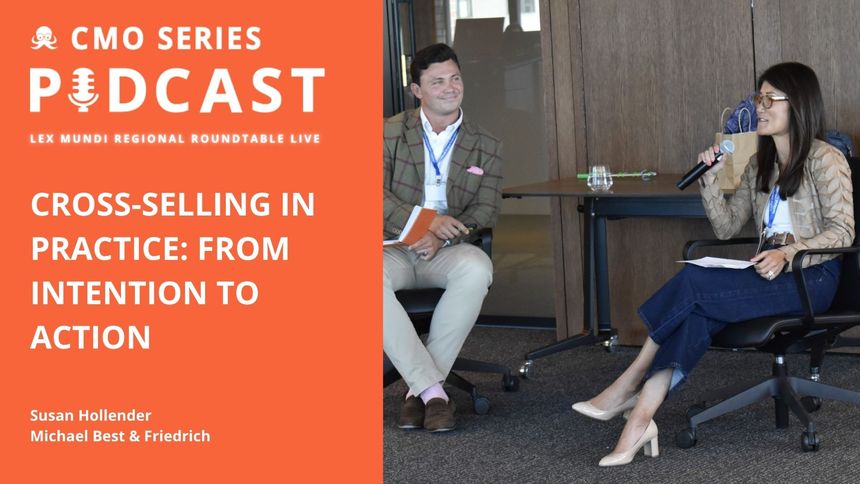



Live from the Lex Mundi Americas Regional Marketing and Business Development Roundtable in Denver, this special episode of the CMO Series Podcast dives into Cross-Selling in Practice.
Ali Bone is joined by Susan Lee Hollender, Chief Growth Officer at Michael Best & Friedrich, to explore how firms can move from intention to action.
Drawing on insights from Passle’s AI & Cross-Selling Report 2025, the conversation unpacks what’s working across the Lex Mundi network, the barriers that hold firms back, and what clients truly want to see.
From building trust and awareness to proven approaches and success stories, Susan and Ali discuss the practical lessons and ideas for how firms can make cross-selling easier and more impactful.
Transcription:
Charlie: Welcome to the CMO Series Podcast, where we talk all things marketing and business development in professional services. Live from Denver at the Lex Mundi Americas roundtable, this special episode of the CMO Series brings you a conversation on cross-selling and practice. Ali Bone is joined by Susan Hollender of Michael Best to explore what's working and share her practical ways firms can turn intention into action.
This episode is brought to you by CrossPitch AI, the new cross-selling tool from Passle. Cross-selling should be the easiest way for law firms to grow, but most firms struggle. Why? Lack of awareness, lack of trust, and frankly, fear of selling. The result? Missed revenue. CrossPitch AI fixes that, it breaks down silos, helps professionals connect and delivers timely, relevant insights to the right people inside the firm and out. There's no heavy rollout. Just switch it on and try it today. Head to crosspitch.ai to book your demo and make cross-selling happen. Now back to the podcast.
Ali: So Susan, thank you very much obviously, for joining us. To open up, why is cross-selling important in firms today?
Susan: First, just to preface, how I'm a little sad these questions are still coming up every 25 years. And there are stats, you know, are still where it's at, right? And so at the end of the day, there's no perfect science, all of our cultures are different, but what I notice as a core is the human behavior, right? Psychologically, that's what it comes down to, is just this behavior of cross-selling, just not from the perspective of a partner saying, or, or it doesn't matter, attorney is saying, it's not something I can do. Or I don't trust that they'll do the work as good as I do it and or I don't know what they do. Hence the Gibson and Dunn all firm attorney email. Do we have a labor attorney? It's like, well, of course there’s a labor attorney. So, I try to flip this around and you have the word cross selling because our attorneys hate the word sales and selling, we've been using cross collaboration, cross introductions, just to continue to get them away from the scary word of cross-selling. But to the question why it's so important, it's the foundation of the business, right? I mean, if you do not sell, you do not collaborate, you don't grow, where are you going to be? So either you're the firm that continues to grow, or you're the firm that gets acquired. I'm not saying one or the other is a bad thing, it's just your world's gonna change. Evolve comes from the client's perspective. Clients are spending how much percentage reading industry news, and then get so frustrated because their attorneys that they're paying on a timely basis, is not doing the same thing, and they can have a complimentary conversation because they're not reading it, they're not investing in it. So all they see is this level of questioning the value of what the invoice for the billing, you are charging me X and I'm getting Y, and that Y isn't of value to me. And it is just an interesting phenomenon that our partners and our attorneys are still not seeing this. So you flip this all around and with clients, clients, hands down, that's what they want, without clients, we don't have anything. So, you know, the holistic view that this whole silo mentality, it's gotta go away. It's either gonna go away because you change your habits or it's gonna go away 'cause the market decides to take it from you, so you gotta choose which path you're gonna be on.
Ali: Just picking up actually on two things that you mentioned there, Susan. One was the cross collaboration. Interesting, Lindsey, I know you were talking about how at the moment here at Davis Graham, you are facilitating lots of cross-departmental meetings again. So again, it's quite a nice way and a very soft way to get people to start thinking about cross-selling without using the word selling. And then you're also mentioning about the evolving element there in terms of your clients are reaching out to you wanting to talk about things and all they're already doing is getting billing. Again, a piece of research that we did last year showed us that 64% of GCs will reach out to the attorney named on the piece of thought leadership. So again, by creating stuff, evolving, ensuring that you're actually being seen front of mind in terms of what you are doing, GCs are gonna really respond to that. Sorry, please.
Susan: No, I was gonna say just one last thing on that. It's, it's sort of that, I mean, this is the reason and how, at dinner or such, but how Passle and I met was through their octopus because I use the word tentacle effect all the time. And I saw their logo and I said, wait a minute, who already spoke? And this is like six or seven years ago. But it's the stickiness, right? Tentacles about the octopus effect, their suction cups, you want it to be sticky, you want it to sort of stay there, and it's the more harder it is for a client to transition their work. When a lateral leaves or whatever situation's happening, the harder it is for them to just have that movement. As much as we can debate and there's no wrong or right that it's either a firm that they stay with, it's the practitioners they stay with, or the solo practitioner, which one has the most risk. The solo practitioner who does the one area of work for X amount of years and they leave and they jump to another firm, guess what? The work's gonna go with that. No matter how much we think the firm is of value, but if there's three or four areas of service, the harder it is for the client to let go because it gets into a conundrum on their organization side as well.
Ali: So kind of moving on, interestingly, one of the things that comes up along with, you know, Susan and I spoke about it extensively before getting into this, is some, some of those barriers to cross-selling. We all want to do it, everybody's been speaking about it in the room over the last 24 hours, but actually finding those successes are quite difficult. An interesting part of the research that we had, this is both an enabler and a blocker, the two biggest things that kind of, as they both either enable but also block that cross-selling element, is that trust and awareness internally. You know, Tom spoke about it this morning, you know, there's an attorney in Germany, they've got this work that they need to do. Are they actually gonna give it to that person based here in Denver or not, or if they don't really know them, they don't know what they do. Maybe the answer's probably no. So how can you increase trust and awareness amongst your attorneys. But kind of feeding into that, I’d just be really interested to hear from you, Susan, as sort of what are those biggest barriers you've seen that are stopping cost-selling?
Susan: I think a lot of it is that what you just said is, you know, I go back to sort of the behavioral innate sort of nature of lawyers and the way they were trained. So a couple things that I see is their personalities, they’re risk-averse, hate change, we're sort of schooled to go to a private practice and look at all of their 1/8, 1/16, call it whatever you want, their time. And they don't have the ability to even get to know their colleagues' area of practice because it all comes down to time and money. So one of the things at our firm that we're continuing to evolve, is giving them a certain level of investment hours forms the bottom line. Because if you don't have the time to visit other offices and you don't equate that to some level of a quote-unquote ‘billable time credit’, when it comes to comp there's only so many hours in a day. I wish we could put 24, 48 hours on a clock, but usually people need to sleep somewhat, right? Eat, be with, they will be with their family, and have that life to bill, but that billing, it can't just be for clients. That billing has to be investment to have intra relations amongst your offices, have the money and the means and the budget to go fly and do these things. And so, it's a full circle of sort of the simplicities of how you change behavior and you gotta support them by being able to have them, have those opportunities, have time to go visit, be able to go to open houses outside of their home office and as we've continued to grow geographically, it's a nonstarter. You have to be able to invest in all of our attorneys, especially more right now on partners, because that's the behavioral change we need to start with. Because you don't lead from the top, you're not really showing examples for your associates.
Ali: Just picking up from the training element, I know Tiffany mentioned earlier, sort on the succession that you're doing with your senior associates, getting them more involved. Is there anything you are doing with some of the junior, more junior members of the firm, your associates, senior associates, to change their thoughts around? You mentioned obviously their sort of, the way that they're trained, the individual hours towards this.
Susan: Sure. Well, I think they're changing us. So I think about our summer associates program and at the end of the summer program, they have to do a session, so it's like a mock trial. Like they get their topic, their business topic 24 hours before they have to do the presentation, they get into small groups and you're going down to old school, like burn them in that oil and you have to present to the leadership committee as their final project. And we test that in many ways, it's a business problem, we don't give them a legal problem, we give them a business problem and not surprising, it was around AI. Unbelievable the amount of readiness and the presentation and the thoughts of their opinions, which were very clear and not surprisingly, but were very articulate, right? They are thinking about these things and no matter what our leaders were taught or think, they're ready to go from law school. I mean, they're coming in, they're gonna be vocal, they want to be leaders sooner than later. And all of these disruptions are very positive because it helps our BD group, who’s leading different levels of business development training right now for different audiences. And we don't always start with the top, we start with associates, there's just different modules for different areas because if you don't start from the early entrees of their private practice experience as full-time employees, attorneys from the get go, it is harder to change behavior as they get older and more into their careers 'cause they're gonna be set in their ways.
Ali: You can’t teach an old dog new tricks. Interesting. So kind of building into that, obviously we mentioned this whole idea of the trust awareness, you know, how can firms start to build more trust and awareness to make cross-selling that bit easier? I know when we were speaking, you said, in some ways at Michael Best, sort of 5-10% your attorneys are really good at it. So just interested to hear some of your thoughts around that?
Susan: Yeah, this is a bit controversial, but about three years ago at a partner retreat we took all of the partners income and equity and we put them in a bucket, and we said there's six different profiles of all of you in this room and every one of you have a value in the growth of the organization. You might be great, professional developers, you might be great service client service folks, but neither one of you wanna go anywhere in front of an external audience. You've got great salespeople who are great to connect, but they're horrible closers 'cause they are two different skill sets, at least in my opinion. And so we put people in different profiles and buckets. They hated it, of course, they're gonna challenge you, ‘how come you put me in here? I'm not here. How do you know? Don't know me’, all these things. But it was just the start to say you have to have an identity 'cause all of us cannot be everything to everyone. So, back to your reference on the, it's like 5-7%, we’re truly not just our you know, our sort of sales, our book of business, our top folks, they're also the ones being pulled to do everything. They're on the management committee, they're on the board, they're the proscript chair, they're the office managing partners, again, goes back to time. If you only have X amount of time, you are pulling them away, the opportunity costs for being out there more. So, we are doing something sort of behind the scenes now where they are getting credited, more for certain acronyms of the credit, like the working received versus the origination. There's a lot of debates around what the value are for these different columns, and we are definitely putting a lot more onus on particularly those folks to get more origination and push the work out. So push it down to the other profiles that can do the work, they're very good at it, they're great servicing, so you're out there doing what you're doing in the best way. Of course it's controversial 'cause everybody wants to be fair and everybody says, how come I can't get that? But, I don't think we're gonna be able to disrupt unless we make change and take risks because at the end of the day these are the folks for now, they have naturally proven that they can do this, and with that we give them sort of a concierge support, which means these folks call about billing questions, they're first in line to get them answered 'cause they need to get answers and support done on a faster avenue because it's, it's just the way the math works. Again, you can't pick and choose to be even for everybody, but this model has worked 'cause now there's this internal competition of folks wanting to jump to that next level. Well, these folks are doing it, I can do that, I see the support system, I'm witnessing what they're putting together as a firm, I want some of that, I wanna be able to get that. I don't think it'll be all of our equity partners who get into that slot because it's just not what's gonna make them happy because money doesn't drive everyone for happiness, sometimes it's other things. So they get to choose their path, so initially they might have been quote-unquote ‘put into an area because that's what we sell’, but that does not mean anyone has to stay there. It's up to that individual to decide, hey, here are my options, and secondly, how can I get there? And it might not just be by themselves, it might be in clusters of cross-selling, cross-collaboration, like all of these things 'cause it takes a village and we've seen movement. It again goes back to behavioral changes in a lawyer, you can't push them or train them or, or have them always say to you, what have you done for BD lately. It's more like, hey, you all need to do this too.
Ali: I think this will lead into the next question, but I was just thinking, I actually wanna open this up to the room. Does anybody do anything, and this comes to you as well, that sort of like lunch and learns around, you know, we're now focusing on AI, these are the people that are the AI experts internally. Does anybody do anything like that to help facilitate. Jenny, you do? Oh, amazing. I was, it was only an idea that came to me just as you were talking about some of the stuff you’re doing there, is that internal? How do you get people to understand what's happening internally?
Susan: I think it goes back to getting our BD folks out of the administrative burdens of being, what I call, like the operator every day, and getting them trained to be able to attend these types of function, learn so that they themselves can go out and connect folks. Our business development folks should be our internal connectors. They're the ones that the phone should ring and they should know who to connect, who do, and make sure that gets done and not be in charge of website maintenance, or my bio needs to be updated, or get me a bylined article 'cause I'm the best. Like all of that stuff is just draining for our BD folks who have elevated their careers to get to that next level. And again, leaving some of the administrative tasks that are important that need to get done every day, but start to train your junior folks to learn more about that process.
Ali: And in terms of that process, are there any methods or approaches that you've seen working particularly well at Michael Best? I know that during our conversations ahead of this, you're saying traditionally IP seen as somewhere that cross-selling would actually be really easy to do, but actually that is not the case at all 'cause the relationships are and stuff like that, not to hear kind of what works well in some good approaches.
Susan: Yeah, IP, you know, we all have our stereotypes that we put on our practice groups, So litigators are over here and our corporate guys who are doing the deals are over, over here, and here's the IP group. Historically at Michael Best our IP group really was the founding, historical sort of, nature of how we grew and there was always this push from the others to say, you have all the mega clients, you have all the Fortune 500s, you have the portfolios, how come you are not introducing me to the decision maker X? And the answer's very simple. They don't know them. One, they don't know them 'cause it's in a completely different building, they deal with folks who are doing IP work, engineer minds, analysis completely in the R&D group sometimes, you're in a completely different area and talking about personality profiles, they are the least comfortable introducing you to anyone, even if they're getting stellar service, right. So, this was learned it was, I wouldn't say learned, but it was exposed and this goes, to sort of evidence based of what lawyers need to always know, like show me evidence, give me metrics, how come? And we did a sales conference, I don't know if any of you all know Marcus Evans, there's a very hot and cold with Marcus Evans. We went to IP conference, we took our quote-unquote lead sales folks, we continue to do it 'cause we have seen ROI, but it is a very long game. I mean, it is a very, very long game but we have seen the return and they realize how hard it is even for themselves to go get new clients, and then we took non IP folks to the IP conferences, said, why don't you go try? And they realized that it's not the right audience, and it's almost like you have to put them in the space for them to realize what it is and what it isn't because again, you gotta go to what and how they communicate and what's gonna sort of make it successful for them. And, it was an interesting experiment and it was just sort of done by accident, just 'cause the other room happened to be a GC conference and the IT conference was on the other side and yeah, they realized it's not that easy and the counterpoint is, do you really want to be working, was a larger and more broader conversation around client profile, do you really want Fortune 500 commoditized work? It's a question we've, we've inherited a lot just through the years, but is that really our path?
Ali: Interesting. I'm mentioning successes there, are there any successes that you'd be open to sharing with the group? I'm sure people will be fascinated to hear where there has been success in cross-selling and maybe some of the methods that went into that.
Susan: Yeah, we went through I mean it's, it's as true as account management teams, right? And we've got a couple vendors here who probably will get law firm ways of doing BD and like crack their head against the wall. And we did account, we're doing account management, it's around our impact clients, Hearn and Jordan are very involved in our impact clients and long story short, the way it started was really down to account management 101. We looked at our clients in different profiles of where we're historically getting the work, what the amount was, where do we wanna be in the right space? Is this the right space and industries that we wanna continue to concentrate on? Are they paying on time? What's the relationships? All those things and we came with different tiers. And those tiers accidentally created cross-selling teams, because it's account management, and through that process there's continued conversations. And they don't know what they don't know, they're like, oh, well this is a program we're gonna be involved in account management, but yeah, you're cross-selling, you're talking to each other, you're dealing with different problems in the sense that the person who's working on a deal right now or working for, you know, on a matter, knows what the others are doing 'cause you're having conversations around account management. And I don't know now, is it monthly or quarterly, Jordan and Hearn? the impact client conversations, you know, is it more monthly or quarterly? Quarterly. And a lot of that is also derived from our outreach program that the managing partner and myself, we go out to clients, whether it's virtual or in person or otherwise, and ask all of the non-work questions, more business. And then indirectly we get a lot of service response rather good, bad, or indifferent, we do get a lot of different feedback from the GCs. Sometimes it's not the GC at all, it's the AGC, sometimes it could be the different titles that are not necessarily the highest titles, and that has been an educational point I think for a lot of our client relationship attorneys as well, that it's not always those higher titles. There's a lot of folks doing a lot of work with quote-unquote, you know, private law firms like ours and we are a vendor. I don't care what anyone says, we are an outside vendor that different levels of in-house legal folks engage with. And decision making and influence does not always come from the top, and sometimes it's usually they have no clue who we are.
Ali: Interesting. I know that you've kind of touched on it there, but you were saying some of the biggest success really is just that management, that sometimes the attorneys that are doing the work on a day-to-day basis, it's hardest for them to think about cross-selling. It should be the people managing those relationships, sort of up-tiering it a little bit, who find out the intricacies of it. So building into kind of, I guess our final question, just relating it to everybody here ultimately, is how can Lex Mundi as a collective, support more cross-selling between you?
Susan: You know, I thought about this last night and I mean we're all here, and there's a lot of familiar faces, and I haven't been to a conference in a couple years and it's great to see that there's all of this commitment from the business development marketing team, from the member firms. I think we all believe in the organization. Our colleagues are managing partners, they, everyone goes to respective different, you know, conferences, we're all members, we're active members still. There's a reason for that. I think one of the things Lex Mundi, you are an aggregate of data from all of us. You all spend a lot of time on market trends and market industries and all this information, and all of you and all of us, like how does that connection work taking out some of the human component? Meaning, road shows are great, engaging with us by email and all these conferences are great, but it's all manual, right? And we are all torn in so many ways with our time, whether you're a Lex Mundi team member, or us as member firms, I like to see us use more AI and like send us what we say we're gonna be doing for our partners, right. Could we be getting some dashboards, like quick snapshots of just things that are happening as far as, ways we can transfer that right into that meeting we're gonna be going into internally for a practice group or a service offering, some initiative. We need quick bites. And now, I mean, AI isn't just a choice, it is here to stay, I don't know what anyone else's opinion is, but we're already late in the game, right? I mean, it's moving at a speed that we'll never catch up to because it'll just always be there. I'd like to see us just be able to get more of that data in a much more digestible way so that we ourselves can pass it on, and see more success of that rounded success coming back.Because I am a, a victim of it, you know, Jenny does a wonderful job sending us all kinds of information and sometimes, like it's in the middle of me, like doing Cartwheel over here, right? It's like, oh crap. Like how am I gonna get this over? And then it boom, boom falls way down and it's an absolute priority, but it's just, it's gone down the dark hole because of all the day-to-day things we've got going on. So, just ways of communicating with the member firms so that we can make it much more easier for us to translate it back.
Ali: Yeah. I mean, I don’t know whether it's even possible, but I thought it was fascinating yesterday, Jenny, you were saying about the example with Jones Walker and taking that work from White & Case, but that's super, super cool, I don’t know whether that, other people in the room already knew the story, how you distribute that, but it's clear that how you’re coming together as collective, you can just be great at the part with some sort of thing. Anyway, thank you very much. Really appreciate that, Susan.
Charlie: You can follow the Passle CMO Series podcast on your preferred podcast platform. Thanks for listening and we'll see you next time.
/Passle/53d0c8edb00e7e0540c9b34b/MediaLibrary/Images/2026-10-14-09-22-13-024-6acf49c5944aac193a981bb9.jpg)
/Passle/53d0c8edb00e7e0540c9b34b/MediaLibrary/Images/2026-10-22-11-14-29-774-6ad9f015ed262a90b1bf36f6.jpg)
/Passle/53d0c8edb00e7e0540c9b34b/MediaLibrary/Images/2026-10-19-13-24-47-415-6ad61a1fdc6374f637024697.jpg)
/Passle/53d0c8edb00e7e0540c9b34b/MediaLibrary/Images/2026-10-13-16-00-13-704-6ace558d477453bcaa2eba35.jpg)
/Passle/53d0c8edb00e7e0540c9b34b/MediaLibrary/Images/2026-09-28-10-59-02-989-6aba4876c6484376446500cc.png)