

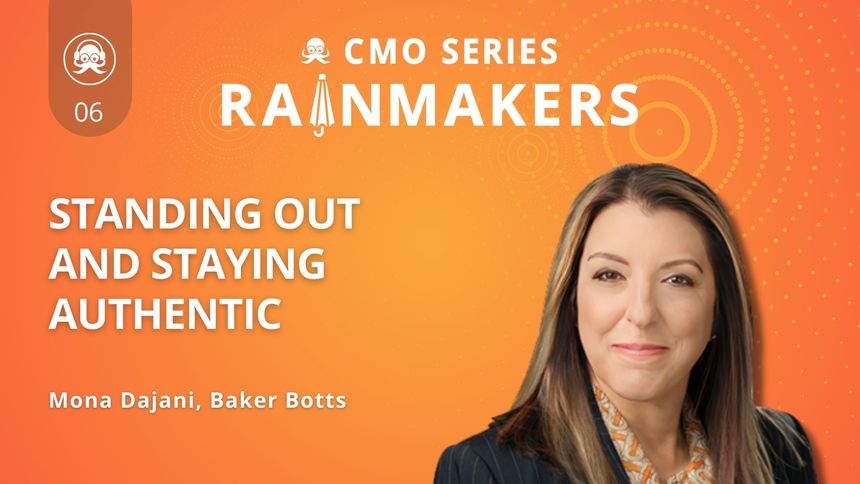



Building a book of business isn’t about being perfect or staying invisible, it’s about being consistently authentic and recognizable long before clients even need you.
On today’s episode of CMO Series Rainmakers, we’re joined by someone who has redefined what it means to build a book of business in Big Law. Mona Dajani, Partner and the Global Co-Chair of the Energy, Infrastructure and Hydrogen teams and Co-Chair of the Baker Botts Energy sector worldwide, has spent more than 25 years carving out a reputation as one of the most dynamic and recognizable voices in the sector.
From broadcasting A-list interviews on early-morning TV to posting daily market insights, Mona has turned visibility, personality and consistency into a true competitive advantage. Her ability to generate work, often from followers, viral posts and even dinner parties, is the definition of rainmaking.
Tune in to hear:
- Mona’s unique career journey from broadcasting to law
- The role of authenticity in driving business
- Leveraging thought leadership and cross-selling for big client wins
- The role of the human behind the lawyer
- Practical advice for building a book of business
Transcription:
Yasmin: On today's episode of CMO Series Rainmakers, we're joined by someone who has redefined what it means to build a book of business in big law. Mona Dajani, Partner and Global Co-Chair of the Energy Infrastructure and Hydrogen teams and Co-Chair of the Baker Bots Energy sector worldwide, has spent more than 25 years carving out a reputation as one of the most dynamic and recognizable voices in the sector. From broadcasting A-list interviews on early morning TV to posting daily market insights before most lawyers have had their first coffee, Mona has turned visibility, personality, and consistency into a true competitive advantage. Her ability to generate work often from followers, viral posts, and even dinner parties, is the definition of rainmaking. In this conversation, Mona shares how she built her brand, why authenticity wins, and the practical steps any lawyer can take to grow their own platform and leverage thought leadership to build their book of business.
Charlie: This episode is brought to you by CrossPitch AI, the new cross-selling tool from Passle. Cross-selling should be the easiest way for law firms to grow, but most firms struggle. Why? Lack of awareness, lack of trust, and frankly, fear of selling. The result? Missed revenue. CrossPitch AI fixes that. It breaks down silos, helps professionals connect, and delivers timely, relevant insights to the right people inside the firm and out. There's no heavy rollouts, just switch it on and try it today. Head to crosspitch.ai to book your demo and make cross-selling happen. Now, back to the podcast.
Yasmin: Mona, welcome to the podcast.
Mona: Wow. Thank you so much for having me. I can't wait to talk with you, this is so exciting.
Yasmin: Of course, we have so many questions to jump into and so many things to discuss. You are so brilliant. So I think we'll dive right in and just talk about how we got here. So, before we get into your rainmaking journey, Mona, can you take us back to the beginning, and what led you to law school when you already had a thriving career in broadcasting?
Mona: Well, yes. I wasn't really sure what I wanted to do, to be honest. When I was a law student, I was approached to join a morning TV show in Chicago and basically interview celebrities. So, I was doing that as well as going to law school. And you know, it was pretty hard because I had to get up super early in the morning and go to the studio and get my face done, et cetera, and then go to school. After about a year and a half, I was at a fork in the road and I had to make a decision on what I wanted to do, either stay in broadcasting or at this point I was a lawyer. So, for a lot of reasons I decided to pursue law, only because broadcast was kind of a fluke that I got picked to do this. And so that's kind of how I got started.
Yasmin: Wow, that's awesome. You've had an incredible career so far, Mona. Was there a moment where you recognized the need to stand out once you became a lawyer?
Mona: I always recognized the need to stand out. That was something that I learned when I started my career. You know, the whole point of being a lawyer, a transactional lawyer like me, is to help people and be very passionate about what you love, which I am with, you know, doing deals and transactions, and you have to be really authentic. And I discovered that most lawyers are not like me, and so I knew that the only way that I could practice law was to be authentic. And being authentic for me means that I wanna be out there, I'm not afraid of being in the press, you know, today I'm in the press, I'm on TV, I'm in the media a lot. And I think that that's one of the things that I enjoy and it really is an authentic piece of myself. But I also knew realistically as a big law lawyer that you have to stand out and distinguish yourself to do well so that you can build that book of business.
Yasmin: It's funny you mention being passionate about, of course, helping people and kind of having that drive within you to want to stand out, and it's interesting thought leadership has probably been a really good vehicle for you to be able to stand out and differentiate yourself. When did it click for you that writing and media and having a public voice could directly drive business, and how did you start developing that muscle? I'm sure your career in broadcasting probably helped with that.
Mona: Yeah. I would say early in my career, I noticed that the lawyers who were getting the most interesting opportunities weren't always the quietest or even the most senior. They're the ones that people knew, clients remembered them, colleagues talked about them, they had a point of view. And for me, that was the inflection point. I understood that if I wanted to build a real book of business, not just service other people's books, I had to be visible in a way that felt authentic. And I learned, and I leaned into what I genuinely cared about, markets, energy policy, and explaining complex ideas in plain English. I didn't try to sound like everyone else. I didn't try to wait for permission, and over time that visibility compounded. Clients started calling because they see me on TV, or they read a post, or they heard my name from someone they trusted that they did a deal with, and the work just followed. So, standing out for me wasn't about being louder, it was about being recognizable, consistent, and real. And that's something any lawyer can do. You don't need a massive platform, you need a clear voice, a point of view, and the discipline to show up consistently.
And I think that early on, people treated having a public voice as having, you know, something separate from business development, almost like a hobby. And what I learned is that visibility is business development when it's done with substance and consistency. And you're right, I mean, for me, broadcasting helped enormously, not just in terms of confidence on the camera, but in learning how to communicate under pressure and explain complex issues in a way that people actually wanna listen to. And that skill translates directly to clients, boards and decision makers, and I think the real muscle was built through repetition. I started showing up consistently, sharing market insights, reflecting real time developments, and offering a point of view rather than a legal memo. And again, over time, over this 20 years plus career, people began to associate my name with certain topics. And once that happened, inbound work followed naturally.
I think what surprised me the most is how directly it drove business. I've originated matters from a single post or an appearance in the media and, you know, even a dinner conversation that I started because someone felt like they already knew how I think. So bottom line is yes, I think the broadcasting experience did help, but more than anything, it was about learning to trust my voice, staying disciplined, and showing up and understanding that credibility is built in the public long before it converts into revenue.
Yasmin: You've dangled a carrot for me. You mentioned having this discipline and then also having that help you build business. Can you give me a really good example of how your thought leadership and how this disciplined personality has helped you turn work into, you know, a big client win?
Mona: I would say that a few years ago, I started writing consistently about the collision between AI data centers and energy infrastructure, long before it became the mainstream legal conversation it is now. And at the time, it obviously wasn't legal content, it was more market focused on power constraints, grid congestion, siting risks, capital structure, and why energy was becoming the limiting factor for AI growth. And I was, I posted about this relentlessly, I was in the media, I was in the press early mornings, weekends, whenever something moved the market. And that discipline mattered. And over time, people began to associate my name with that intersection, not just energy law, but strategic energy thinking.
And one day, I got an inbound message from a senior executive at a global infrastructure platform who had been quietly following me for months, and he said, you know, we're about to make a real major bet in this space, and you're the only lawyer who's thinking matches how we see the market. And that turned into a flagship client relationship, multi-jurisdictional work, complex structuring, and ongoing strategic advisory and legal work, not just a one-off deal. So, what's important is that the work didn't come from a pitch deck or an RFP. It came from their familiarity with me over time, you know, seeing me in the press and in the media and on my posts. And by the time we spoke, he already knew how I thought, the trust was already there. And my discipline showing up consistently with a point of view meant that when the moment came, I wasn't being evaluated, I was being selected. And that's the power of thought leadership. When it's done with intent, it compounds quietly and then it converts, often exactly the moment someone needs you the most. So that's just one example.
Yasmin: That's a pretty powerful example. So if that's the one you can share, that's pretty brilliant. Working in such complex matters, Mona, and having such a visible personal brand, and again, such a highly regulated, kind of, sensitive space. How do you decide what to talk about, and how far to go all the while towing the line of staying authentic and protecting client relationships and firm sensitivities? Like how do you do that?
Mona: Well, first of all, I mean, I am a practicing lawyer, so I can never reveal anything that's confidential or attorney-client privilege. And I think the bottom line here is that balance is everything, you know, so I never comment on clients, but I will comment extensively on the markets. I talk about systems, trends, incentives, and risks. I don't talk about individual transactions or confidential strategies. If something would make a client uncomfortable or if they recognize themselves in it, it doesn't get talked about or posted. So, I also have a very disciplined filter before anything goes out, I ask myself three questions. First, is this additive? Does it actually help people understand what's happening? Second, would I be comfortable reading this back to a client or my firm's leadership? And third, does it reflect how I think professionally, not just what will perform well.
So, authenticity doesn't mean oversharing. It means being intellectually honest. You can have a strong point of view without revealing privileged information or creating friction. And in fact, restraint often creates credibility. People trust you more when they see you know where the line is and respect it. And the other piece is consistency. When your audience understands the lane you operate in, they don't expect you to cross it, and over time that clarity really protects the client relationships and your brand. Clients know I'll never trade or trust information for attention, and ironically, that allows me to have a very visible public voice. So I think authenticity and discretion aren't intention when it's done right, they reinforce each other. The only exception I will mention is, I do have a lot of clients where I am the lead attorney on a big transaction and they want me to post about it, or they want me to discuss it with their explicit permission. So, they've already posted, you know, and so that's the only exception that I will, and I'll say that I'm proud to be part of the team to make this happen, things like that.
Yasmin: I love it. I think that also plays into the trust that you've built with some of your clients, and kind of brings us into our next question, which is, you have such a brilliant energy, big personality. We talked a little bit about the hospitality that you do when it comes to entertainment, especially when it comes to business development, you've done such a wonderful job at bridging all of those pieces together to cultivate this beautiful recipe for success when it comes to BD and authenticity. What role does being the human behind the lawyer play in building that trust, and winning work, and cultivating recurring clients, right? How do you keep bringing people back with all of these different facets of your personality?
Mona: Oh wow. Well, you hit on a topic I really love to talk about. So, excellent question. I think at the end of the day, people do business with people they trust, and the trust is built with someone who feels seen, not sold to. So being the human behind the lawyer isn't about performance or personality for its own sake, it's about creating a real connection in a profession that can sometimes feel overly transactional. And hospitality has always been a natural extension of that for me, you know, whether it is a dinner, a conversation, or a shared experience, it's about slowing things down and giving people space to be themselves. And when you take someone out of the boardroom and into a human setting, you learn how they think, what they care about, and how they make decisions, and that's invaluable for long-term client relationships.
For me, I bring my culinary school expertise as well as being a sommelier, and I have these amazing dinners that I host myself. Sometimes they're closing dinners, sometimes they're dinners where I want to make some introductions between clients to possibly do a deal together. And I think, again, what brings people back isn't the event or the charisma, although they love it. And I have to tell you, whenever I have a dinner party, which is very consistent, I always have more people show up than I've invited. So, I think what brings people back is consistency. Clients know that the same person they meet over dinner, is the person who shows up in a crisis on a Sunday night, are in a regulatory fire drill. There's no switch between, for me, public Mona, and lawyer Mona. That continuity builds confidence.
And I also think it's important to let people see how you think, what you feel is important, not just what you know. When clients understand your judgment, your values, your approach to problem solving, you're not just hired for a transaction, you're trusted as an envire. So for me, personality, the hospitality, the visibility, these are just vehicles, and the destination is trust. And once that's there, clients don't just come back, they bring you with them wherever they go.
Yasmin: Wow. First and foremost, before I go into my next question, this is a public outcry for an invitation to one of your dinners. Fantastic. I will say before I get that invite, of course, we have to build trust together here on this very podcast episode, but I'd love to, kind of, broaden this conversation. So we've talked about you as an individual, because you're brilliant. I'd love to bring this to, kind of, the firm level, right? Especially in your experience working at different law firms. What do you think firms get right or get wrong when it comes to incentivizing cross-selling and supporting ambitious rainmakers like yourself? And of course, I’d love to open this up to women especially, who are breaking into this very male heavy environment.
Mona: Yeah. As you know, because I've been practicing for as long as I have, I've had the privilege of working with several different big law firms, and I do think that's an important question because firms talk a lot about rainmaking, but they don't always structure themselves to support it. And I think what some firms get right is that business development matters. Most firms, all big law firms will say they value visibility, collaboration, and cross selling. Where things break down is the execution. You know, too often the systems still reward individual origination over shared success, short-term hours over long-term franchise building, and risk avoidance over growth. And for ambitious rainmakers, especially those building something new or non-traditional, the support has to be real. And that means credit structures that don't punish collaboration, leadership that understands modern brand building and institutional backing when someone is investing time in thought leadership that doesn't convert overnight, but compounds over years. And I think cross-selling is a great example.
Firms say they want it, but it only works when there's trust internally and when partners feel secure, that bringing someone into a client relationship enhances, rather than threatens their position. The best firms create incentives that reward generosity, not defensiveness, not sharp elbows. And for women in particular, their stakes are even higher. Women often feel they have to be twice as prepared and half as visible to be taken seriously. At the same time, visibility is exactly what drives business, so firms that succeed are the ones that actively sponsor women, not just mentor them, and they normalize different leadership styles. There's no single mold for a rainmaker. And I think that ultimately firms that win are the ones that treat rainmakers as long-term investments, not short-term billing machines. And when you give people the freedom, the credit, and the institutional trust to build authenticity and to build authentically, they don't just grow their own practice, they grow the firm's brand and client base in ways that are very hard to replicate.
Yasmin: That's awesome, and it kind of brings us to our closing question, which is so sad. I mean, you've mentioned a couple of things for the firm level, for those lawyers who want to build that book of business, but feel intimidated by the visibility, the writing, the fear of quote unquote, like ‘flopping online’, what would be your step-by-step starter playbook, and what type of mindset shift will matter the most for some of these folks?
Mona: It's funny. When I first started practicing law, it was all about being the lawyer. It was never about the money, and it was never about even the work because the work always came. But I think, you know, now the practice of law is very different. And so I love your question because I think everyone feels that fear at the beginning, even the people who look confident now. And I think the biggest mindset shift is realizing that visibility isn't about being perfect, it's about being useful. If you help people understand something, you're already winning.
So, I think the simple starter playbook I would give younger lawyers, and honestly this could work at any stage, is first, pick one lane. Don't try to talk about everything. Choose one area you actually work in, depth beats breadth. Second, lower the bar for publishing. Your first goal is not to go viral, it's consistency. One short insight a week is enough, or even a month, you know, a paragraph, a chart, a reaction to a headline. Most people never start because they think everything has to be profound, it doesn't. And third, and this is where a lot of lawyers trip up, write and think and speak like a human, not a legal memo. If it sounds like something you're about to say to a client is too mechanical, you're not doing it right. I think clarity builds trust faster than sophistication. I mean, I can't tell you how many times I'll ask, for example, a tax lawyer, who I work a lot with tax lawyers all the time on my corporate transactions, to explain something and I don't understand it because it's so technical. So how is our client, that's not even a lawyer, going to understand that. So again, write and think and talk like a human.
And I think fourth, the last one is get comfortable with being early, not perfect. You know, you don't have to say or post things that don't land, everyone does. That's not failure, that's data. And the only real mistake is disappearing. So, try to stay disciplined longer than feeling comfortable, get out of your comfort zone, and you'll see that leadership and client development, business development compounds quietly. It could take months. It could even take years before you feel, you know, that nothing is happening. And then suddenly someone calls and they say, I've been following you for over a year, and blah, blah, blah. And I think that the mind shift that matters most is this, you're not auditioning, you're building familiarity. By the time someone needs a lawyer, they're not looking for the smartest resume, they're looking for the person they already trust. And if you remember that, I think fear fades, the discipline sticks, and the business follows.
Yasmin: Mona, thank you so much for joining the podcast.
Mona: Thank you very much for inviting me. This has been fun. I'd love to do it again, and we could also do it live at a dinner party.
Yasmin: I would love that.
Mona: Yeah.
Yasmin: That would be amazing.
Charlie: You can follow the Passle CMO Series Podcast on your preferred podcast platform. Thanks for listening, and we'll see you next time.
/Passle/53d0c8edb00e7e0540c9b34b/MediaLibrary/Images/2026-10-14-09-22-13-024-6acf49c5944aac193a981bb9.jpg)
/Passle/53d0c8edb00e7e0540c9b34b/MediaLibrary/Images/2026-09-28-10-59-02-989-6aba4876c6484376446500cc.png)
/Passle/53d0c8edb00e7e0540c9b34b/MediaLibrary/Images/2026-10-08-10-14-29-755-6ac76d050b30ba925ae8bc36.jpeg)
/Passle/53d0c8edb00e7e0540c9b34b/MediaLibrary/Images/2026-10-08-07-04-41-374-6ac740898f60cb75fde15df0.jpg)
/Passle/53d0c8edb00e7e0540c9b34b/MediaLibrary/Images/2026-10-08-07-04-41-241-6ac74089ce624e48d6cc6df6.jpg)