

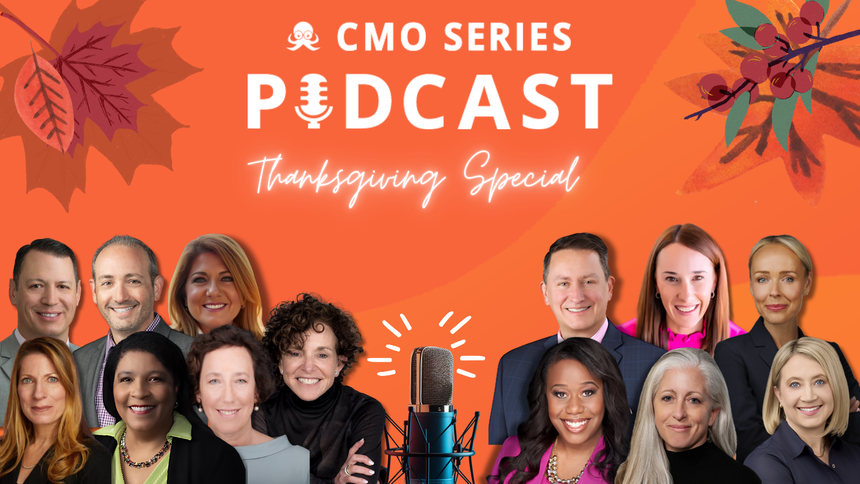





Join us this Thanksgiving, to celebrate with our amazing community of CMO Series friends.
For this special CMO Series Podcast episode, legal marketing and business development leaders reflect on the next generation of talent and celebrate the individuals who have challenged their thinking, encouraged their growth, and helped shape the year’s successes.
Thank you to our featured guests for sharing their insights:
- Sarah Korth, Chief Business Development Officer at Littler
- Gretchen Materna, Chief Marketing and Business Development Officer at UB Greensfelder
- Liz Sobe, Director of Business Development at Robinson+Cole
- Julia Bennett, Chief Marketing and Business Development Officer at Davis Wright Tremaine
- Amy Shepherd, Chief Marketing and Business Development Officer at Davis+Gilbert
- Iwona Kesting, Chief Business Development and Marketing Officer at Kilpatrick, Townsend & Stockton
- Roy Sexton, Chief Marketing and Client Development Officer at Vedder
- Roanne Neuwirth, Former Global CMO and Program director for the Conference Board’s CMO Advisory Council
- Nicole Giantonio, Chief Marketing Officer at Epiq
- Jessica Lyn Zall, Chief Marketing Officer at Burford Capital
- Andrew Laver, Chief Marketing and Business Development Officer at Porzio, Bromberg & Newman
- Deb Ruffins, Managing Partner at Deb Ruffins Consulting Group
- Brandon Meek, Chief Marketing Officer at Gray Reed
From all of us at Passle, we are wishing you a very happy Thanksgiving!🍂
Transcription
Dionne: Welcome to this year's Thanksgiving special of the CMO Series Podcast. In the spirit of appreciation, we invited friends from across the legal marketing and business development community; to reflect on the future of the industry and the people who played a role in changing our guests' approach to their work and have helped bring meaningful initiatives to life. To kick this episode off, we're focusing on the people who have had the biggest impact on how our guests think about their work, approach challenges, and help move their organization forward.
Charlie: This episode is brought to you by CrossPitch AI, the new cross-selling tool from Passle. Cross-selling should be the easiest way for law firms to grow, but most firms struggle. Why? Lack of awareness, lack of trust, and frankly, fear of selling. The result? Missed revenue. CrossPitch.ai fixes that. It breaks down silos, helps professionals connect, and delivers timely, relevant insights to the right people inside the firm and out. There's no heavy roll-outs. Just switch it on and try it today. Head to crosspitch.ai to book your demo and make cross-selling happen. Now, back to the podcast.
Dionne: So without further ado, let's hear from this year's incredible cohort of legal marketing and business development leaders.
Jessica Lyn Zall: Hi, I'm Jessica Zall. I am the Chief Marketing Officer of Burford Capital. I actually couldn't single out one person, because I've learned so much from my entire team this year. We've been going through a pretty significant transformation at Burford, moving from what I call Marketing 1.0 to Marketing 2.0. We're bringing back a much more integrated approach to marketing, working more closely with business development, and making sure everything we're doing is tied to our commercial goals and delivering a more consistent client experience.
And that comes with a lot of change, and change is exciting, but it's also hard, and everyone approaches change differently. I think one of the biggest things my team has reminded me is that sometimes I need to slow down to bring everyone along. I'm naturally someone who has a lot of energy, likes to move quickly, loves to get things done, but I've learned how important it is to listen, to trust people's expertise and experiences and understand what they need from me to be successful.
I've also learned to appreciate the smaller wins along the way. When you're so focused on where you wanna get to, it's really easy to forget how far you've already come. And I think that's probably been my biggest takeaway this year. Leadership isn't just about setting the direction and driving change, it's about creating an environment where people feel empowered, supported, and have opportunities to grow and shine, and I'm really grateful to my team for reminding me of that.
Julia Bennett: Hi, I'm Julia Bennett, and I am the Chief Marketing and Business Development Officer of Davis Wright Tremaine. This year, I would say my whole team has actually taught me a lot about AI, and they teach me a lot about how to incorporate AI into my own work and the work of the team every day. My client experience team has done some really incredible stuff using AI to improve a client's matter workflow, which helps them better serve their own customers.
And team members across BD and PM come up with prompts on a daily basis that help us produce great intel for our lawyers. And the eye-opening piece of that, for me, has really been that we can lean into AI, use it as a partner, establish governance and guardrails, but lean into it in such a way that it accelerates our work and the work we do for our attorneys.
Roy Sexton: I'm Roy Sexton, Chief Marketing Officer at Vetter in Chicago. I wanna give a shout-out to my colleague, Lexi Blainer, who's our martech manager and is just a wonderful soul with so much energy and so much to give, and she'll probably cringe that I'm calling this out. But we had a meeting maybe three or four months ago, and she said, "Roy, you're always so positive. You're always so affirming. I appreciate that, but I need the hard truth, too." And, and I paused for a minute, and I realized that sometimes kindness and support come from giving people the criticism they need without baking it in the... You know, we're always taught the sandwich. Give them something good, give them criticism, give them something good again.
And, she was saying to me quite plainly, "Our trust is there."I know you support me, but I wanna grow and I wanna get better at what I'm doing, and I need you to tell me where I'm falling down”. And it's just, you know, at this late stage of life, you'd think you would know that intuitively, but it sort of unlocked something for me where I was like, yeah, there is, there is kindness in candor.
Liz Sobe: This is Liz Sobe. I'm the Head of Business Development at Robinson & Cole. This year at Robinson & Cole, I saw the smooth transition of managing partner from Rhonda Tobin to Mike Werbin, an experience that reinforced the importance of trust, listening, and collaboration. As tools and technology continue to advance our work, the people behind it matter more than ever, and that belief guides how we approach business development and marketing under our strategic growth umbrella, not only in our own collaboration, but in how we work with every business team and attorney at Robinson & Cole, and most importantly, with our clients.
So I'm reminded to pause, listen carefully to what is said, and what may be left unsaid, and consider how we can be genuinely useful. Our role is not simply to promote services, it is to help solve problems when the time is right. Trust grows when we show up, follow through, listen, and lead with generosity. And so the managing partner transition showed me and reminded me that a connection may be the initial spark, but lasting relationships are built through positive interactions over time.
Iwona Kesting: Iwona Kesting, Chief Business Development and Marketing Officer at Kilpatrick Townsend Stockton. Something that always stands out is a piece of guidance that I got from our Chief Operating Officer, Alex Rahm, on our first meeting when I arrived at the firm. And he reminded me that there is always a good use of your time, a better use of your time, and a best use of your time. And that's something I keep in mind not only on a daily basis, but on a minute-to-minute basis in my role.
Nicole Giantonio: Hi, I'm Nicole Giannone. I'm the Chief Marketing Officer at Epic. I believe that our team has really grown this year because every person on the team has owned something. They've been 100% responsible for one aspect of their job. And one thing I've learned over my career, it's best to give people things that they own and they can control and they can influence. It's really been exciting to watch people do their jobs.
Gretchen Materna: My name is Gretchen Materna. I am the Chief Marketing and Business Development Officer at UB Greensfelder, otherwise known as UBG, and I started with the firm in March of this year. So what have I learned or what has a team member taught me this year that has helped guide my efforts? There's a lot there. So for a little bit of context, when I jumped into this role, this firm is a product of a merger that took place just over two years ago, and you would like to think in two years plus that a firm has all the kinks worked out.
And unfortunately, that was not the case. So when I started with the firm, the team was down to very few people. We were down to four. So I knew part of my mandate was really to grow the team and figure out what we wanted to do to kind of shape how we support the attorneys. So building a strong foundation was really what was necessary for me and something I had to focus on. And so patience came along with that too. As a CMO, you wanna hit the ground running and show that you can do stuff, but it's really important to take time, especially that first year, if I'm being honest, that first year, to really listen to your team, your attorneys, your peers, and staff before making big changes.
It's also really important to digest the history and context because if you dive into something not acknowledging or taking into account what was tried or done in the past, you are setting yourself up for failure. So I am still seven months in, actively meeting with partners across offices to better understand their practices and learn more about the office culture because the marketing tactics that you put in place, they all need to resonate with the personalities of the office and the firm as a whole. So what I've learned, just to go back to the root of the question, is that I have to take my time and slow down, and that is hard to do when you are trying to prove yourself in a new role. But I really believe that if you don't do that, you are setting yourself up for failure.
Dionne: Next up is Deb Ruffins, Managing Partner of Deb Ruffins Consulting Group.
Deb Ruffins: I was actually talking with John Mitchell, the purple coach, who is my liaison for the book that I just mentioned that I'm working on, and he has given me two excellent pieces of business development advice in this process.
One is to use the writing of the book as an opportunity to do business development. So call people and have conversations with them, and people will inevitably answer the call if you say you wanna talk to them about a book you're writing. That has been true. And then the other thing he told me just yesterday, actually, was if you have too much content for the book, turn that content into either a course or an article or something else that you can use for BD, and none of it goes to waste.
Andrew Laver: Andrew Laver, Chief Marketing and Business Development Officer at Porzio Bromberg & Newman. Day-to-day, we are constantly being told about AI and how it is continuing to grow within our industry. One of my team members challenged me to stop thinking about AI as a future capability and start treating it as a present-day productivity tool. While my firm may not be Am Law ranked, that doesn't preclude me or us from tapping into the same tools that firms down the street use regularly. That shift moved us and me from talking about possibilities to finding practical ways to work smarter every day.
Amy Shepherd: This is Amy Shepherd. I'm the Chief Marketing and Business Development Officer at Davis & Gilbert. So when I think about what, something meaningful that the team has taught me as I've transitioned into a new firm and, and what it has shaped my approach is really flexibility. It's amazing to kind of be able to discern the differences between a large firm and a smaller firm, but the needs of the lawyers don't change.
And so flexibility really, and the ability to pivot and wear many hats, I think we all do that regardless of the size of our firms. But when you have a smaller firm and a smaller team, it really the flexibility and the degree of willingness to move in the moment has really been something incredible that I've learned from my team and something that I'm embracing as well as I'm being forced to do that as well.
So it's really been extraordinary to have a team that really can step up in so many ways at the drop of a hat, um, to fulfill and meet the needs of the lawyers, regardless if it's marketing, comms, BD, and it's really been a wonderful experience.
Dionne: Closing out this section of this episode is Roanne Neuwirth, Former Global CMO and Program director for the Conference Board’s CMO Advisory Council. Followed by, Brandon Meek, chief marketing officer at Gray Reed.
Roanne Neuwirth: Well, I was reminded and really reinforced about my long belief in the fundamental importance as a leader in not being the one to solve all the problems and come up with all of the brilliant ideas. I've always strived to create an environment for my team to make sure they're stretching, they're thriving, and that they feel free and safe to come up with innovative ideas and creative solutions on their own, and also to really reward that kind of thinking.
But of course, it's not always easy to know if that's working. And earlier this year, we were challenged with a panicked and confusing request from the global leadership team to sort of drop everything and rapidly build a new global campaign based on what was a laundry list of disjointed ideas and I frankly was very frustrated, first about the impact to the momentum of our program, and also trying to figure out how to spin up something with this sort of laundry list was really rather exhausting.
But one of my direct reports, she took this as an opportunity to get excited about. She sprung into action as she does. It was so impressive the way she stepped back and tried to look at these disjointed ideas through the lens of our buyers, our clients, and she ended up creating what was really a brilliant concept that both addressed the leadership team's concerns with those topics, but it also elevated these random thoughts to a really compelling and sort of flexible go-to-market story that we were able to use in different geographies.
The BD team was able to have all different kinds of conversations. The consultants were able to tuck in all kinds of conversations around it. She went on to lead her leadership team peers to pitch in to actually bring this to life. I didn't have to do anything. I didn't have to chase people and create a sense of urgency. They just did it with her leadership. And I mean, she gave me lots of opportunity to contribute and steer the initiative as we rolled it out, but it was so rewarding to be reminded of what's truly possible when you believe in your team and set them for success.
Brandon Meek: I think the thing that I've learned the most in my year or so with Gray Reed is just how much, uh, the legal industry is a referral business, more so than anywhere else I've seen in my kind of professional services career. Attorneys really focus on that referral angle, leveraging existing relationships, whether it's existing clients, it's other law firms, it's CPA firms. They're very big on,really cultivating, uh, those interactions, um, over time and, and building really strong, long-term partnerships with those that they work.
Dionne: The first part of this episode, we've reflected on the people who have helped shape our guests' approach to their work. Now, let's turn our attention to the meaningful initiatives they've launched this year and the individuals who have played a role in bringing those to life.
Julia Bennett: So one of the development initiatives that we worked on that may not seem like a development initiative, but really was, was our all-attorney retreat. And the theme of our retreat was around business and client growth. Our goals were to foster cross-practice collaboration, to facilitate meaningful discussions among our attorneys, and to have fun while we were doing it.
And every part of the CMBDO org touched that retreat, from my practice managers putting together agendas for practice and industry group meetings, to my marketing and business development teams working together to facilitate introductions and using CrossPitch to help laterals identify people that they should meet. Everybody really leaned in to make sure that this was one of the best retreats the firm has ever had.
Roy Sexton: While I'm, you know, embarrassing my team, I wanna give a shout-out to Maziel Abrego. We started the year with a website and brand launch, one of the projects I inherited when I came here, and she led that very well. And then we had a shareholder retreat, so kind of the trifecta. When you're a new CMO, you work on those things, which is great, and you learn a lot about the organization. But I said, "You know, Maz, I want us to retool our client development side of our team, do a light reorg, look at the pitch and proposal process, really get under the hood of these processes”.
And we brought in some consultants, Wendy Bernero's helping us out, and Maz took to it beautifully. And I've just seen this fabulous evolution in her and what she's doing with the team, and the strategic thinking she's bringing to how are we measuring the effectiveness of this? How are we creating greater efficiencies? How are we bringing in tools that empower the team to not just respond to the request, but help shape the request and make sure we get success out of it? So it's a bit of a reorg, a bit of a structural change, a bit of a process improvement, but really all tied to Maz and, and what she's doing. And, you know, she's gonna be on the international board Legal Marketing Association next year, so, you know, she's in her zone. If you see her, give her a pat on the back.
Liz Sobe: One initiative this year at Robinson Cole that is making a meaningful difference is our Small Talk, Big Impact program, which I launched over the summer with the help of my team and a summer intern, and I'm very grateful for their creativity, enthusiasm, and partnership in bringing the idea to life.
Its message is simple: small, genuine conversations can have a big impact, especially in a world where technology has an increasing influence on how we connect and build relationships. Before our all attorney... our recent all-attorney retreat, we used the theme with our first through third-year associates to help them make the most of networking with colleagues they might be meeting in person for the first time.
And we're also weaving the idea into several of our client development initiatives and encouraging a broader habit of communicating thoughtfully. Sometimes saying less means more, and making space to listen, understand what matters, and responding with intention. So I'm grateful to my colleagues who have embraced the Small Talk, Big Impact business development strategy and are helping to carry it forward.
Gretchen Materna: It's still early, but a new initiative or development that we've introduced since my time here was actually launched today. So today we launched a brand-new intranet homepage as well as a gifting store, which might not sound completely innovative, but when you're when marketing owns the homepage, you really need to think about how best to utilize it.
But when I started, and through my listening tour, what I really, like, heard a lot about was the need to cross-sell, which makes sense given the merger that took place a couple of years ago. But the act of cross-selling can be really tricky. It sounds easy enough to refer work for, you know, to a current client to a new colleague. But at the end of the day, you need to build awareness and trust before partners are going to cross-sell.
So given that marketing owns this homepage of the internet, which I know many people will say that is where information goes to die, but still we owned it, so we need to make the most of it. And it was not being used, utilized to its tech- its capacity. So we decided to revamp it to be more people-focused and help attorneys, but really everyone gets to know one another on a certain level.
So our tagline is, "Our business begins with you." So we have a section on the internet devoted to asking our attorneys, "What is your focus?" Who are your clients and what are the trigger words that help another attorney understand when to engage you? So, we set it up in a way that's quick, digestible bites of info that we hope are easier to retain.
And I know this sounds basic, but in order to do cross-selling, if you don't know who your partners are or what they do and can speak to the services the firm can offer, you really can't do cross-selling or do it properly. So it was a very basic, kind of foundational type of effort, but something we thought was important to kind of build upon to do bigger cross-selling.
Iwona Kesting: I recently rolled out an initiative that is focused on cross-selling a core set of our targets in the middle market, and we identified a list of approximately twenty-eight targets. And I've assigned a BD team lead to each one to work with the relationship lawyer for each of them and to drive those efforts forward.
And I'm particularly grateful to the BD team that is assigned to that effort because it will require systematic pursuit and efforts towards developing and growing those relationships with those clients over the coming year and a significant amount of their time, and everyone is already incredibly busy. And it just is something that I'm very grateful for the team rallying behind, the firm rallying behind, and all of the relationship lawyers and the other lawyers that will get pulled into this to help us with.
Deb Ruffins: And it's going to sound pretty simple, but it wasn't a way I was looking at this thing. So, a former colleague of mine, Andrea Bazemore, we worked together at Hogan Lovells. I left. She left. She went to get her doctorate in leadership and she did her thesis on Black female associates, and she found a very interesting gap in the associates' perception of themselves and their abilities and their likelihood for success, and the partners.
And the partners basically said, "They are terrible communicators. They don't know how to read the room. They don't anticipate." All of these things have to do with EQ, or emotional intelligence. And as I was talking to talent leaders in different firms, they were saying, "That's a generation issue. That's not just a Black female or a diversity issue." And there's a lot of interest in helping lawyers get started in the right way with good EQ skills. So Andrea and I have started delivering a program on that topic. And for me, I was like, "Well, I don't work with associates usually, and I get EQ as part of business development and relationship development, but why me?"
And what she helped me understand is the core skills are all the same. It's all around communication. It's all around listening well. It's all around, you know, if you develop a relationship with your lawyers internally, with your senior associates and partners, those same skills are applied for developing relationships with clients and prospects when you get to that stage. And so particularly with the advent of AI and it's eating up all the, you know, basic junior lawyer work, the lawyers are going to have to learn a different set of skills to make them successful. And it is all around these abilities to, you know, emotionally regulate, to have cognitive empathy, to just listen for the opportunities, not to pick apart an argument.
So skills the lawyers already have, but they have to learn how to apply them in different ways. And so that's been a new learning for me this year, and I'm really excited about the potential of that kind of focusing on how do you improve your impact by improving your, quote-unquote, "soft skills," not something that's taught in law school or as part of the typical professional development programs.
Jessica Lyn Zall: I'd say the biggest initiative has been investing in how we develop as a team, not just individually, but also how we work together. We've really focused on three things that are closely connected, professional development, embracing AI, and building a much more integrated approach to marketing and business development.
On the professional development side, we've introduced more formal training around integrated marketing planning, strategy. We've been encouraging people to build skills outside their immediate areas of expertise. AI has also been a big part of that. I, myself, am a huge believer that AI can help us work smarter, take some of the more manual and time-consuming work off our plates, and free us up to spend more time on the things that really require human expertise, like strategy, creativity, relationships, and collaboration.
I always say that AI doesn't replace human expertise. It gives us more time to use it. And that really ties into the third piece, which is breaking down silos and getting people working together across the organization, across marketing, business development, and the company as a whole. Because ultimately, the more connected we are internally, the better experience, or the better the experience we can deliver to our clients, and the greater the impact we can have across the business.
So for me, these aren't three separate initiatives. They all reinforce each other, and the more we invest in our people and give them the right tools and opportunities to develop, the better we collaborate and the more meaningful our work becomes. And none of this happens because one person comes up with an idea. It's been a real team effort, and I, again, I'm incredibly grateful to everyone who's embraced these changes, who's challenged our thinking and, and helped bring everything to life. We're still evolving, but I think we're building a really strong foundation. And I think that's a nice thought to end on, especially around Thanksgiving.
At the end of the day, I'm really grateful to have a team that's willing to embrace change, that challenges me and keeps learning together. We're still all learning, myself included, and I think that's what makes the journey rewarding. And if there's one thing this year that has reinforced for me, it's the transformation. Transformation is really about people. Technology, processes, and strategies are all important, but it's the people who ultimately make it happen.
Roanne Neuwirth: Well, I was reminded of the power of helping when it comes to business development. And in professional services, business development is selling, and delivery. They're intertwined, and as you build relationships, they're happening continuously. And good consultative selling or business development is really all about asking deep questions, listening, inspiring, and helping your prospect solve their problem, get new ideas, and experience the value of collaborating with you as part of the process.
I had my first meeting with the principal of a small consulting firm, and 10 minutes in, sort of my head was, like, already spinning with ideas. She understood my challenge really fast. She asked questions that I wouldn't have thought to ask. And it was really interesting. She gave me three or four really actionable suggestions, things that I could just go do, whether or not we ended up working together. She was able to describe a clear path for me to get where I was hoping to get, sort of based on quickly what she'd learned, her ideas, and sort of her expertise and knowledge. But it was in the context of what I cared about. I actually was having a lot of fun during the back and forth, and in that moment, I could absolutely imagine working with her and her team.
I felt like we were sort of already working together. And I knew it was a BD call. I knew I was being sold too. I'm in the business. But it was so interesting. I didn't feel annoyed that I was getting sales pitched. I found myself, while we were talking, running through, "So, okay, what am I gonna do to make this happen?" And I think that's why when you think about business development and professional services, it's all about helping. And I sometimes hear consultants or even lawyers say, "We can't give away our ideas. We can't give away our insights. That's really risky. People will just go do stuff without us." But I think this experience shows that that's just not true.
If you go into business development with that helping consultative mindset and think of the conversations as starting on the journey, one, to work together, two, to solve a problem, three, it's really gonna pay back in spades.
Nicole Giantonio: On the marketing team within Epiq, this year we introduced career cohorts. We have four career cohorts. They go from people that have worked between one and six years, six and 12 years, 12 to 20 years, and then 20 and beyond. This was an idea that came about in our employee survey. It allows each of the groups to focus on things that are important to their point in their career. So those that are under six years are looking to do a lot of different projects and see what they like to do.
Those that are between six and 12, we've asked them to pick their major and become the best at it in the industry. Those that have worked in the industry or any industry from 12 to 20, they're really focused on leadership and how do I lead people through the next phase of delivering results to the organization.
And those that have worked past then 20, we're really focused on, again, what do you enjoy doing and then how can we make it a very fulfilling part of your time or your career? So those cohorts have been really critical. It was an idea of another leader within the organization, and it really has gotten people inspired to come to work and think about more than just the work that's on their plate, in their Monday board, but really what they want to be doing for the rest of their careers.
One of the things that has changed is that AI is changing and really disrupting both legal and marketing, and of course, we do both. And what we're focused on within Epic and within Epic's marketing department is not only doing things faster or more efficiently, but really changing what we do. Eliminating things, adding things, and really looking at our entire strategy on where AI, specifically agents, autonomous agents, can impact our business.
Sarah Korth: Yeah, this one, this one was hard because, like so many other people, we're incredibly busy. But really sticking with that theme about the collective we, a good example of this for us has been the launch of our business development training initiative earlier this year.
At Littler, we wanted to be much more intentional about how we help our attorneys develop as business generators. With multiple generations in the workforce today, we really wanted to create a mix of different tools for them to use to address the different ways they learn. So from short form context, to podcasts, to tools, to templates, really the goal was to give everyone this common playbook and language around business development without suggesting to them that there's only one right way to do it.
Great business developers don't all look alike. We say that a lot. For some, you know, it's relationship building, and for others it's thought leadership, networking, et cetera. But we really wanted everyone working from the same playbook, and that doesn't mean everyone has to play the same way. So I think really what I'm most proud of though is how the training initiative all came together. So I mean, a huge shout-out to some business development leaders on my team, Alison Coleman, Jen Bonesteel, Denise Curtis, they really led that effort with input from our entire BD team.
Amy Shepherd: So there's a, you know, there is a me- you know, meaningful initiative that we've introduced this year. Like many, chief marketing officers and marketing teams, we focused on our CRM system. And it really has brought about meaningful change, and the team really has stepped up. You know, technology is always challenging. It's always difficult to get lawyers to change their work styles and adopt new approaches. And the team really has been so focused on change management and guiding the lawyers and through the transition to launch the CRM with some success.
So it's really been a great experience and, and I couldn't have done it without the team around me. It definitely takes a village.The marketing operations technology team, our communications teams, have really stepped up to work together to bring this to life.
Andrew Laver: This year we took on two significant projects that really went hand-in-hand. We launched a refresh brand, and we opened our new headquarter office in Parsippany, New Jersey. Those by themselves were major milestones for the firm. But what I'm most proud of is how the team came together to make it all happen. Throughout the process, they managed an enormous amount of change while continuing to support the day-to-day needs of the firm, the attorneys, and our clients.
The rebrand wasn't just about a new look, and the move wasn't just about a new space. Both were really about positioning the firm for the future. My team embraced that vision, brought tremendous creativity and energy to the work, and stayed focused on the details that ultimately made a difference. Watching them adapt, collaborate, and execute at such a high level reinforced what I've always believed, great accomplishments are rarely the result of one initiative or one person. They're the result of talented people pulling in the same direction. That's what made these efforts successful.
Brandon Meek: Yeah, there's a couple of initiatives that I've done over the last year or so, that I think really took that learning that I had around the referral network, aspect of law firms. One is a video production platform in order to really highlight individual attorneys. Most branding and marketing focuses on the firm level and maybe the practice group level. But I've really been trying to take it to another place in terms of really focusing on the expertise and, and the individual personalities of the attorneys that work in my firm.
Giving them the stage to go out and share their knowledge, um, share their personalities, and give clients an opportunity to meet us before they meet us. The other is around our answer engine optimization program. You know, as the technology in the legal industry has really started to evolve, moving our firm to a place where we're being found in more places beyond what the, what the tradition, the traditional mechanisms have been.
I've really tried to build up a platform for AEO where users that are interacting with AI engines, they're, they're, they're using AI engines for search capabilities. They're really trying to get specific legal industry questions answered and find attorneys that can support them. I've really built up a platform to get Gray Reed positioned into that framework. And, you know, our partners have been really supportive of both of these endeavors. I think they've really started to understand over the last three or four months in particular, the value of these, of these investments, that I have recommended on behalf of the firm. Um, and it's, it's really exciting. We're really seeing the firm benefit from these.
Dionne: That is a wrap on this year's Thanksgiving special. A massive thank you to all our guests for joining us and to all of you for listening. From all of us at Passle, we are wishing you a very Happy Thanksgiving.
Charlie: You can follow The Passle CMO Series podcast on your preferred podcast platform. Thanks for listening, and we'll see you next time.