



AI is transforming the legal industry, yet many firms are missing a trick. While policies and strategies are taking shape, marketing and business development are too often left out of the conversation.
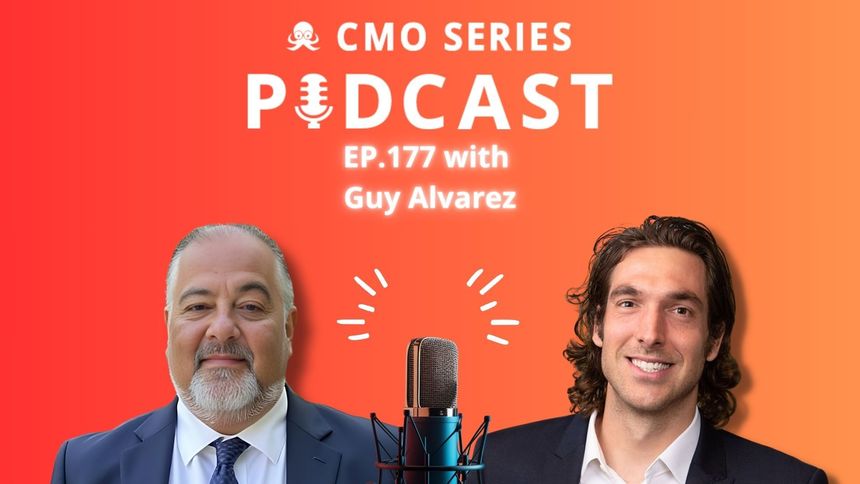
In this episode, Charles Cousins speaks with Guy Alvarez, lawyer-turned-entrepreneur and founder of InnovAItion Partners, on why marketing and BD leaders need a seat at the AI table, and how their involvement can drive innovation, meet client expectations, and give firms a competitive edge.
Guy and Charles cover:
- Guy’s journey into legal marketing and the work he has done with Good2bSocial
- The pivot towards AI and the turning point for this
- Key insights from Guy's recent survey on AI adoption in legal marketing and BD
- The current position of the legal field in adopting AI into marketing and BD
- The role legal marketers should be playing when it comes to AI strategy.
- The steps firms should be taking to move in the right direction in adopting AI into marketing and BD
- Advice for team leaders or individuals navigating the space of AI adoption and how they can set themselves up for success
Transcription
Charles: Hello and welcome to the CMO Series Podcast where we talk all things marketing and business development in the world of professional services. I'm Charles Cousins, and today we're joined by Guy Alvarez, founder of Innovation Partners. And many of you know Guy 'cause he's a long-time leader in legal marketing. We are diving into guy's latest AI research. And what it means for marketing and BD professionals in law firms.
Charlie: This episode is brought to you by CrossPitch AI, the new cross-selling tool from Passle. Cross-selling should be the easiest way for law firms to grow, but most firms struggle. Why? Lack of awareness, lack of trust, and frankly, fear of selling. The result missed revenue. CrossPitch AI fixes that. It breaks down silos, helps professionals connect and delivers timely, relevant insights to the right people inside the firm and out. There's no heavy rollouts. Just switch it on and try it today. Head to crosspitch.ai to book your demo and make cross-selling happen. Now, back to the podcast.
Charles: Guy, welcome to the podcast.
Guy: Thank you, Charles. It's a pleasure to be here.
Charles: And, this isn't the first time we've been on a podcast together, but the roles are reversed, so I'm -
Guy: That's right.
Charles: I'm the one asking the questions today. So, yeah, good to catch up. And I think maybe to give a bit of context, if there are some people that have maybe been living under Rock and dunno who you are, maybe you can give us a brief intro and start with your story.
Guy: Sure.
Charles: You've had a career in legal marketing. So maybe take us through your background, the work you did with Good2bSocial, The sale to best lawyers, and then what led you to shift your focus fully towards AI.
Guy: Absolutely. So I started out as a lawyer. I am a recovering lawyer. I practice international trade law for the first five years of my career. A topic that was really not relevant, and now today it's like the hottest thing. But in any case, I actually built one of the very first law firm websites for my firm. And I decided I'd liked digital marketing better than I liked practicing law. So I left the practice of law and went to work for what was then the New York Law Publishing Company, which today is ALM. Running Law Journal Extra. And then I left there and I went to work for KPMG. I was Global Director of Digital Marketing.
I was there for about five years, and then I decided to go back to my legal roots. I was first as a consultant and then as an employee worked at the practicing law institute, PLI. Helped them set up their online division and a lot of the digital products that they have today. And then in 2012, I decided to start Good2bSocial. I started it really out of my kitchen table just by myself. And 12 years later we had about 30 full-time employees. We were one of the leading digital marketing agencies for law firms, working with firms of all different types, all different sizes from Am Law 50 firms to solo practitioners and everything in between.
And in August of 2023, we sold Good2bSocial to Best Lawyers which is a private equity backed company. I stayed around for another year or so, and what I started to see is I started to notice that a lot of the work we were doing at Good2bSocial was really; could be done with AI. So I started to understand that AI was really gonna impact the two industries that I was in. One marketing and the marketing function, and two, the legal industry. And so I decided to leave at the end of December of last year, and I dove head into AI and learned as much as possible as I could. I took a course at MIT on AI and Business Strategies, aside from many other courses, and here I am, working and helping law firms and other professional services firms understand how to use AI to grow their practice and grow their firm.
Charles: Yeah, and I am connected with you on LinkedIn, so I regularly get to see your, your post that you're putting on there and some brilliant stuff. So if you folks aren't connected with Guy, make sure to connect. He’s got some brilliant updates and content that goes out on LinkedIn.
Guy: Thank you, Charles.
Charles: And recently you ran a survey around AI adoption in legal marketing and bd. Can you give us an overview of what you set out to learn there and who took part in that?
Guy: Yeah, so I ran the survey in conjunction with Amy Shepherd at Gladstone Growth. We decided to partner to run this survey. It's the first of its kind survey, so there's been a lot of surveys around adoption and even surveys around adoption in the legal industry. But we felt that there was no real data in terms of how marketing and business development professionals at law firms were using AI.
So we created this survey. We started to run it, and it ran for about three months. We got well over 80 responses. The breakdown is about 30 to 35% Am Law 100 firms. Another 17% or so were Am Law 200 to 100. And then the remaining 40 something percent were mid-size firms and boutiques. So we had a pretty good representation across all law firms and, you know, some of the leading things that we saw come out of it where, number one, most firms have an AI policy, which is not surprising since we're talking about law firms. But when it comes to involving the marketing and business development function in AI policy, AI direction, AI strategy across the board, most firms are not doing that. They are not involving CMOs in their AI councils. In fact, many CMOs that I have spoken to have said that they're having a really difficult time proving why there should be an investment into AI. Training was another thing that we saw. There's very little training overall on AI and those firms that are doing training, they're doing one size fits all types of training.
They're not training specifically the marketing and business development folks in terms of their use or how they can use it. So while adoption seems to be on the rise, and we've heard from firms, a lot of firms are using it. At the beginning stage, it's experimenting.There seems to be a lot of room to cover to get to a stage where most firms are using AI from a marketing and business development perspective.
Charles: And apologies going off piece a little bit. This wasn't one of the questions we talked about, but in terms of that adoption, has it been in a structured way or are the people that you were speaking to kind of it's like individuals finding something and taking it to their leader and saying, “Hey, what do you think to this?” or was there, did you come across any sort of -
Guy: Not a lot of structure, Charles, quite frankly. Not a lot of strategy. So it's, again, this is the funny part, when you look at the data. Yeah, everyone, or mostly everyone has an AI policy, but when you talk about strategy, very few do. And there was a similar survey and report done by an organization called the AI Marketing Institute, which was a broader survey looking at all marketing functions.
And when you look at the results of that survey, more than 60% had an AI strategy in place. But not that many had a policy in place, so it's sort of like reverse roles. But clearly what I have heard from a lot of the CMOs and marketing and business dev professionals is that there's no real strategy as to how they're rolling it out. There's no training across the board. There's no strategy. There's no way to test out what use cases they should be doing. So it's more of a sporadic kind of thing than a cohesive strategy.
Charles: Yeah. And based on that research and the folks you spoke to, where would you say firms are really, in terms of adopting AI in the marketing and BD function? What's the general sort of feel?
Guy: My feeling is they're very much at the beginning stages, most firms. A lot of them are doing it ad hoc as you mentioned. And it's interesting because while the Am Law 100 firms have a defined strategy around AI and when it comes to marketing and business development, they don't really have one. I was speaking to a director of innovation at an AM Law 50 firm, and a very well known guy. And I said, you know, what are you guys doing in marketing and bd? He's like, that's not for me. I don't really know what we're doing. Which was kind of surprising, but that's kind of where I think we are today.
Charles: Yeah. And do you think it probably sits more then with the marketing and BD leaders rather than if someone's got that sort of head of innovation role, or do you think their role should encompass marketing and bd if not just legal process?
Guy: I think law firm leadership, for the most part, is making a mistake in not giving CMOs and CMBDOs a seat at the table when it comes to AI policy and AI strategy. There's a lot of noise about AI and how it's being used for the practice of law. There's very little information about how AI is being used for the business of law. And not giving CMOs and marketing leadership a seat at the table I think is going to result in a lack of coherent strategy. And also what I'm hearing is clients, GCs and other clients are starting to ask “How are you using AI? You know, how does that impact your billable rate? How does that impact the amount of work?” And so if you don't have marketing folks sitting at that table and strategizing how to respond to that, that's gonna become an issue pretty quickly. So I really think most firms are making a mistake by not deeply involving their marketing and business dev leadership in decisions about how to use AI.
Charles: Yeah. And in terms of, are there any ideas you've got about what's holding things back or what are the biggest challenges or blockers that are getting in the way and stopping that from happening?
Guy: So we asked that question in the survey, and the three top responses we got are not gonna be surprising for you, right?
So number one response was fear of the AI making a mistake or fear of confidentiality issues or security issues. Again, and this is typical of a law firm culture, you know, lawyers are very risk averse, so of course they're being very careful. I have made the argument that a safe place to start is in marketing and business development because you're not dealing necessarily with external data, you're dealing more with internal information, and using AI to do internal functions. So that was number one.
Number two was culture. And that is, you're going to run into that, especially in the legal industry, right? The three pillars of most firms' culture is number one, the billable hour. Number two is the hierarchical structure of law firms where you have a lot of associates and a few partners. And then number three is that risk averse mentality, right? So when it comes to culture, it is a challenge to adopt a new technology, especially a technology as transformative as AI. And I believe AI really requires more than traditional training, but it's actually a behavioral change.
You have to actually rethink the way you do work to properly integrate AI into your workflows and to really benefit from it. So I think that was another big challenge. And then the third challenge that we heard was lack of budget, right? But the problem with that is sort of like the chicken and the egg dilemma, because what I have heard from marketing directors and CMOs is they're being asked to present business cases for why they should be investing in AI, but they're not letting them experiment with AI. So how can you actually build a case if you're not using it? So I think those are the main challenges that we're seeing at law firms.
Charles: So in an ideal world, without those challenges in place, I guess, what role should legal marketers be playing in the AI strategy? So how would it look in, you know, best case scenario? In an ideal world.
Guy: Best case scenario from my perspective is, as I said, marketing and business dev leadership should have a seat at the table when firms have AI councils or AI groups that are discussing strategy. Number two is there needs to be specific training for the marketing BD teams. The type of work that they do is different from the practice of law, and it's just as important in terms of knowing your clients, cross-selling, business development, all of those different things. And as you know, with what you guys are doing at Passle, you know, one of the great use cases of AI is the ability to cross sell and handle other marketing and BD functions.
And then the third one is to start small. I think it's safer when you experiment and start with small use cases. I think you need to get your team involved as much as possible and come up with a few use cases where you can start to apply AI and measure the results. And then as that grows, then you can start to formulate a larger strategy. But I think a safe place to start is with internal processes and with a few use cases where you can prove out value and you can prove out efficiencies.
Charles: Start small, land and expand. And, I guess that links into where I wanted to go next was around, your advice on where the firms start. Like how do they get to that point? What are the first steps they should be taking to start moving in the right direction? You mentioned about, you know, they need a seat at the table and starting small. But, is there anything that you think, you know, if someone's out there thinking, I dunno where to start, what would be your advice to them?
Guy: So the firms that we're working with, we're starting typically with an audit and it's a three-prong audit, so we're looking at their technology. So what technology do you currently have in place? How are you doing what you're doing today from a marketing perspective? Second, we look at their people, you know, what's their talent level? What's their skill level? How well do they know AI? Do they feel comfortable? Are they scared of it?
And then the third piece is processes, right? How are you doing things today? And what processes could you start with right now where you could apply AI to make them more efficient, more productive and free marketing and business dev folks up to do more strategic type of work? You know, marketing and business dev right now are being asked to do more with less, right? We're hearing about budget restrictions and hiring freezes. And so it's not for a lack of work. 'cause they have a lot of work to do. So strategically deploying AI, I think is a really good way to start.
Charles: Mm-hmm. I like that quote that I keep seeing on socials is “Your job isn't gonna be taken by AI, but it might be taken by someone that's using AI.”
Guy: That's exactly right.
Charles:Yeah, that is a neat idea. We are now actually gonna jump into a bit of a quick fire round where we are going to ask you a few questions just to learn a bit more about you, and then we'll go back into your key sort of takeaways and wrap up. The first question I've got on my list is what are you reading or listening to at the moment? This could be work related or it could be outside of work.
Guy: I'm reading a lot of books at the same time. I just finished reading a book by Ethan Mollick called Co-Intelligence. It's a really great book. Do you have it?
Charles: Not to show, but yeah no, it's back there.
Guy: Yeah, great book. Even if you don't know anything about AI, it's a really good starting point that kind of explains in basic terms, what AI is and how it's going to change our lives.
I listen to about 20 different podcasts. You know, the AI Legal Marketing Institute has a great podcast on marketing artificial intelligence. There's a podcast called All In that I listen to a lot. There's a company called Every, that has a podcast and has some great newsletters that I read.
But it's difficult, I'll be honest, keeping up and that's my job. Keeping up with the rapid pace of AI and everything that's going on really requires a strategic approach on how to do it because you can very easily get overwhelmed with all the things that are happening and how quickly things are happening.
Charles: Yeah. And what's one thing in your working life you couldn't live without?
Guy: That's a great question. I think the ability to talk to people. I think that's one thing that AI is never going to replace is, you know, you and I have, I've known each other for a while. Like you mentioned you were on my podcast several years ago, but every time I see you having a conversation, catching up that human to human connection I think is really important.
And so I think that's the one thing that I couldn't live with in terms of work, if I wasn't able to talk to people all the time, seeing them both either virtually or in person. I think that's really critical and it's a really important way to understand what your, you know, your client's needs are, what's keeping them up at night, where they see opportunity. So for me, that's the most enjoyable and most critical part of my work.
Charles: Yeah. Fantastic. Are there any habits that you think have helped you, particularly in your career?
Guy: I wake up earlier and earlier these days, because I always find that there's not enough time in the day to do everything you want to do. I also, before I go to bed at night, I will take a little bit of time to journal, what are the things I learned about today, things that I might want to go back to later on, or things that I want to tackle the next day. So I kind of prioritize the things I want to do that day, and I really focus on those things because you can get interrupted a million different ways.
So just try to come up with two or three things that really need to get done that day. I think it has helped me a lot. And the last thing is, uh, you know, when I was at KPMG, I had a boss that had a saying, he said, make sure you can be cozy with chaos. And what I have learned,both as an entrepreneur and as a business person, is that things change all the time. Some things are in your control, a lot of things are not. But being able to not only navigate uncertainty but thrive in it, is a unique skill. And I think if you can learn how to do that, regardless of what you're doing in life and what kind of work you do, I think it's, you're gonna be successful.
Charles: I like that. I've actually written that down. Cozy in chaos. Cozy with chaos 'cause I've got a coastal rowing race this weekend and it gets pretty chaotic out there. So I'm just gonna get cozy with the chaos. Have you got any professional wellbeing tips that you can share? You mentioned journaling, but anything else in just looking after yourself?
Guy: Yeah, so one of the things that I have found AI to be great at is, uh, helping to synthesize information. And again, we are at a point where we're getting more and more information each day, so prioritizing is important. One of the things I've been doing is I've been using a tool from Google called Notebook LM. And Notebook LM is sort of like your personal knowledge manager, if you will. So what I do is whenever I wanna learn about a specific topic, something new, I wanna learn or wanna take a deeper dive into it, I'll start by doing a deep research on Google Gemini. I've tried all the different deep research tools and I have found Gemini to be the best, more expansive.
So I'll typically give it a simple prompt. It'll come back with a 10 - 20 page report. Really, really good, good source - it gives you all the sources so you can check them. But rather than read the entire thing, what I'll do is I'll throw it into Notebook LM, and I'll ask it to create a podcast and it does that automatically. And you know, 10 minutes later I'm going out for a walk or doing some exercise. I'll throw on my headphones and I'll listen to it. And it's a great way to learn about new things. And the cool thing is you can actually ask the AI podcast host questions so you can actually interrupt them and ask 'em if there's something not clear, if you want to get a little deeper. So I have found that to be a really great learning tool and something that I recommend everyone should be using. Whether you want to use it for personal growth or for your work. It's really a fantastic tool.
Charles: Yeah, I'm gonna check that out. That does sound fun. Okay. So jumping back to our main sort of question and wrapping things up, we wrap our podcast up in the same way every time. We specifically ask for the, the sort of one key takeaway.So for you, I guess, is if someone's leading a team or maybe just starting to explore this space around AI and business development and marketing in law firms, what's the smartest thing they can do right now to set themselves up for success?
Guy: I think the one thing that I've been recommending to people is try to keep a journal of a work week. Like try to just make notes may, whether it's middle of the day, end of the day, look through your calendar and look at all the different things that you did that day. And think about how much time you spend on those things versus other things like answering email or being on Zoom calls and that will give you an opportunity to see where there are places where you can apply AI just as a person to make your work more effective. Where could you create workflows or automations or things that will make it easier and spend less time on the tedious, repetitive type of work that we all do.
Then those will give you good ideas of use cases that you can use. The other thing is for, for a marketing leader. Give your team the ability to experiment, in fact, encourage it, right? 'cause a lot of times the best ideas come from people that are doing the work on a day-to-day basis. It doesn't always have to be bringing in a consultant and you know it, yes, those things work, but I think the best ideas come from the people that are actually doing the work. So giving your team the freedom and ability to do that, I think is really important and it's gonna be a game changer.
Charles: Yeah. I love that. I think that's a good way to wrap up the podcast is to encourage experimentation in this space. Well Guy, I'm sure we could talk for a couple of hours, but we'll wrap up things there today. Thanks for coming on and telling us a little bit about what you are up to. For folks that want to reach out and get in touch with you, what's the best way for them to do that?
Guy: You can find me on LinkedIn. I'm on there every day. So just reach out, connect with me. I'm always happy to have conversations and if anyone has any questions, happy to chat.
Charles: Wonderful. Well Guy, thanks for your time today and have a great day.
Guy: Thank you, Charles. It's a great pleasure to be here and I look forward to continuing the conversation.
/Passle/53d0c8edb00e7e0540c9b34b/MediaLibrary/Images/2026-10-14-09-22-13-024-6acf49c5944aac193a981bb9.jpg)
/Passle/53d0c8edb00e7e0540c9b34b/MediaLibrary/Images/2026-10-13-16-00-13-704-6ace558d477453bcaa2eba35.jpg)
/Passle/53d0c8edb00e7e0540c9b34b/MediaLibrary/Images/2026-09-28-10-59-02-989-6aba4876c6484376446500cc.png)
/Passle/53d0c8edb00e7e0540c9b34b/MediaLibrary/Images/2026-10-08-10-14-29-755-6ac76d050b30ba925ae8bc36.jpeg)
/Passle/53d0c8edb00e7e0540c9b34b/MediaLibrary/Images/2026-10-08-07-04-41-374-6ac740898f60cb75fde15df0.jpg)