


Diversity, Equity, and Inclusion has become a critical framework for organisations striving to create more supportive environments for both current and prospective employees. As the competition for talent intensifies, firms are recognising the importance of addressing gaps in representation.
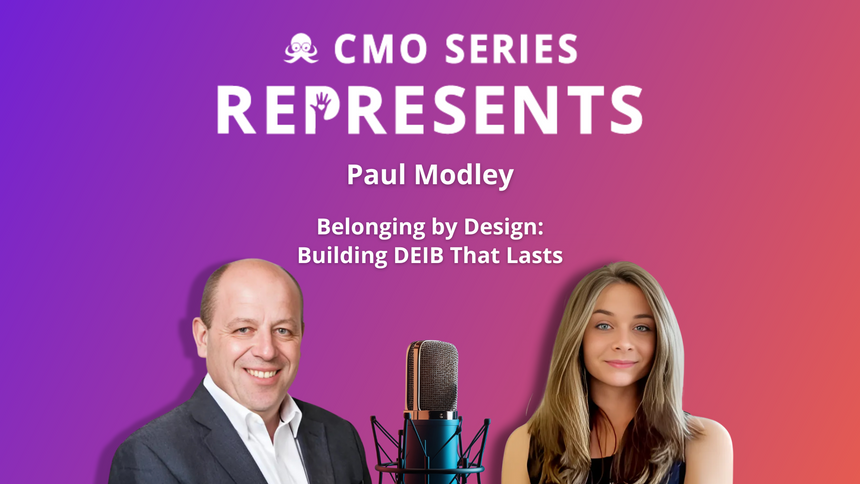
Today's guest on CMO Series REPRESENTS is someone well-versed in driving meaningful change and is here to discuss why building a culture of belonging matters. Olivia Backon is joined by Paul Modley, AMS’s Managing Director of Diversity, Equity, Inclusion, and Belonging.
Paul’s journey has been powerful and inspiring, taking him from his working-class roots in Wales to the London 2012 Olympic and Paralympic Games, and now leading the charge at AMS where he has created a global Diversity, Equity, Inclusion, and Belonging Centre of Excellence to ensure that existing and emerging talent get the support, resources and recognition they deserve.
Paul and Olivia explore:
- The influence of Paul’s upbringing in shaping his commitment to social mobility throughout his career
- How AMS has advanced its DEIB initiatives in response to global pivotal moments
- The strategies AMS is implementing to elevate disability inclusion and neurodiversity within workplace conversations
- How AMS supports clients in navigating their own DEIB journeys while maintaining clarity and consistency in its internal strategy
- What genuine buy-in for DEIB looks like in practice
- Practical advice for organisations seeking to strengthen and embed a more impactful DEIB strategy
Transcription
Olivia: Welcome to CMO Series represents where we talk all things diversity, equity, and inclusion in professional services marketing. Today we're diving into what it really takes to drive meaningful change and why building a culture of belonging matters. I'm Olivia Backon, and our guest today is Paul Modley. Managing director of diversity, equity, inclusion, and belonging at AMS.
Paul's journey is a powerful one, from growing up in a working-class Welsh mining town to shaping inclusive hiring at the London 2012 Olympics, to now leading a global DEIB Center of Excellence at AMS. Paul's story is one of persistence, purpose, and quiet transformation. From social mobility to neurodiversity, internal culture to client consulting pool is shifting not just policy but mindset; and today he's here to share how.
Charlie: This episode is brought to you by CrossPitch AI, the new cross-selling tool from Passle. Cross-selling should be the easiest way for law firms to grow, but most firms struggle. Why? Lack of awareness, lack of trust, and frankly, fear of selling. CrossPitch AI fixes that. It breaks down silos, helps professionals connect and delivers timely, relevant insights to the right people inside the firm and out. There's no heavy rollouts. Just switch it on and try it today. Head to crosspitch.Ai to book your demo and make cross-selling happen. Now, back to the podcast.
Olivia: Welcome Paul.
Paul: Thank you, Olivia, and thank you for the wonderful introductions.
Olivia: Thank you so much for taking the time to join us. To start with Paul, can you tell us a bit about your journey into diversity, equity, inclusion, and belonging? You started at AMS in quite a different role, so how did that evolve into what you do today?
Paul: Yeah, I'll take a step back before I joined AMS. So, as you mentioned in my introduction, I worked on the London 2012 Olympics and Paralympics, and I was very lucky to be involved almost from the beginning in 2007, not long after London was awarded the games. And working on the games really kind of opened my eyes to diversity and inclusion, because a lot of what we wanted to do with London was to engage with our different community groups, in the parts of London where the games were really taking place. So Stratford, Greenwich, Hackney, Walton Forest, etcetera.
So it's really important for us to really think about differences and engage with communities. So that's really where it all started for me. And then after finishing the games, I really had no idea what I wanted to do, having been involved in such a wonderful event, like the games. It was actually quite a challenging time for about 12 months, but I found myself at AMS and 12 years later I'm still there. So it was a really good move for me, but when I joined AMS, I went into, I guess utilizing my talent acquisition experience. I went into a client-facing role to kind of lead some of our significant accounts. And I remember meeting with the founder of the business, the chair of our business now, Rosaleen Blair, and she kind of knew about my passion for diversity inclusion. She said “Look, Paul, I want you, yes, we want you to do this important role of kind of managing some of our client accounts, but I'd love you to start thinking about diversity and inclusion from an AMS perspective.” And that's really what I did for the first six years of AMS. On the side of my desk, I really started to think about diversity and inclusion. I set up some kind of mechanisms for us to bring people together and to think about how we could celebrate diversity and inclusion across our business, and I was doing that alongside my day job. And then about five years ago, I made a move to take on internal hiring. So I was responsible for how we hired into AMS and, at the same time, I was then given formal responsibility for diversity and inclusion for the business.
And, and then about 18 months after that, I moved into my current role where I now sit. So I'm responsible for our center of Excellence for diversity, equity, inclusion, and belonging. It is really important for us to have belonging on there. And I've got responsibility for our internal strategy. We are about eight and a half thousand people business now. And therefore, it's really important for us to kind of create that environment where people can thrive, they feel that they belong and there's a strong inclusive culture. So that internal focus is super important, but I also have an external focus in terms of making sure that we think about our brand externally, that we don't just lead with our brilliant talent acquisition services, but we are also known for how we can support our clients from a diversity, equity, inclusion, and belonging perspective. So that's the journey. That's how I've got to where I am right now.
Olivia: Amazing. Thank you so much. So interesting to hear how that role you, you kind of really produced for yourself and, you know, you took on lots of different parts of the business, looking at that internal and external focus as well. And when we spoke before, you'd mentioned that your passion for social mobility stems back to your childhood, and it'd be interesting to know more about what shaped that focus for you and how does that has actually played out in your professional life.
Paul: Yeah, I'm really proud of where I come from. I come from a small, well, it used to be a very small town. It's now kind of grown, and it's become almost a suburb of Cardiff. It's on the other side of the mountain of Cardiff, but it used to be, you know, part of the, the valleys, the Welsh Valleys where all of the mining communities were; which were decimated in the kind of seventies, eighties, and I don't believe that any mining takes place across the Valleys of Wales right now. But that was my humble start and, you know, I absolutely, I described my family life as working-class. My dad worked at a factory. My mother was a cleaner. I was the first to go to the university and I remember going to a Welsh University.
So it didn't go too far, but it was my first experience of meeting other sorts of people my age who'd gone to private school, and had a fairly privileged upbringing. And the university halls that I stayed in were quite formal. So they had a formal dinner every few nights in the week, where we had to wear black gowns. Now this was totally different for me, I'd never experienced anything like this before. And I talk about suffering, social shock, social class shock, because that experience was just so different. As I said, I'd never met anybody who'd gone to private school. I'd really not engaged with people outside of Wales before.
So it was all very, very, very different. But I guess I've taken that experience, and I've relished the experience of moving around. Since then, I've lived overseas. I've lived in the US for 12 months. I've lived in Australia for three years. I've lived in New Zealand for three years, and my home is now London. And I'm delighted with that sort of experience that kind of shaped me from an early, early, early age, and it's really kind of opened my eyes to social mobility. So I've been delighted to only lead our sort of AMS strategy around social mobility, over the last three or four years. But I've used that really from a personal perspective as well to drive how I develop my career and how I think about how I can help other people as well.
Olivia: Yeah, absolutely. I imagine for a lot of people that cultural shock can be quite common, going to university as often as the first time you're away from where you've grown up and what you're used to. So I guess moving now a bit forward into the recent past. What has been the focus of your DEIB efforts in the last couple of years? When we spoke before, you mentioned the impact of the George Floyd case.
Paul: Yeah.
Olivia: Can you share more about that, and what changes the business has seen as a result of those kinds of events?
Paul: Yeah absolutely. So I think as a business we are very proud of our focus around gender. We've always had a really good story to tell around gender. Around 70% of our global employees are women. As I said, we were set up by a female founder, so we've always been proud of that focus on gender. But I guess following the George Floyd murder, that caused us to be really introspective and to think differently from an ethnicity lens, which we'd never really done before. And as a result of that, when we looked at our representation, particularly at a senior level across our global community, we knew that we had a challenge, and we talk about this openly. So when we did this analysis at that point in time, only 4% of our global leadership population were ethnically diverse.
So we knew that we needed to change that. And we set in place an ethnicity action plan, and we're on the second cycle of that right now. So we've moved to dial on our representation. We're now at 18.5% globally, and we're again, really proud of that. And how have we done that? Well, we've done a number of different things. We've obviously thought about hiring in a more intentional way. So we've worked really hard, particularly in our UK business and our US business, to make sure that we are thinking about how we go to market, and really sort of opening up our sort of attraction channels as wide as possible.
That sort of external hiring has absolutely helped. We've also been very targeted around promotion and really, again, thinking about how we can bring our ethnically diverse colleagues through the organization. We've also done things like sponsorship programs, mentoring programs, and kind of working across the organization to get our colleagues to think very openly about, around ethnicity, representation. We set up three particular employee resource groups. One for our black employees, one for our South Asian employees and one for our Hispanic employees. And again, that's really enabled those community groups to come together and their allies to really focus on, you know, those communities and help the organization to better understand the needs of those different communities.
We've also joined us with different external programs. One being ‘Change The Race Ratio’ program, which is based out of the UK. And it's a bit of a campaign movement. One of the things it kind of asks its members is to drive for greater representation at a senior level from an ethnicity perspective. So we've absolutely been able to deliver against that. We've also introduced ethnicity pay gap reporting, which is not a legislative requirement right now, but as part of being members of ‘Change The Race Ratio’ campaign, we are committed to do that. So I think we've been reporting on our ethnicity pay gap now for the last three years. So again, we're really proud to be able to look at that. And then, from a data perspective, we've done an awful lot in terms of looking at our data to make sure that we are taking any potential bias out of our hiring processes, out of the way that we promote people, looking at attrition and also looking at engagements.
We can cut that by our different ethnicity data groups as well. So, going back four, five years ago, at that point, we knew that we had a big challenge, but you know if I look at all of the work that we have done since then, it clearly has made a difference. But we continue to kind of focus on what we need to continue to do over the next three to five years. It's not one of those things that you tick and say job done, there is definitely more work to be done for us.
Olivia: Absolutely. I imagine something, you know, a third amount of work and commitment spans across, you know, huge numbers of people within the business at AMS. Would you be able to talk a little bit around, you know, who was involved in that, obviously your team and, and how that looks across the business?
Paul: So, in terms of my own team, I like many DEI teams. We have a very small team. So I have a team of three people that help me to kind of drive both our internal activity and our external activity. I'm probably supported by another, between 20 and 25 other colleagues who are either leading our employee resourcing groups. We have 11 of those who are embedded in our regional teams and helping me to understand the specific nuances and requirements of our different regions. So yeah, I'm massively helped by that team of about 20 to 25 people. And then, in terms of the EXCO and the sort of senior-level support that I have, I've mentioned a couple of times now, I've been very lucky to have had the direct support and sponsorship of Rosaleen Blair, our chair. She's been very actively involved all the way through my career in AMS and really has enabled me to do a lot of the things that we've achieved in our DEIB plan. So we have formed a DEIB board, which Rosaleen chairs. We also have our CEO on there, Gordon Stewart. We also have one of our non-exec directors there, and she's the CHRO for the New York Times.
And then we have two other EXCO directors. So, both of my bosses are really, the Chief Innovation officers and the Chief Human Resources Officer. And as the board, we meet on a quarterly basis, and ultimately, I am responsible for reporting to the board in terms of our progress, where our challenges are, and making sure that we're driving the right objectives in our internal and external plans. And obviously the challenge that we face externally with the environment around DEIB has meant that that board structure has been really helpful over the last nine months, particularly getting that insight from our non-exec director, Jackie, but also from Rosaleen and Gordon, Joe and Nikki as well. It's been super helpful to get that senior level buy-in support to everything that we continue to do.
Olivia: Yeah absolutely. So really as a firm wide commitment to that work and making those changes and huge impacts. Paul, what of the other topics I wanted to cover with you is around disability and neurodiversity, which are often underdressed in corporate DEIB work. How is AMS approaching those areas and what challenges and breakthroughs have you experienced so far?
Paul: Yeah, it's a really great question. And in many of the conversations I have with clients and other external partners. So I think the good thing to see is that both disability and neurodiversity have definitely moved up the priority list, when it comes to kind of board discussions around DEIB or exco discussions around DEIB. But it is still fair to say, if you did a straw poll the two kinds of primary issues around diversity and inclusion right now would still be about gender and they would still be around ethnicity, particularly at the sort of senior level representation. Some of the things that we have been doing over the last few years we signed up to become a member of ‘The Valuable 500’, which is another global campaign that is aiming to put disability and neurodiversity at the heart of board conversations.
So it's been really helpful to be part of that campaign and many global organizations have signed up to it. We have established both a neurodiversity and disability employee resource group, and it's been really helpful for both of those active ERGs, to be talking about, you know, the challenges of the disabled community and the challenges of the neurodiversity community and to kind of get our employees to get our sort of hiring managers and our line managers behind that. So, you know, really building awareness, which has been super helpful. We have also been working with our clients who have indicated that, you know, they really want to focus in on hiring more disabled talents or hiring more neurodivergent talents. And we have a couple of relationships with some partners. So we work with ‘Evenbreak’ in the UK, and they are a leading specialist in the acquisition of disabled talent. And then we work with ‘Auticon’, another partner who can help clients and ourselves to acquire more neurodivergent talent. So, you know, we've tried to work really hard to kind of make sure that we support our employees in terms of building awareness, and creating a space for our disabled talent and our neurodivergent talent to be the best people they could be and to be successful in our organization. But we're also trying to work with our clients as well, to support them in hiring and retaining, more disabled and more neurodivergent talent.
We've done some fascinating things with some of our clients. One retail bank headquarters in the UK. We embedded a disability coordinator as part of the recruitment team there. One of the things that they were noticing was that there weren't, well, too many disabled people dropping off during their recruitment process. So we embedded a coordinator to really support disabled candidates who had declared their disability as part of the recruitment process. As part of that recruitment process, we were enabled, and we were able to support that client to hire more disabled talent. So that's just one example where we've been able to influence one of our clients to hire more disabled talent. So there is definitely a lot more work to be done, but it is good to see that both disability and neurodiversity are moving up in the priority list.
Olivia: Yeah absolutely. It is such an important topic, and it is fantastic to hear that, you know, some of these large businesses that you work with are really taking this on board. Have you got any other examples of where you've really helped your clients that you support navigate some of these topics? Potentially any challenges or obstacles you came up against and how you were able to navigate those with your clients?
Paul: Yeah, I think the obvious one right now is the impact of the backlash against DEI not just in the US with the new administration, but we, you know, we are seeing some of that backlash in the UK, right now with some of the rhetoric coming out of Reform. So over the last nine months, you know, we have been having quite a number of different conversations with our clients in terms of how they best react to that external perspective. We are seeing a range of ways in which organizations are responding. Some are peeling back, some are removing their employee resource groups.
Some are remaining committed to, you know, continuing to drive their DEIB programs, their initiatives, etcetera, as are we. We've not changed anything at all. So we've been able to play that helpful advisor role with our clients and other organizations that we support externally to be able to kind of maneuver and react to that current situation. But it is challenging. There's no doubt it's really challenging right now. And as I say, this is not just about the USA. You know; we'd have to think about this globally, and how we kind of direct our support and how we support our clients, whether they're based in Europe, APAC, UK. Interestingly, what we're seeing across EMEA right now is the emergence of a lot of new legislation to drive greater focus around equity, disability focus, and inclusion. So, that's really interesting to see how that's evolving and, I guess our role, it's become very regionally focused to understand the different challenges that organizations may face from, you know, whether it be the UK, Europe, APAC or America, etcetera.
Olivia: Absolutely. And one of the things you've, you've spoken about on this podcast already, Paul, is that an important part of navigating this is having such strong leadership backing for DEIB and you have that at AMS. Would you be able to reiterate really what meaningful buy-in actually looks like in practice for yourselves at AMS, but also for potentially businesses that you work with?
Paul: Yeah, I get asked this question a lot, and you know me, I've never been challenged on this one. I've been very lucky enough to have had steadfast support from my senior leaders, as I say, currently, our CEO and our chair. And it was absolutely proven back in January when we were starting to see that challenge coming from the US in conversations with Gordon and with Rosaleen, like there was no debate about the support. We remain resolute in our focus to drive inclusion and that sense of belonging across our global business. We are not going to peel back. And that for me, I have to send such a strong message across our organization. And I remember Gordon doing an email to all of our global employees just stating that, and that for me is, it was like that, that's what senior leader support is. And I just felt I had my back totally covered in terms of, you know, driving that global strategy and not peeling back from that. And I say to a lot of my peers in the industry, if you don't have that senior-level support, if you don't feel like you've got the backing of your CEO, or your chair, that's a challenge. And you're not going to be able to really deliver what you want to deliver globally without that senior-level buy-in. So I think it's super, super important.
Olivia: And as someone who's kind of listening to you talk about this, it really highlights that actually DIB is more than just a strategy. It's a real core value at AMS, and it really shows that this has been persistently upheld, you know, wherever there are challenges against it. Paul, I really appreciate all of your insights around this really important topic. So the final question from me is, what one piece of advice would you give to others trying to drive a more robust DEIB strategy in their own organization?
Paul: Brilliant. Question to finish on and this is something that I have been really kind of focused on, particularly in the last nine months. Is that the real need and importance of linking DIEB strategy to business value or to kind of driving business success? I think there's a massive lesson to learn from George Floyd's response. Many organizations overinvested in DEI teams, overinvested in training programs that didn't really make a difference. So what we've seen in the last nine to 12 months is a kind of shrinkback of DEI teams have become smaller, and investments have probably reduced. But I think what it's forced us to do, and I think this is really helpful, it has forced us to really think about that value.
What is the value to the business, and really making sure that whatever programs you want to do, it's really going to make a difference to that bottom line. The organization and add some value to the staff. So that's kind of the number one piece of advice is to really think about the value drivers of DEI and make sure that they absolutely deliver value to the business.
Olivia: Fantastic. Thank you so much, Paul, for joining us today.
Paul: It's been a real pleasure. Olivia, thank you for inviting me along.
Charlie: You can follow the Passle CMO Series podcast on your preferred podcast platform. Thanks for listening, and we'll see you next time.
/Passle/53d0c8edb00e7e0540c9b34b/MediaLibrary/Images/2026-10-14-09-22-13-024-6acf49c5944aac193a981bb9.jpg)
/Passle/53d0c8edb00e7e0540c9b34b/MediaLibrary/Images/2026-10-13-16-00-13-704-6ace558d477453bcaa2eba35.jpg)
/Passle/53d0c8edb00e7e0540c9b34b/MediaLibrary/Images/2026-09-28-10-59-02-989-6aba4876c6484376446500cc.png)
/Passle/53d0c8edb00e7e0540c9b34b/MediaLibrary/Images/2026-10-08-10-14-29-755-6ac76d050b30ba925ae8bc36.jpeg)
/Passle/53d0c8edb00e7e0540c9b34b/MediaLibrary/Images/2026-10-08-07-04-41-374-6ac740898f60cb75fde15df0.jpg)