



Implementing a seamless Content Management System that is able to grow alongside the firm in the long-term should be a top priority within law firms' digital strategies. Through extended team collaboration, firms can create a shared vision for suitable future marketing technology, ensuring flexibility and scalability, while also boosting efficiency and SEO.
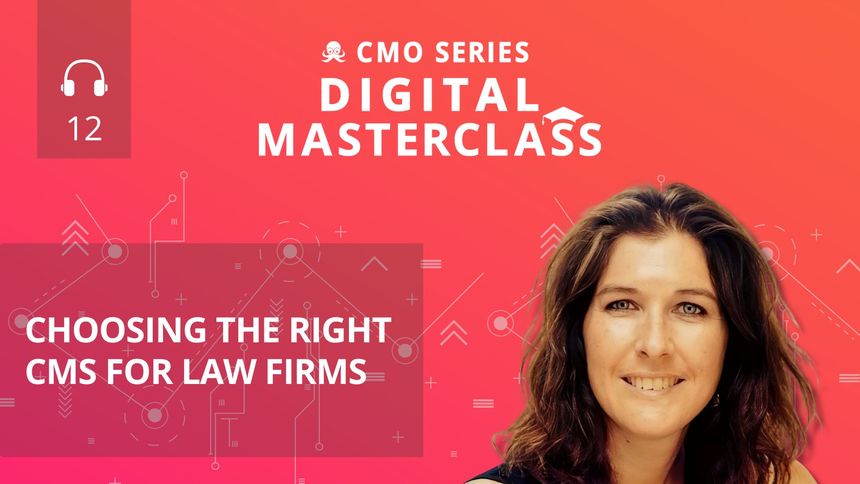
Today on the Passle CMO Series Digital Masterclass Podcast, we’re diving into CMS for the legal sector, a crucial part of a firm’s marketing and business development toolkit. Carrie Dyer, Digital Account Director at Appius, a company with deep experience in the legal market, with clients including Freshfields and Ashurst, joins us to discuss how firms can choose the right CMS.
Carrie shares her insights on:
- Appius’ experience and high reputation within the legal market
- The critical importance of creating an effective CMS
- Various main CMS platforms and their different offerings
- The key factors and processes to consider when selecting a CMS
- Common pitfalls many firms continue to face
- Her expert takeaways for implementing a successful CMS
Transcription
Sam: Welcome to the Passle CMO Series Podcast. Today we're diving into Content Management Systems for the legal sector, a crucial part of your firm's marketing and business development toolkit. We are joined today by Carrie Dyer from Appius, a company with deep experience in the legal market.
Charlie: This episode is brought to you by CrossPitch AI, the new cross-selling tool from Passle. Cross-selling should be the easiest way for law firms to grow, but most firms struggle. Why? Lack of awareness, lack of trust, and frankly, fear of selling. The result? Missed revenue. CrossPitch AI fixes that. It breaks down silos, helps professionals connect, and delivers timely, relevant insights to the right people inside the firm and out. There's no heavy rollouts, just switch it on and try it today. Head to CrossPitch.ai to book your demo and make cross-selling happen. Now, back to the podcast.
Sam: Carrie, welcome to the Passle CMO Series.
Carrie: Hello there Sam, thank you for having me.
Sam: It's lovely to have you on for the first time. I think if we kick off, it might be best if you fill us in a little bit on Appius and on who you are and on those routes that you have in the legal and the professional services sector.
Carrie: Yeah, of course. Thank you. So yeah, Appius is a full service digital agency based in the UK, that means we help arrange organizations with a strong portfolio of professional services, including legal, to do digital. We've got a full team of backend, frontend developers, creatives, user journey designers, digital marketers, as well as an embedded project management team and website infrastructure support services, and all these services essentially enables us to fully wrap around what a particular client would really need. We also have an extremely talented bunch of skilled digital strategists, which I am a member of. I work closely with my clients to ensure that they get the best out of Appius and out of their website investment. So I'm a digital marketer advocate through and through with many years, um, back in the day with SEO and paid activity myself. We've had the privilege of working with a number of legal firms actually, so including Freshfields, Ashurst, Bird & Bird, and Kennedys. We actually delivered the full integration of Passle into the Bird & Bird website, with a best in class use of the product that's really empowering that individual thought leadership on scale for that firm. We are working with others on digital strategy planning, positioning change, and dialing up what digital can offer to law firm businesses, their customers and their employees.
Sam: Wow. So we definitely, we're definitely talking to the right people about, uh, content management systems. Yeah, and I think from Passle’s side, we've worked with you guys on projects and we know that you can deliver the website, but also then the Passle component within it, which is, which is really important for us, um, to know that there's, there's a firm that can put that into the website system. Um, a lot of people carry the website, uh, for a lot of people, the website might be something that exists, you know, just online that they interact with, but at the heart of it is, is the CMS, the Content Management System. Many people will know how important that is but I wanted to just start this podcast off and set the tone a little bit and get your take on why the choice of CMS matters, and why is it something that people should invest the time in to get right?
Carrie: Well, yeah, I mean, CMS isn't just a backend system. It could and, and it really should, drive efficiency, security, flexibility, all the user experience, ambition, and play a real, sort of, direct role in how your firm attracts and serve clients online. Um, obviously we know expectation from everyone is increasing, so getting that CMS right in terms of what a user is expecting to see, can really enable marketing teams to move quickly. Um, and obviously conversely, getting the wrong one can really slow things down, in terms of being able to react to different changes in the market. So yeah, I'll just lean on a little bit of research really from IMG collected from interviewing 250 senior marketeers, they're telling us that 60% of marketeers are actually spend most of their time not doing marketing, in terms of what they're reporting. So, you know, there's a big disparage between being that creative, being that marketeer, doing the stuff that they thought they were gonna do and they left uni and sort of got into the role, versus having to deal with stuff that isn't actually marketing. And a lot of that is around having to work with their technology and troubleshoot technology, and in fact, 71% of those that were questioned or those senior marketeers said that they often lose creative time because they just have to troubleshoot their tech, um, and that includes obviously, CMS issues or not being able to, kind of, get the programs or the campaigns that they want off the ground because the CMS is holding them back. So these are quite important stats that we, you know, we've, we've taken on board and, you know, part of this is kind of getting the message out that there's someone here to help. Um, and the CMS shouldn't be sewing you down in that way and hopefully the right choice is, is part of that. So, yeah, your CMS, it should really allow your team to create and update content, ideally without relying on IT, I'm sure everyone's been in that situation. If it does, uh, if the CMS is clunky, you will see bottlenecks and campaigns will just grind to a halt. It needs to be optimized for SEO and user experience, things like page speed, your metadata management, and obviously mobile responsiveness should just be built in. You need those personalized experience for different audiences, which really is increasingly important for firms wanting to stand out in the competitive legal market from, from the view that that, that we see. A good CMS would integrate seamlessly with analytics and marketing automation tools. So again, helping your teams understand like what's working and what's not in terms of what you're doing with your campaigns and, and taking those campaigns a bit further, and also allowing the automation to work for you. Um, and then finally, as your, sort of, firm grows and launches new services or expands internationally, you want a CMS that can grow with you, um, and support that without, kind of, having to costly re-platform every couple of years. So this choice really matters, um, and you've only got to look at some of the latest Living Group ratings, again, report from earlier of the year, to sort of understand the benefit to investing wisely into digital technology to really transform those challenges into opportunities.
Sam: I really like that idea you've mentioned there, the core idea, although there's many aspects to it, is that the right CMS enables you and allows you to leverage your creativity and, and do more. Maybe the wrong CMS is something that holds you back, and there's a point that you made about, detracts from being able to do the real marketing. Yeah, I really like that. So just coming now to talking about the, the options that are out there, so you're making this choice for a CMS and investing the time to get it right because it's key, at Appius you work across a number of different legal projects, and I know that you've worked with a number of different CMSs. Could we just take a second now to talk about the core options that are available and, and maybe what sets each of them apart or what makes them different to each other in terms of making that choice?
Carrie: Yeah, sure. So Appius are a .Net development house, which means that we choose to develop in code that's part of the Microsoft software development framework and ecosystem. And within this, the CMSs that we build in are Sitecore, Progress Sitefinity, Optimizely, and Umbraco. The Umbraco is the unlicensed open source version that we deliver in. So you may have heard of some of those in, you know, in, in your, uh, in your careers or, or on your path somewhere. The first big differentiator is probably between the open source, so like Umbraco versus a license model. So, an open source CMS doesn't have any licensing costs, it's community driven, and in the case of Umbraco, it's, it is backed by Microsoft, uh, but has lots of contributors from developers worldwide. So a downside is that some of those community packages of code that you get, so the features that you can use, are often built by someone else, they might not have the same SLAs as licensed enterprise tools, so if they break, they break. Some organizational, sort of legal and compliance teams are a bit uncomfortable with that and the open nature of, uh, that code use so in that we would, you know, we would be using code produced by anyone and bringing that into infrastructure, which does have some perceived risk. The licensed.net CMSs all come with their full SLAs to fix bugs, uh, produce updates and apply critical patches. They offer dedicated support often with compliance, well, very often they all have, uh, compliance certifications and their own regular penetration testing, and they're suited to kind of large scale global sites with millions of visitors annually. They also often include caching, content delivery, network integration, and scaling tools out the boss. So that's all kind of the techy stuff, um, in terms of the CMSs that we typically work with and what kind of overarchingly, sort of, differentiates them. The most exciting part of some of those licensed CMSs is the rich feature sets that are available, so such as personalization and marketing automation capabilities, touched on in the earlier questions, some of the advanced workflows within the CMS, which means your editors and content writers can kind of get on with their work at scale, but you as a firm and, and you as a CMO are safe in the knowledge that there's a kind of a tight approval process in there. They will have multi-sites, multi-language capabilities, and pretty much established, kind of built-in analytics and reporting. They offer e-commerce integration and functionality, which is obviously an interesting expansion of legal marketing for things like selling subscription of key content on the website. And all these features can be built in using an open source, so a non-licensed model, um, but very likely they will require plugins which tend to need to be bought, or they would have to have their own custom co-developed to kind of get the same functionality that you're looking for. Um, so that's kind of the overarching kind of view of the CMSs that we work with here at, here at Appius.
Sam: It's, is it fair to say then that there is no one CMS that you should pick? There's no sort of leader that is the one there. It's very much what is gonna be right for your firm? What's gonna be the right fit? Um, and, and what things do you need, what are your requirements and what best fits those?
Carrie: A hundred percent. It's not a case of going, go for this, this is, you know, this is the one that every firm's using, or this is the one that every professional service is using 'cause it, 'cause it does everything. Often that can lead to over engineering, over investment, um, or just something that just doesn't grow enough with your firm because it needs to be matched with, with where you are. But yeah, got a bit more on that later on and I think we're gonna touch on that topic about how, how you would go ahead with making those decisions, there's, there's just so many.
Sam: Yeah, let's do that. So you, you've sent across, we'll put in the, the resources alongside this podcast. Um, you, you've sent across a kind of guide.
Carrie: Yeah, go for it.
Sam: It's a, it's a little diagram that talks about different areas that you need to consider, so we'll put that alongside, but can we just discuss those sort of key factors to consider and think about as a firm and how do they impact what CMS might be the best fit?
Carrie: Yeah, so we've, you know, we've touched on it there. There are in fact hundreds of CMS's on the market, right? So I've talked about four of them, you know, so far. But there's just tons and, and they're growing all the time, so there's a lot to choose from. So it's a really hard decision to make, and if you do approach that decision-making with just kind of looking at that feature comparison alone, then you will struggle. We'd recommend considering the selection in the context of your wider tech stack, so make that included in the decision-making. So do you have plans for integrations i.e with your CRM, or any HR systems or portals or anything like that? So, and, and also, what's the data strategy of your firm? Um, what are you planning around that and, and where can a CMS potentially fix some gaps and help there because there's so much that CMS can do, especially if buying into that enterprise solution. Um, you know, a lot of them have their own, you know, CDP et cetera, that, that you can, that you can lean on for that. So we say it's really important to start with that mindset, that it's not about picking the best CMS as we just spoke about, as there may not be a perfect fit for your ambitions, but there could be one that suits you the best. Um, so you'd want to consider that the best CMS might be the one that you already have, that's always a really good place to start. It could be the, the one you've got hasn't been implemented, um, to fully suit the firm, or like I said, over-engineered and it can be somewhat descoped in the next iteration of it. It could be that you, you know, you're not getting the most out of it and that's what's limiting you, um, or how it's being used potentially as well. So, you know, are you using the right tools in the right way, are they set up and configured in the way that suits you and the way your team need to work? So you may want to consider changing or even gaining a partner to assist with helping you get the best out of what you've already invested in, and I think that's a really first thing to look at is don't necessarily just throw away what you've got because everyone struggles with it. Perhaps get another pair of eyes to just check the configuration, um, or push back on the agency that is helping you at the minute and just say, look, is there another way that we can, we can look at this to make this work better for us? Um, so we see this at Appius, the way we work and what we offer, and then actually that approach can really often lead to kind of great gains and not going down a road of throwing away a lot of investment into a selection process that you've done a few years ago, but actually just changing the build or changing the configuration. So you mentioned, obviously the, the slide that I've sent over, so that really kind of just shows the guys who are watching, what things you might wanna consider. So when it comes to choosing a CMS of your legal firm, remember again, there's no one size fits all, it's kind of like that tailored suit, it really, the right choice does depend on that fit, not the fashion. But, there are kind of four key trade offs, I think we would, we would start with, which is obviously budget, always at the top there. What can you afford to buy and run long term? What is your firm up for essentially. Um, you wanna look at the complexity, so do your editors need ease of use or are they really interested in kind of having that powerful flexibility to be able to do everything the way they want to do it exactly. Um, do you enjoy the, kind of, off-the-shelf solution when it comes to feature sets, so you know, oh that sort of does what we want to do, we will fit into that. Or do you need something that's really bespoke and extendable? Are you taking your brand, your firm, into a space that does things in a slightly different way and, and that's what's driving you as a firm to do. And therefore you need a bit of that ability to, to build things in a bespoke way and extend what the features are doing for you. And then you wanna have a look at that composability, so a lot of the time these CMSs are either that all in one system, in a box, what you get is what you, you know, what you open is what you get, type thing, it's all there in one system. Or you can purchase things in a modular fashion, so you can decide which bits of, uh, the cool functionalities that you want that can be built on and actually what's quite cool about that is that you can potentially build on over time. So you're not ready for that, you know, day one, but you can potentially add on modulars, things like personalization or the marketing automation, could come in day two, et cetera. So those are kind of the four things that I would start off with. There are the non-negotiables, again you should see that on the, on the visual as well. So things like security, scalability, compliance, you know, there's no point talking about sensitive client data because we all know, and obviously meeting all this global, um, and local regulations. You do want to be looking for some support. So like what happens if, if I need someone, whether I have an, you know, an agency or someone in place supporting us or not, um, because that's, you know, that can come and go as well, so where is that support? What is the community like and also what's their vision? Does what they have planned, for things like AI and, and data and how they're handling this, the sort of the global reaction to regulations of, of AI and data, does that excite you and, and does that fit with where your firm's going as well? Um, so yeah, a roadmap that kind of matches your firm's ambitions is, is what you're looking for and I think those are quite key non-negotiables, so I’d kind of almost start there and then go to the four things that I spoke about at the beginning. So you can use those four sliders to kind of really help prioritize what matters most for your firm. And yeah, the right CMS isn't the one with the longest feature list either, it's the one that suits you, your people, your clients, and your growth goals really of the firm.
Sam: Yeah. So just to summarize where, where you're going from there, Carrie, so you're saying-
Carrie: Yeah, sure.
Sam: Take a look at your, take a look at what you have, that's your existing tech stack, that could be the different things that need to connect to the website and HR portal, your CRM, that might be something to do with AI and data as well. Consider your, your current resources, what have you got, whether that be, you know, your current, um, CMS, and what are the current things that are holding it back, or how can we be using it better. Then consider your non-negotiables, go through and look at your security, scalability, support, community, compliance, and vision, and then make some decisions and make some calls about what can we afford as far as budget goes. How complex do we need this to be? What are the key features? How composable, how sensible does this need to be, in terms of developing and, and adding to it in the future?
Carrie: Yeah, absolutely. And like I said, we've worked with lots of customers who can, can easily go through that process, uh, Appius ourselves can assist in that process as well. We do sort of guided consultative services. So we'd start by listening to you and your teams, your marketing teams, the lawyers, the clients, what they really need from their digital experience. We capture functional and technical and compliance requirements that can help shape that selection in the, in the early selection choice. We then have a look at assessing your digital maturity, so digital maturity mapping, uh, sort of program. So are you at the beginning of your digital journey or are you ready to really push the boundaries with personalized multi-channel experiences? And that mapping really helps us balance the ambition that you have with the reality of what we're looking at for you. Um, then you wanna have to scan, scan through the CMS landscape from established enterprise platforms to the agile headless options and identify the technologies that likely fit, fit your needs in there. Um, at that point, again, with Appius sort of assisting in the background or, or with you, we can get a bit of a smaller short list and analyze each platform against your requirements to see where it fits best and where there are gaps. And then set up some tailored demos so you can actually see the systems in action and, and have a variety to, to look through and get the right people in to have a look at those demos as well. And then finally, we'd help guide you through those vendor demos, highlighting strengths, weaknesses, long-term considerations. You know, again, what's happening, you know, year one, but what about year two, year three, year five. So the goal isn't just about picking a CMS, it's choosing a platform that will grow with your firm, which I think I said before.
Sam: That's really good. We, we've discussed there, Carrie, a little bit the things that you want, you need to do to get this right. So how, how to think about this in a way that leads to the best, the best possible option set and then the correct decision. Can we talk just a little bit about, uh, what are the sort of core pitfalls you see people making? What are those, those things that can cause you to stumble along the way? What are the, the core problems or the, the core, um, issues that might cause someone to get this decision wrong?
Carrie: Yeah, that's a great, great question. As an agency, we see it all. So I think the biggest pitfall we see at Appius is a bit of a siloed approach to that choice. So either the CMO is left to just pick one, um, with perhaps, and, you know, I don't mean this unfairly, but perhaps a bit of limited knowledge of what the technology can achieve in a wider context for the business. Um, and a choice that's often left for them to procure from a pretty tight marketing budget. Or, we'd see the CTO or IT team pick one that solely suits their, the infrastructure in the organization, without really involving any of the end users, so content editors and marketers, or even, you know, the actual end user lawyers, et cetera, and clients, about what they want and what they need to achieve. So both those two are extremely shortsighted and I think what we would highly recommend, and I'm talking to a bunch of CMOs here, do whatever you can to pull in a wider senior team from tech, IT, your CTO, to collectively look at the business goals and needs when you are choosing your next CMS. It does make a difference if you're all on the same page. So find that advocate, find that technical person who can help, who can help you make decisions, but also has a decision making input in the business as well. Um, and again, I like to think that Appius is a consultant of services we have in the form of a marketing, MarTech consultancy package can be a bit of a catalyst for that. So we help to get that group-think dynamic together. So it's just about bringing business teams together in a shared vision of where the marketing technology is going, so that you're not missing out on opportunities. Things are moving so quickly across digital, across technology, um, and often both sides miss out on what the opportunities can be if you just sort of come together in the same room and start talking to one another and, and thinking together and making those decisions that's right for every type of audience and every consideration of the business.
Sam: I'm sure that that will be a familiar story to, to all, um, big marketing decisions that people make that get the right people in the room and then go through the process of what do we actually need? What are gonna be the, the things that cause this to be an effective or, or, or incorrect decision. Um, Carrie, it's been brilliant discussing this with you, and I'm sure that people who still have further questions, can, can reach out. And I think we've sort of scratched the surface of this, it would've been lovely to have, you know, an infinite time and go into individual details of, of exactly, exactly all the different CMSs and exactly all the different considerations that people need. Um, if we are closing out though with, with a kind of final question, uh, from this overview. If you are giving a piece of advice to those, thinking about a switch to a new CMS or, or thinking about their options, what would that one piece of advice be? What would be a takeaway that people can, uh, go back to their desk with from this podcast?
Carrie: Yeah, I think it goes back to the earlier point. So, you know, that biggest mistake we see in CMS selection happens when a firm tends to chase features or follow trends without really asking, you know, what do our teams' need to deliver today? And like, what are we trying to give our clients and what are our clients expecting tomorrow? So that covers all the things we've spoken about, making sure that your CMS selection choices is fit for you right now, but will grow with where you need to be. Your firm will have a long-term view of, of the strategy of where you're trying to get to, and your CMS really should and could, the good ones out there will grow with you and allow you to start smaller and then package on as you, as you go along. And that, that's a sign of a good, sort of, CMS and CMS partner for you to work with. So start with those people, start with the goals and start with making sure you're, you're buying and changing for today, but also for tomorrow as well.
Sam: Okay. So now we've come to kind of, uh, before we, just before we wrap up, we always like to do some quick fire questions to get to know people a little bit more on the CMO series podcast. So Carrie here are yours. What are you reading or listening to at the moment?
Carrie: I am listening because who isn't listening to audio books and podcasts. I've actually started the Bernard Cornwell Sharpe series, which sounds a bit random, and I feel about 30 years too late. Um, my 19-year-old son has just become a rifleman in the British Army and, uh, I thought I'd do him proud and understand the history about, uh, about that particular part of the, the British Services.
Sam: Oh, classic. Yeah. Yeah. Brilliant. Old, old Sharpe. Um, what's one thing you couldn't live without in your working life?
Carrie: It's gonna be coffee, which I'm sure everyone says. I'm literally on one now. Yes, it's gotta be the coffee. Um, and I think just surrounding yourselves with, with the right people, um, and, and the right team that, that can help you get the best out of everything.
Sam: I'm sure that the coffee helps you get the best out of the team, best out of the team as well with the coffee. Um, are there any habits you think have been really helpful in your career?
Carrie: Yeah, I think for me, um, working in client services, working with organizations, it is about people and it's about empathy and understanding what a CMO, what a CTO, what a CMS editor, what a CIO needs. Not all C-Suite obviously, and, and in fact it shouldn't all be C-Suite, it should be across the breadth of the organization. So, really the habit is just trying to remain empathetic and understanding, you know, what is it that each of those people need from me, from our services and, you know, what's important to them. And just, just put myself in your shoes really, uh, of what it's like to make all these decisions, um, what can seem quite lonely. So yeah, just kind of like be empathetic, be understanding of, you know, how every business needs to have a bit of support in, in that way. So, for me in my career, that's, that's what I tend to do.
Sam: Fantastic advice for anyone I’m very sure. Um, and our final quick fire here, what's your favorite way to unwind Carrie?
Carrie: I enjoy my walking, so yeah, very lucky to live down here. Uh, like I said, Appius is based in Bournemouth. I live just outside the New Forest, so, uh, in a nice space and uh, yeah, if it's been a long day and the coffee hasn't worked, I go and walk it off.
Sam: Carrie, that's wonderful. It's been so lovely having you on, we really appreciate it. Thanks for coming on the CMO Series, we hope to talk to you soon.
Carrie: That's brilliant.
Charlie: You can follow the Passle CMO Series Podcast on your preferred podcast platform. Thanks for listening, and we'll see you next time.
/Passle/53d0c8edb00e7e0540c9b34b/MediaLibrary/Images/2026-10-14-09-22-13-024-6acf49c5944aac193a981bb9.jpg)
/Passle/53d0c8edb00e7e0540c9b34b/MediaLibrary/Images/2026-10-13-16-00-13-704-6ace558d477453bcaa2eba35.jpg)
/Passle/53d0c8edb00e7e0540c9b34b/MediaLibrary/Images/2026-09-28-10-59-02-989-6aba4876c6484376446500cc.png)
/Passle/53d0c8edb00e7e0540c9b34b/MediaLibrary/Images/2026-10-08-10-14-29-755-6ac76d050b30ba925ae8bc36.jpeg)
/Passle/53d0c8edb00e7e0540c9b34b/MediaLibrary/Images/2026-10-08-07-04-41-374-6ac740898f60cb75fde15df0.jpg)