

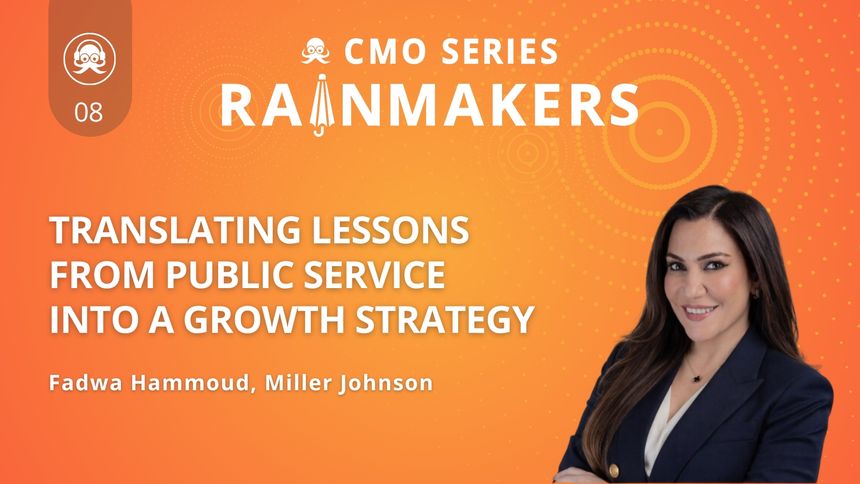



A good rainmaker does not just provide contacts for a firm; they connect them.
On today’s episode of the CMO Series Rainmakers podcast, Alex Haidar sits down with Fadwa Hammoud, Managing Member of Miller Johnson’s Detroit office, for a conversation on how her distinguished career in public service has influenced her approach to business development, collaboration, and rainmaking in the private sector.
Prior to joining the firm, Fadwa led a trailblazing career as both the youngest and first Arab-American and Muslim woman to serve as Michigan’s Solicitor General and to argue before the U.S. Supreme Court, following which, she served as Chief Deputy Attorney General in Michigan.
Fadwa is a modern rainmaker who drives growth with intention by deepening existing client relationships, building trust, and opening doors to opportunities across the business.
Alex and Fadwa dive into:
- Fadwa’s public service experience, and how it has impacted her private-sector career.
- How she channels past relationships, reputation, and interpersonal skills into her work.
- Improved methods of communication and collaboration between partners.
- The crucial link between a client's success and the firm’s success.
- Being a selfless leader and its impact on the team as a whole.
Transcript of the episode
Alex: Most law firms talk about collaboration. Far fewer build it into how work is actually won and grown. My name is Alexander Haidar, and on this episode of CMO Series Rainmakers, I'm delighted to be joined by Fadwa Hammoud, managing member of Miller Johnson's Detroit office, to unpack what collaboration really looks like when it is led from the top.
Fadwa's path to firm leadership was forged in public service, where credibility, accountability, and trust were not optional. Those experiences now shape how she approaches rainmaking in private practice, with a strong focus on cross-selling, community, and growing with intention. In this conversation, we'll discuss what firms can get wrong about collaboration, how Miller Johnson is embedding it into culture and client relationships, and how lawyers can use it to both drive individual success and firm-wide growth.
Charlie: This episode is brought to you by CrossPitch AI, the new cross-selling tool from Passle. Cross-selling should be the easiest way for law firms to grow, but most firms struggle. Why? Lack of awareness, lack of trust, and frankly, fear of selling. The result? Missed revenue. CrossPitch AI fixes that. It breaks down silos, helps professionals connect, and delivers timely, relevant insights to the right people inside the firm and out.There's no heavy roll-outs. Just switch it on and try it today. Head to crosspitch.ai to book your demo and make cross-selling happen. Now, back to the podcast.
Alex: Fadwa, welcome to the Rainmakers podcast.
Fadwa: All right. Well, it's so great to be here with you, Alex. I'm really excited. Thank you for the kind introduction.
Alex: Just to get started, I wanted to give maybe a little context to our listeners who maybe don't know you. So before joining Miller Johnson, you were the Chief Deputy Attorney General in Michigan, and prior to that, you were the youngest and first Arab American and Muslim person to serve as Michigan's Solicitor General.
And in that role, you were also the first Arab American Muslim woman to argue before the United States Supreme Court. Not only is this an inspiring story, but really a unique path to becoming a managing member. So I'd love to get started by asking: How did those experiences shape the way you think about business development and rainmaking today?
Fadwa: I think that just based on what you, shared right now, it's obvious that my path to rainmaking or business development has been completely unorthodox, right? I've never practiced in the private sector until a little over two years ago. I didn't come into my role here at Miller Johnson with a traditional book of business.
You know, I came in with credibility and, you know, I hope, a reputation that I had built over years in public service, whether it was, you know, at the attorney general's office, different boards that I've served on, my time at the Wayne County Prosecutor's Office, and just involvement in the community as a whole.
The challenge was, you know, how do I translate that into a sustainable practice? And I did. I've exceeded the financial goals that were set for me by the firm. You know, I jumped in as managing member for our Detroit office, and what I can tell you is that many of the relationships that I built across the table in, in government Became some of my first private sector clients, and ultimately some of them the firm's significant clients, right?
I think I realized very quickly that, when I entered the private sector, the same principles drive business development. It really is those relationships that you build across the years. I didn't suddenly become a salesperson. I didn't suddenly become a person who's looking for business.
I just became more intentional, I would say-
Alex: Mm-hmm ...
Fadwa: about relationships that I had spent years building. So I started asking, you know, "How can I continue being useful to these people?" I would deal with a lot of these businesses on the compliance end when I was in government. You know, what problems are they facing?
How can I connect them with the resources that can help them by utilizing the firm? And now I'm growing the Detroit office here. I'd say I've taken that one step further. It's not just like, how can I grow my practice? I'm asking, how do I turn the relationships that I have in this market into lasting relationships with the firm?
Goes back to what I said earlier, and what we've discussed is it comes back to being very intentional about the value you bring to the relationships you already have.
Alex: I love how you tied that really together really nicely about relationships being those same principles, whether you're, you know, going from public sector work to, you know, trying to help people with complex problems.
And I just wanna dive maybe a little bit deeper into, you know, you talked about how you weren't automatically transitioned into a salesperson. But when we spoke previously, you described yourself as being, you know, very aggressive about business development, but again, not in a transactional way.
Fadwa: Yeah.
Alex: So I'd love to ask, you know, how would you define rainmaking? And what does it actually look like when you are with a client?
Fadwa: Sure. I would, and I think you're exactly right. I'm aggressive about business development, probably even more aggressive about client retention. And I'll connect those in a second.
I think that getting a client once is not success, but becoming their trusted advisor over time is. My approach is not just being aggressive about business development, my approach is always relationship first and not pitch first, if that makes sense. I don't believe rainmaking is, as I know that this is what the podcast is called, yeah, I don't believe rainmaking is about constantly chasing the next client, right?
Like, how many clients can I bring in? And on top of being, you know, relationships first and investing in those relationships, there's tremendous growth sitting inside the relationships we already have. Like, when somebody becomes my client, I want to understand their entire business, not just the matter that they hired me to handle, for example.
You know, I want to know what they're worried about, where they're growing, where they're vulnerable, and who else at Miller Johnson could make their business stronger. That, to me, is the aggressive nature of really caring about the client as a whole.
Alex: You mentioned, to each their own, you know, some people might define rainmaking, you know, in their own way.
But to you, you know, it's not just about how many clients you can bring in and churn through, but really building a deep relationship with those clients and really, like, cross-selling across the entire firm and all, you know, being, becoming their trusted advisor. And that's kind of where I, I'd love to hear maybe a little bit more about the cross-selling culture at Miller Johnson.
You know, practically speaking, how does that actually show up in a client conversation or when you're meeting with a client, and how do you lead that shift in a profession where client ownership is, typically deeply ingrained?
Fadwa: Yeah, and I really love this question, Alex, and the importance of it, to the growth of the business as well, right?
And, I don't just think of it as cross-selling. Like, yes, we say cross-selling, but, but I also think more of it as surrounding the client with talent, is how I like to think of it. If I'm the only Miller Johnson lawyer my client knows, I haven't done my job. My responsibility is not to personally solve every problem.
God knows I can't do that. It's really to understand the client well enough, recognize what their problem is, and be able to identify which attorney at Miller Johnson should also be sitting at that table. I listen first and map out the client's needs, then I build a team around those needs, and I think that that's very important.
That's maybe the first client meeting or the second or the third. I have client meetings where, you know, that may include five different attorneys from the firm that I've identified are areas where the firm can add value to that client. And oftentimes, I do those with my client at least twice a year at no charge to them, but really an opportunity for us to add value to them and for them to meet the different attorneys that could add value to their business.
You know, I may bring in an employment lawyer or a transactional lawyer, a real estate lawyer, a litigator, an IP lawyer, and God knows, like, you don't want me touching IP stuff. But depending on what the client's business is, you know, I don't simply make an introduction and disappear, right? Like, you build that trust.
You care about the client, their business, and I really transfer that trust. You know, I tell the client, "Yeah, I know this attorney. I trust this person. This is how I think they could help you." I think it's important as we grow the business, when we think about growth and cross-selling, that the client knows the client's relationship with Miller Johnson is bigger than just their relationship with me, if that makes sense.
You know a client who just knows me has a lawyer, they have an attorney. But a client that now trusts five of my colleagues has a law firm. That's the ultimate goal.
Alex: Yeah. And it's, you know, really demonstrating to them that, you know, you are truly a full service firm. That maybe is just helping on one matter, but can help you with everything else that you need to do.
I guess kind of on the flip side, now I know you're fairly new to private practice, but what do you see maybe in the market as what law firms are not really hitting the mark on when it comes to collaboration and cross-selling, and why does it so often fail to translate into real growth?
Fadwa: I think I can highlight things we can do better, right?
A couple things I would say come to mind. I think that oftentimes we start with the wrong question. You know, what else can we sell this client? As opposed to going back to the previous question, what else does this client need? And I think that that distinction changes everything.
One is about us, the other one is about the client. Even cross-selling and collaboration, the cross-selling fails, I think, when it feels like you're selling rather than service. So this concept of, my client, people become so very protective over those relationships. Of course, relationships matter.
and lawyers work incredibly hard to build them. But if I am so protective over a relationship, which we see across the firms, then I'm not exposing that client to the rest of the firm's talent. You know, I'm protecting my piece of the pie instead of growing the pie, which really is a missed opportunity.
You know, I really think that bringing others into a relationship doesn't necessarily diminish one's value. It really demonstrates my value of what I can bring to that client. And I think the second point here is that we're seeing a lot of firms that get growth wrong when they grow for the sake of growing, and I always have to be so cognizant of that.
Entering into a new market because competitors are there rather than because the client needs them there. You know, I'm, I'm, I'm a big believer in strategic planning, right? I think that growth without a business development plan, to just pop in different spaces, opening up offices without a business development plan or a client-driven reason can really dilute the culture instead of strengthening the firm.
We can add revenue and headcount and still lose something that's very important if people also stop knowing one another, trusting one another, and sharing opportunities. So, you know, I think that that's, also the other thing I wanted to add is, really that growing with purpose and not just for the sake of growing.
Alex: I love that. And I mean, that kind of ties into, you know, Miller Johnson as a firm, right? And, you know, that's where I kind of want to come onto next is, you know, Miller Johnson's culture. I believe I'm right in saying Miller Johnson is the fastest growing law firm in Michigan.
Fadwa: And very proud of it.
Yeah, we are growing and, I'll tell you just in the Detroit office now, and I'll focus on the Detroit office. When I first joined, I would say we had about between 10 and 15, and as of today, we're at 68. It's been awesome. But again, it's growing with intention, and like what does that mean? We're not just interested in being bigger simply for the sake of growing or being bigger.
Yeah. We want to be more relevant. We want to be more capable. I want to make sure that we're more valuable in the markets that we serve, and I think that Detroit has been a perfect example of that. You know, we didn't just enter this market by putting our name on a building, but we also entered it by becoming a part of the community.
You know, I mean, I think that for me this was very personal, especially with my relationships in Southeast Michigan, my care for the diverse communities here in Southeast Michigan. I've said this earlier on in the podcast, I'm very intentional about building relationships, especially in Southeast Michigan here.
You know, being present, bringing people together, understanding the business community that's here, identifying unmet needs, especially to communities, and we have lots of diverse communities. Some on the verge of first generational wealth that don't know the importance of a full service firm.
I love being able to grow with our clients, and then also hiring strategically. And, but also, you know, not becoming an island within Miller Johnson, like having the Detroit office become an island, right? Like the real power the Detroit office has, has really been the entire firm behind it, whether it's in Grand Rapids or Kalamazoo or Chicago.
And every relationship we develop in Detroit can connect capabilities across the firm, right? Across Miller Johnson. We're not just intentional about growth within, but also we're intentional about identifying capability gaps rather than simply adding lawyers. Like, that's part of the strategic planning I was talking about.
I think that Irwin IP is a great example of that. So Miller Johnson recently joined with an IP firm, a very reputable IP firm in Chicago, and this wasn't saying, "Okay, let me just add some more IP attorneys." You know, we identified a gap and helped complete that full service offering, by adding IP litigation capabilities alongside the work that we already do, Alex, which is prosecution, you know, and trademark work.
And kind of bringing the full IP service now to the client. And also, you know, our clients are growing and, and when your clients grow, you grow with them. Their businesses become more sophisticated. You know, then we become more sophisticated. Our capabilities and our relationships grow with them as well.
So it also means, and I think that this is important too when it comes to business development, is being very intentional about hiring from different communities. And what I mean by that is, you know, people bring their relationships with them. They bring their credibility. They bring their communities with them, communities that you and I may never have access to.
And I think that that's so important. You know, this matters when you're trying to serve markets and communities that historically may not have had a deep relationship with larger firms. And I think that that's how you scale an office really without losing the relationship-driven approach that got you here.
So to wrap it all up, you know, about Detroit, like, we're not trying to simply build a bigger Detroit office. We're really trying to build deeper roots in this area, you know, in Southeast Michigan as a whole, and then connecting those relationships to eventually strengthen the entire firm, right? And not just Miller Johnson's Detroit office.
Alex: I love how that you basically brought it full circle kind of starting with communities, you know, Miller Johnson being a really, you know, regional firm, focused firm. But, you know, with a full service capability, and then really deciding to, like you said, grow with intention around your clients. Around the clients' needs so that they grow with them.
And again, you know, focusing on how you can grow this one office within the firm based on those, again, back to the community, you know, everyone's individual relationships. And, you know just a funny point, I think you had mentioned that, you know, sometimes you could meet clients at, you know, places that you would never expect, somewhere like a wedding.
Exactly Now I kinda wanna go on, a little bit different part where I essentially wanna ask, since you've been part of the firm, what have you found that actually improves collaboration? You know, is it structure or is it incentives? You know, how does that play through your leadership?
Fadwa: Yeah, no, I mean, listen, I think structure matters, right? I think that incentives matter.
But people ultimately take their cues from leadership, right? Like, I don't think that culture is what leaders say about collaboration, to your question. I think it's like, it's what people watch their leaders do, and I think that that's so important.
Alex: Leading by example.
Fadwa: Absolutely. And, I think it ties into another question that you asked earlier, too, kind of about cross-selling and collaboration.
Like, if leaders hoard their relationship, talk about a culture of everybody else hoarding their relationships.
Alex: Yeah.
Fadwa: But if leaders share opportunities, if they make introductions, if they give credit, if they celebrate people's wins and are there for their losses, right? That behavior, I think, becomes contagious.
I really do. You know, and I feel like I have to model what I'm asking other people to do. My role is to bring in work for the firm's most competent people, which I think I work with extraordinary people to execute, and not to hoard it. And I think that culture is important. Your colleagues feel valued when you're bringing them into your client relationships, when you're giving them opportunities, when you're making these introductions and not feeling threatened when somebody develops their own relationships with the client.
Like, that really should be the goal, and that's a cultural value, I think, that's very, very, very important for collaboration. If we want... You know, I mentioned earlier that for clients, I like to have, you know, some meetings a couple times a year with our clients so we can see what their needs are and see how we can grow their business and ours, right, by introducing them to other attorneys.
And if we want, like, our partners to invest in those meetings, you know, for client strategy sessions, then also leadership has to treat that non-billable business development time as valuable as well, and not as time that somehow matters less because it wasn't billed. You know? And I think that's what I mean by creating a culture that kind of values connections.
I think that collaboration also requires generosity. You know, sometimes you give somebody else the introduction, they get the work, they get the spotlight. And that's a win if, if your mentality is to grow the firm and the business, right? 'Cause I truly believe collaboration is if the firm wins, I win.
And I think that the strongest rainmakers aren't gatekeepers. I go back to that word I just used, that they're connectors.
Alex: And again, you tied that together really nicely with that earlier question about, you know, how you can incentivize those partners to, you know, spend time doing that relationship building, you know, the meetings with the clients to really stay ahead of their needs, and ultimately, the idea is that that will pay off more than just, you know, hoarding that one relationship with a client.
You know, it comes through generosity, it comes through, you know, celebrating people's, everyone's wins, and realizing that if the firm wins, I'm winning. And I just wanted to close by reflecting on all that we spoke about on your experience. For any lawyers listening who want to build, you know, their personal leverage and firm-wide impact, what is one thing you think that they should start doing differently when it comes to collaboration and cross-selling, or maybe what is your one main overall piece of advice?
Fadwa: Think like an owner. I say that to our attorneys here all the time. Think like an owner of the firm, not simply of an employee of the firm. I think that that changes how you see every relationship, how you see every opportunity and, and colleague, and how others look at you. You know, when you think like an owner, you stop worrying about or thinking, "What's my matter?
What's, what's my client?" You know? Start asking like what's, what's good for the client, because trust me, that's what's best for the firm, and people will start to see that. Stop, waiting as we think about growing in business development, stop waiting for the client to need you again. Build the relationship when they don't need you.
You know? Schedule a meeting when there isn't a crisis. Don't bill for that conversation. Sit down with them when there isn't an active matter. That trust is your business. That reputation that you're building, those relationships, is your business. You know? Ask them what's happening in their business, what they're worried about, where they're headed.
That really is something we often miss. We get so busy and, you know, if there's not a certain matter that we're working on, we put that to the side. It's worth the investment. And then, you know, look around your own firm. Who has a relationship? Who has a skill set or experience that could bring value to your client?
And, and don't be scared to, you know, make that introduction. Play the long game. You never know when the right opportunity is going to show up. So again, I say this to our attorneys all the time, too. Treat relationships as relationships, not as immediate transactions, you know? And I think, you know, being genuinely proud of the work that you're doing, being genuinely proud of your firm matters.
I believe in the work our Miller Johnson attorneys do. I do, and I'm so proud to introduce them to others and brag about them, right? And I think that-
Alex: Mm-hmm ...
Fadwa: And I'm proud of the culture we're building. I always say this to our attorneys, and they remind me of it, and we live by it. Like, we don't take ourselves seriously here, but we take our work very seriously.
And I think that how you feel about the place that you work at, clients start to see that, too, and that energy reflects off of them. And it makes it so much easier to bring in clients and recruit talent because I'm recommending people I believe in. And invest in the relationships from within the own firm.
I, you know, with your colleagues. You know, we spend an enormous amount of time trying to expand our own networks, too. Sometimes the greatest business opportunity is sitting across the table from you or in the office next door to you. I think many attorneys miss out on that because they're, they're not building those relationships.
The goal isn't simply to, you know, win a client when I really wanna grow in my firm. You know, it's to keep a client, grow with the client. And then when you do, and you offer them all these resources, you really become indispensable to that client, but you have to invest in those relationships with the client and with your colleagues.
And, and you do that by thinking like an owner, whether you're a partner or an associate, an equity member or not. Tell all of our associates, even tell our summer clerks, "Think like owners, not simply as employees of the firm."
Alex: What an amazing way to end. You know, thinking like an owner and believing in what you do.
It's a really great message. Now, Fadwa, it's been amazing talking to you about all of this.
Fadwa: So great talking to you and the work that you are doing and the information that you're putting out, and I just think it's great for the legal community. I'm happy you invited me.
Alex: Thank you.
I thought maybe if you have a few extra minutes, we'd ask you a quick-fire round, just to get to know you a little bit more. Yeah. If you're up for that?
Fadwa: All right,
Alex: Let's do it All right, now these are fun questions. A little bit more fun. So starting off, what are you currently listening to? It could be music, podcasts, an audiobook.
Fadwa: Oh my God. So I am obsessed with Arabic music. So I currently listen to new songs in Arabic.
Alex: But any favorite artist in particular?
Fadwa: My favorite Arabic artist will always be Najwa Karam. Look her up. She is awesome.
Alex: Yes. I am very familiar. Oh, now what is the best piece of advice you've ever received?
Fadwa: I've received lots of great pieces of advice, but one I try to continue to remind myself of is that I have this mentor of mine that I asked one time, and I have to share this story 'cause it really left an impact on me. And she was just like, You know, she was an awesome woman.
She was doing all of these things and, you know, had kids and was amazing at her job. And, I looked at her and I said, "How do you balance it all?" And she just laughed at me and she said, you know, "Fadwa, there's no such thing as balancing. We're constantly juggling." Yeah. But then you learn that there are some balls that you can drop and they'll bounce right back up, and there are some that are made of glass.
And you have to realize that as you're juggling all of these different things, that you are a glass ball, and you can't keep putting yourself together every time you drop that ball down. You know, oftentimes we forget about ourselves in the process when we're trying to do all of the things. I'm juggling all of these things and, and oftentimes, you know, it's just one easy ball to drop.
And I think once you take care of yourself, when you're healthy, when you are happy, that is contagious. So take care of yourself because if you're trusted, if you're not trusted to do that, then you can't take care of others. And she gave me that advice, and I hold it. Now, I don't always follow it, I have to be honest.
But I always try to remind myself of it.
Alex: Well, I definitely learned something new, so thank you for sharing. Now, what is a book or resource that you'd recommend to someone in your field?
Fadwa: A book or a resource? I mean, this is so funny, but get a copy of the Constitution and go through it.
Yeah. Our democracy is so important now more than ever, and this is when I believe that book matters now more than ever. Yeah so in my field, I think that there is no more important book than the Constitution of the United States, as cheesy as that is, and I will always give that answer. For general book advice, a book that I am reading that I love and I've read so many times that I encourage everybody to read is called The Prophet by a Lebanese author named Kahlil Gibran, and it's in English.
Alex: Mm-hmm.
Fadwa: It is amazing. It gives awesome world advice. I've seen it. And if you haven't read it yet, you have to read it.
Alex: It's number one. It's definitely been- Okay, good. Yeah, it's one of my favorites. What is your favorite way to unwind after a busy day?
Fadwa: I have two awesome kids, and they are so busy, and I definitely don't unwind when, you know, they, like, I wish I could, give you, like, an awesome answer, like drink my coffee next to a pool or go on a run or a jog or- I don't have time for that right now.
Alex: Mm-hmm.
Fadwa: I have a job that demands so much of me, and I have, you know, an awesome husband and two awesome children and parents and, you know, family members that I absolutely love and adore. But at the end of each night, I love sitting down with my family and just talking about our day and listening to my kids telling me all about their friends' dramas and school things that are happening, and not talking about work whatsoever.
But I would definitely say, you know, I value family so much, and, you know, we often become so consumed in our jobs that I look forward to those conversations and I prioritize them, and they're definitely my therapy throughout the week.
Alex: Very important glass ball.
Fadwa: Yes, absolutely. Um- I love that.
Alex: Very- And lastly-
Fadwa: One that you can't drop.
Alex: Exactly. And lastly, where is your favorite place to visit and why?
Fadwa: My favorite place to visit is, no question, Lebanon. And not just because I was born there and, you know, spent much of my childhood there, and it holds people that I love there so very much. And I find, you know, I'm a true believer that you find different homes in people, not in places.
And, uh, I have my grandmother who helped raise me there, and, and she's from South Lebanon, and she's still there. And she is my favorite place, as, as, as cheesy as that may sound. But I love to visit there. I love the smell of everything; reminds me of my childhood, you know, and, and, and the years where there weren't necessarily too many things to worry about.
So I love to visit places that have people in them that I consider home. And even if she weren't there, if you have a chance, or if any of your listeners have a chance to visit there, the situation's been a bit unstable there, but it is one of the most beautiful places where you can go swimming and hiking and snowboarding probably all in the same day.
Alex: There is no place like home, and, you know, family, like you said, there's nothing more important than family.
Fadwa: Yeah.
Alex: That is a lovely, lovely note to end on. And but again, I wanted to thank you so much for taking the time to join me on the podcast. It's been an absolute pleasure speaking with you today.
Fadwa: It's a pleasure speaking with you, and I look forward to you coming and visiting me in person at Miller Johnson.
Alex: Me too.
Charlie: You can follow The Passle CMO Series podcast on your preferred podcast platform. Thanks for listening, and we'll see you next time.