

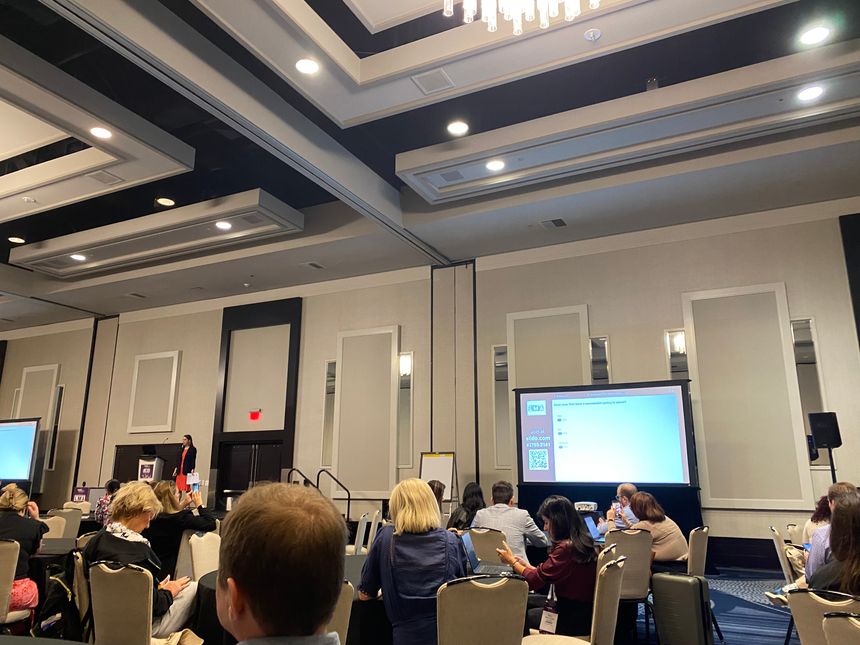


In her breakout session at LMA 2026, “Succession Planning with Purpose: Driving Growth and Protecting Relationships”, Jillian Kanter McKenna, Director of Marketing, Business Development & Client Services at Verrill, gave us an insight into what marketers need to know about preparing for the next generation of lawyers.
Planning for the next generation of a law firm can be a very delicate and emotional process; attorneys who have built their identity around their work will naturally find it difficult to part ways with their professional lives. Combined with lack of leadership urgency and no one formally assigned to drive it, firms can easily find themselves in succession conversations after it is too late. Improperly managed loss of legacy fee-earners and the institutional knowledge that comes with them can sink a firm.
When Jillian polled the room at the start of her session, 55% of attendees said their firm has no succession plan in place, whereas 23% responded ‘unsure.'
That is a lot of firms flying without a parachute, and a lot of client relationships more exposed than leadership probably realizes.
Why this is urgent right now
As the baby boomer generation nears retirement age, being proactive is essential to ensure smooth relationship transitions and a consistent client experience.
As of writing in April 2026, the youngest of the baby boomers are 62. Lawyers over 65 years old make up 13.1% of the profession and lawyers 55-64 years old make up another 17.9%.
While these numbers may not seem like a lot in isolation, in many firms, a large share of top-client revenue flows through billing attorneys who have been practicing for 30+ years.
Why marketing and BD are uniquely positioned to assist
Marketing and BD professionals sit at the intersection of client knowledge, attorney relationships, and firm strategy in a way no other department does. Business professionals in law firms can identify which clients are relationship-dependent, where there are practice gaps, and how to best integrate incoming laterals. Framing these conversations in terms of client service and growth, rather than compensation, career, or equity, will make transitioning attorneys far more likely to trust and open up with you.
Jillian introduced a practical framework which she used to guide her through 40 one-on-one meetings with attorneys at her firm: The SCALE framework
- SIZE up the risk: Pull the data. Years of experience, revenue trends, timekeeper percentages by client etc. Look at what percentage of total firm revenue is tied to at-risk billing attorneys. That number, when presented in actual dollars, tends to get leadership's attention quickly.
- CACULATE and ALIGN: Build client profiles. For each attorney, map their top clients against timekeeper percentages for the current and prior year. Who is doing the work? Who has the relationship? The data often tells a different story than the attorney's perception.
- LAUNCH the transition: "Launch, not lead" since marketing cannot run the transition, the attorney has to; business leaders can give it structure, momentum, and the data to guide it.
- EXPAND the relationship: Use the intelligence gathered to reintroduce lost service lines, identify cross-selling opportunities, and build what Jillian called "laddered" relationships: connections at multiple levels between the client organization and the firm, so that when senior leaders retire on either side, the relationship holds.
What the one-on-one conversations actually look like
- Bring a printed client profile: timekeeper percentages pulled for current year and prior year, so you can have a grounded, data-informed conversation about who's actually in the relationship.
- Start general, then introduce the data: read the room. Some attorneys are ready to dig in while others need time.
- Frame it as a firm-wide initiative: not a conversation about their retirement, but about client service and growth across the firm. This reduces defensiveness significantly.
- Ask about the history: senior attorneys love talking about how a client came in, who referred it, what the relationship has been. That history is exactly the institutional knowledge you need to protect.
- Document everything: and revisit it. Successors change. Timelines shift. What did not seem relevant in the first meeting might become the key insight six months later.
Jillian also advised that this should not be a one-time conversation. End every meeting by asking when feels right to check in again. Even when an attorney does not give you a retirement timeline, their answer about follow-up cadence tells you something.
When an attorney pushes back on early outreach
One of the best Q&A moments: what do you do when an attorney is five years out and gets defensive, "I'm still growing my practice, I'm not done"?
"You want to position it as: ‘you are a top attorney at this firm, you have great client relationships, and we really want to learn more about them.’ You just want to gain more insight into top clients to make sure we're supporting them."
Framing in terms of making sure the firm is doing right by their best clients instead of the attorney winding down, reduces friction and benefits people who will carry those relationships forward.
The case study reality check
The fictional firm Jillian walked through had a basic succession policy but no real teeth, with a large concentration of top-100 client revenue tied to a minority of attorneys with 30+ years of experience. The risk she flagged was not just losing those clients directly but the cascading effect that when big clients leave because their primary relationship retired, mid-sized clients start to reconsider. Meanwhile, the talent watching from inside the firm starts making their own decisions about the firm's future. Succession risk compounds.
Succession planning has a reputation as a leadership problem, an HR problem, a partner compensation problem. What this session made clear is that it is actually a BD opportunity. The firms that get ahead of this will not do it through policy alone but because someone in BD took the time to build the relationships, map the risks, and help a senior attorney leave a lasting legacy.
/Passle/53d0c8edb00e7e0540c9b34b/MediaLibrary/Images/2026-01-12-10-16-56-904-6964ca18ab784af100f11853.jpg)
/Passle/53d0c8edb00e7e0540c9b34b/MediaLibrary/Images/2026-10-08-10-14-29-755-6ac76d050b30ba925ae8bc36.jpeg)
/Passle/53d0c8edb00e7e0540c9b34b/MediaLibrary/Images/2026-10-08-07-04-41-374-6ac740898f60cb75fde15df0.jpg)
/Passle/53d0c8edb00e7e0540c9b34b/MediaLibrary/Images/2026-10-08-07-04-41-241-6ac74089ce624e48d6cc6df6.jpg)
/Passle/53d0c8edb00e7e0540c9b34b/MediaLibrary/Images/2026-10-08-07-04-41-183-6ac74089d24614eebffa86bf.jpg)